

2026-08-16 · 22 min read · Raw Drafts / China / App Ecosystems / Systems Design / Digital Infrastructure
China Has Apps for Things We Still Call Society
A field atlas of the Chinese software operating families, workers, merchants, markets, mobility, desire, and the state, and what changes when an app becomes an institution.
I started with a simple question: what are some big apps in China that I might not have heard of?
The first answers were too easy. WeChat, Alipay, Taobao, Douyin, Meituan, Xiaohongshu. Even the supposedly deeper layer was still made of products that could be explained through familiar Western categories: Chinese YouTube, Chinese LinkedIn, Chinese Yelp, Chinese Spotify.
That way of looking at China is useful for about five minutes. Then it becomes a trap.
It assumes that every digital product must be a local version of something we already understand. It treats the Chinese internet as a parallel app store where the logos and regulations are different but the categories stay the same. The more I kept digging, the less that description worked.
The stranger apps were not simply different media platforms. They dispatched furniture installers, coordinated battery swaps for delivery riders, moved agricultural harvests, trained civil servants, introduced strangers through human matchmakers, authenticated antiques, supervised children, filed taxes, handled traffic violations, and connected a birth certificate to the rest of the state.
China has apps for things we still call society.
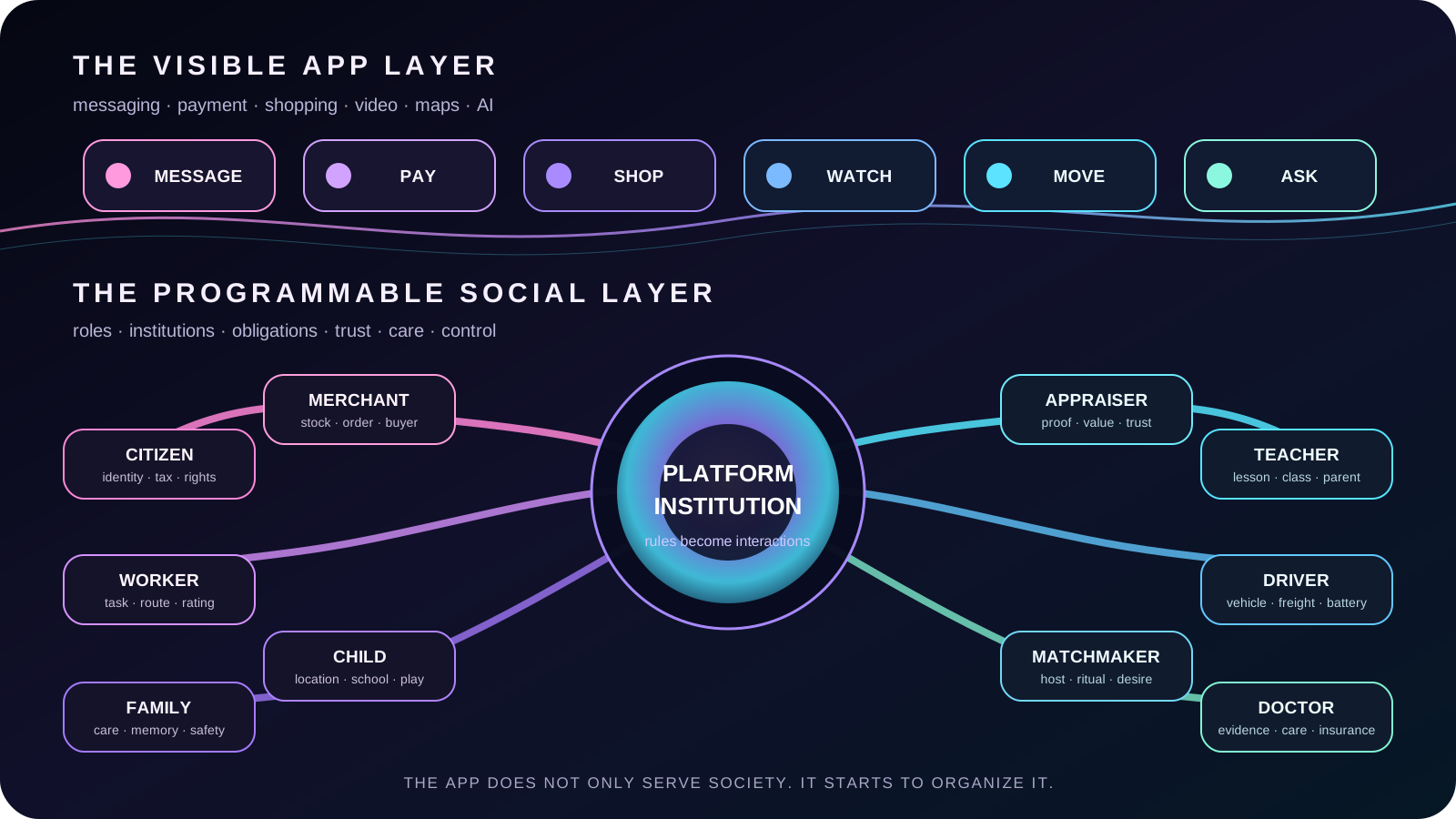
The point is not that China has digitized everything perfectly. Many of these products are cluttered, coercive, badly reviewed, commercially fragile, or built around forms of labor and surveillance that deserve much more scrutiny. The point is that the category boundary has moved. An app can now behave like a market, a school, an employer, a family archive, a professional guild, a transport authority, or a government counter.
The definition of an app has expanded into the definition of an institution.
The airport is not the city
Western conversations about Chinese software often end at WeChat. That is like trying to understand a city by looking at its airport.
The airport matters. WeChat, Alipay, Taobao, Douyin, JD, and Xiaohongshu are enormous gateways. They shape messaging, payments, commerce, entertainment, search, and reputation. But gateways are designed to be visible. Their scale attracts journalists, investors, and foreign product teams. They are the skyline.
The systems underneath them are easier to miss. Some live inside mini-programs and never ask the user to install a standalone app. Some are companion interfaces for watches, scooters, batteries, or cars. Some face workers rather than consumers. Some are white-label infrastructure that appears under somebody else's brand. Some are only legible if you work in construction, teach kindergarten, sell jade on livestream, run a restaurant, transport freight, or prepare for a public-sector exam.
By March 2026, QuestMobile measured 1.021 billion monthly active mini-program users across China. WeChat mini-programs alone reached 973 million, while Alipay and Douyin mini-programs reached 644 million and 273 million respectively. At that scale, the App Store is no longer a reliable map of software. It is only one entrance.
The hidden ecosystem is not hidden because it is small. It is hidden because outsiders are looking for the wrong object.
The numbers also require care. Chinese product pages often report registered users, cumulative users, households served, transactions, merchants, or monthly active users as if they belong to one scale. They do not. In this essay, precise audience figures come from QuestMobile; company-reported scale is treated as context rather than a directly comparable ranking.
The app is becoming the institution
Consider 交管12123, the official traffic-management app. It is not a transport startup trying to optimize a small part of driving. It is where the administrative relationship between a driver, a vehicle, and the state becomes interactive. Licenses, registration, violations, fines, inspections, appointments, and records are pulled into one surface.
国家医保服务平台 does something similar for national health insurance. 浙里办 turns Zhejiang's provincial government into a service interface. 个人所得税 and 电子税务局 make taxation a recurring product experience. 国家反诈中心 turns fraud prevention, warnings, reporting, and public-security communication into another icon on the phone.
Calling these "government apps" makes them sound like digital brochures. They are closer to executable institutions.
A physical institution has counters, queues, opening hours, forms, jurisdiction, staff, and rules about who can do what. A digital institution translates those things into identity checks, permissions, status labels, notifications, databases, and buttons. The queue may disappear, but the institution does not. It changes shape.
That creates a design question much larger than whether the interface is convenient.
When the app becomes the institution, who gets to rewrite its rules?
Who can appeal a decision? Who can see why a record is wrong? What happens when the app is unavailable, the person lacks the right device, or the database cannot recognize their situation? A good interface can remove enormous bureaucratic pain. It can also make institutional power feel natural because it arrives as a smooth flow.
The state does not disappear into the app. It becomes harder to see as a state.
Software does not always replace the human
The most interesting Chinese products are often not stories of automation. They are stories of software-amplified humans.
伊对 is a dating platform with human hosts who introduce people in live video rooms, keep the conversation moving, and perform a scaled version of the traditional matchmaker. The app does not eliminate the intermediary. It turns the intermediary into a platform role.
快团团 gives group leaders the tools to sell through private WeChat communities, recruit downstream resellers, distribute commissions, collect payments, and manage orders. The group leader is not merely a user. They are a storefront, salesperson, community organizer, and distribution node.
微拍堂 combines livestreaming, auctions, appraisal, reputation, and commerce for jade, ceramics, coins, tea, calligraphy, and collectibles. Trust cannot be solved by a checkout button alone, so the platform surrounds the transaction with appraisers, hosts, records, and social proof.
万师傅 coordinates the people who complete the physical promise of online commerce: measuring a room, installing furniture, mounting a television, repairing an appliance, or removing the old object after the new one arrives. The consumer sees a product page. The system has to find a human body that can carry the product through the final meter.
幼师贝壳 does not replace the kindergarten teacher. It gives the teacher lessons, media, printables, classroom materials, parent communication, and synchronized surfaces across phones, computers, televisions, and mini-programs. 客如云 does not replace the restaurant manager. It makes ordering, membership, inventory, marketing, hardware, analytics, and operations available as one system. 小鹅通 does not replace the creator. It turns a creator's course, membership, livestream, community, and customer relationship into white-label infrastructure.
The recurring pattern is not "AI takes the job."
It is that the job becomes a role inside someone else's software.
That can make a person dramatically more capable. It can also let the platform define what good work looks like, which actions are visible, how payment flows, and which parts of the relationship become measurable.
Software-amplified humans are still humans. They are just humans whose agency is increasingly expressed through a product schema.
There is a second internet for the worker
A consumer can use Meituan to order dinner without ever seeing 美团众包, the rider-facing system behind the delivery. They can buy through JD without seeing 京东秒送骑士. They can experience Ele.me delivery without encountering 蜂鸟众包.
The worker has a mirror internet.
It contains tasks, routes, deadlines, ratings, proof of completion, penalties, availability, earnings, and the infrastructure required to stay online. 铁塔换电, 这锂换电, and 智租换电 help delivery riders find and manage battery swaps for electric two-wheelers. The battery is not an accessory. It is occupational uptime.
鱼泡直聘 grew around construction and blue-collar recruitment. 牛小二招聘 specializes in truck drivers and logistics. 智联招聘, 赶集直招, and BOSS直聘 address overlapping labor markets through different models of listings, direct chat, and matching. 公考雷达 and 粉笔 exist because public-sector examinations are not a one-time event but an entire recurring career infrastructure.
运满满 connects freight owners and truck drivers. 一亩田 connects agricultural producers, wholesalers, buyers, market prices, logistics, and unsold inventory. The product is not only matching supply and demand. It is making dispersed work legible enough that the platform can coordinate it.
This is the part of the app economy that disappears when we study only consumer screenshots.
The polished front stage says the food is arriving. The worker interface says where the body must go, how quickly, under which conditions, with what evidence, and for how much money.
A service is often two products facing opposite directions.
The child becomes a platform
小天才 looks like a companion app for a children's watch. That description is technically correct and conceptually tiny.
The larger product is a hardware-mediated social system connecting a child, parents, classmates, school expectations, location, communication, safety, and permitted independence. 米兔手表 occupies a similar category. The watch is a phone, tracker, social object, emergency channel, and boundary around childhood.
亲宝宝 makes one child the organizing object of a private family cloud. Photos, videos, audio, milestones, vaccinations, memories, advice, commerce, and multiple generations gather around the same timeline. 学而思亲子 treats learning as a supervised family workflow rather than a private interaction between a student and a lesson. 幼师贝壳 connects teacher preparation to the classroom and then back to the parent.
These products do not merely serve children. They define relationships around children.
A location feature can give a child more freedom because a parent feels less afraid. The same feature can normalize continuous surveillance. A family archive can preserve memories across generations. It can also make the child's life a data structure before the child is old enough to choose.
Care and control often share the same button.
That does not mean the feature is secretly evil or obviously good. It means the design cannot be understood by looking at the immediate user alone. The product has several users with unequal power, different fears, and different ideas about what safety means.
The child is not simply using the platform. The child is becoming the platform around which the family is organized.
The smallest businesses become computationally legible
The most consequential business software is not always sold to companies with IT departments.
秦丝进销存 and 秦丝生意通 bring inventory, procurement, wholesale, retail, branches, suppliers, POS, and online ordering to small merchants. 义采宝 turns Yiwu's physical wholesale markets into searchable, navigable, transactional software. 拍机堂 and 爱回收 split second-hand electronics into professional-reseller and consumer-facing systems. 快团团 turns a private chat community into a distributed retail network.
客如云 is an operating system for restaurants. 自如 combines housing discovery, managed rental inventory, maintenance, furnishing, contracts, and landlord operations. 万师傅 becomes the fulfillment layer for bulky objects that cannot complete themselves. 小鹅通 gives small creators and educators infrastructure that would once have required a software company.
These products make tiny businesses computationally legible without first requiring them to become large corporations.
That matters because informal and semi-formal commerce has always contained sophisticated coordination. It simply lived in notebooks, phone calls, relationships, market stalls, memory, and repeated local routines. The app does not create the business. It translates the business into fields, statuses, dashboards, permissions, and data.
Something is gained. Inventory becomes visible. Orders can travel. New buyers can discover a supplier. A merchant can operate across locations.
Something is also lost. Once the business fits the schema, the schema can begin deciding which parts of the business count.
The spreadsheet was not primitive. It was a local constitution. The platform arrives with a new constitution written somewhere else.
Some categories do not have clean Western equivalents
The media layer becomes stranger when we stop asking which app is "China's Netflix."
红果免费短剧 is built around free, vertically consumed short drama. 番茄免费小说 and 番茄畅听 connect serialized fiction, advertising, audio, and an enormous IP pipeline. 红果免费漫剧 and 火龙漫剧 point toward a newer category between comics, animation, generative media, and phone-native drama.
QuestMobile estimated that short drama reached 718 million monthly active users by February 2026. Standalone short-drama apps reached 335 million, while short-drama WeChat mini-programs reached 427 million. The format is not a small subculture waiting to become television. It is already a mass medium with its own production system.
猫耳FM turns audio drama, voice performance, fandom, and ACG culture into a dedicated economy. 米游社 lets HoYoverse own more of the community, guides, game data, rewards, and fan culture around its games instead of surrendering those layers to Reddit, Discord, and independent wikis. 小黑盒 combines account identity, price history, free-game alerts, player records, maps, guides, and communities across several gaming platforms.
向僵尸开炮, 挪了下车, and 无尽冬日 are reminders that the Chinese game ecosystem also lives inside mini-programs. 百变大侦探 makes live, voice-based murder-mystery roleplay into a social network where people meet by temporarily becoming fictional characters.
汽水音乐, 网易云音乐, 酷狗音乐, and QQ音乐 are music services, but they also show how misleading a category label can be. Each sits inside different ownership structures, recommendation systems, fandom cultures, and cross-product ecosystems.
The useful question is not, "Which Western app is this like?"
It is, "What behavior became large enough here to deserve its own infrastructure?"
Trust becomes a product layer
Several of these apps are really machines for deciding what can be believed.
天眼查 makes corporate registry information, ownership, legal records, and company relationships available as an everyday decision tool. It can be used before taking a job, signing a contract, or trusting a business. 美丽修行 turns cosmetic ingredients, safety claims, skin analysis, and product comparison into a computational consumer interface. 得物 places authentication inside the fashion transaction. 微拍堂 surrounds collectibles with appraisal and reputation. 闲鱼 has to make second-hand trade possible between strangers. 大众点评 turns local experience into a searchable reputation layer.
Trust is often described as a feeling. Platforms try to rebuild it as data.
That can be genuinely useful. A person can inspect a company, identify an ingredient, see a price history, check a seller, or compare other people's experiences. But every trust system also decides what evidence counts. A registry record, an ingredient classification, an authentication process, a review score, and an appraiser's judgment are not neutral windows into truth. They are designed arrangements of authority.
The interface does not merely display trust. It manufactures the conditions under which trust becomes possible.
The app store is the wrong map
Some of the most important products in this excavation are barely apps in the traditional sense.
快团团 lives through private WeChat circulation. 小鹅通 often appears under a creator's own identity. Mini-games run without a conventional installation. 小天才, 米兔手表, 九号出行, 雅迪智行, 爱玛出行, and 台铃智能 are inseparable from physical devices. Worker tools are discovered through employment rather than consumer marketing. Government services may be mandatory infrastructure rather than optional products.
Then there are AI systems such as WorkBuddy and JVS Claw, which point toward another category shift. The interface may no longer be a destination where a person manually completes a task. An agent can coordinate tools, schedules, data, and workflows across several systems.
QuestMobile measured 499 million monthly active users for AI-native apps in May 2026. That does not mean the app disappears tomorrow. It means the unit of competition may move from "which app owns the task?" to "which agent can call the right capability without making the person care where it lives?"
The Chinese ecosystem is therefore being pulled in two directions at once.
One direction produces extremely narrow, role-specific systems: battery swap for a rider, lesson preparation for a kindergarten teacher, inventory for a market stall, public-exam alerts for an applicant.
The other direction produces agents that want to become the interface above all those systems.
The future may not be one super-app. It may be a general agent standing on top of thousands of institutional micro-apps.
Care and control keep sharing a button
It would be easy to write this as either techno-optimism or techno-dystopia.
The optimistic version says China is making everyday systems more convenient, coordinated, and accessible. The dystopian version says every relationship is becoming measurable, every worker is becoming manageable, and every citizen is becoming legible.
Both versions are too clean.
The same system can reduce friction and increase power asymmetry. A rider can find a charged battery and be measured more precisely. A parent can worry less and track more. A merchant can reach new buyers and become dependent on a platform. A citizen can avoid a government queue and lose alternative ways to resolve an exception. A cosmetics app can expose ingredients and intensify the belief that every feature of the body needs optimization.
The tension is not between good apps and bad apps.
It is between what the app makes possible and what becomes difficult to refuse once the app becomes normal.
This is why app categories are anthropology. Each category reveals what a society has decided to coordinate, what it is willing to measure, which intermediary roles it preserves, which ones it removes, and which forms of dependence it accepts in exchange for convenience.
The interface is not sitting on top of society.
It is becoming one of the places where society decides what a person is allowed to do.
A complete field atlas
The list below is intentionally exhaustive. It includes every Chinese app, mini-game, platform, and companion product that appeared during this excavation, including the familiar surface apps and the comparison points that helped reveal the deeper categories.
Gateways, discovery, and general social life
- WeChat 微信: messaging, payments, public accounts, mini-programs, communities, work, and an operating layer for countless other services.
- Alipay 支付宝: payments, finance, public services, identity, and a major mini-program ecosystem.
- Taobao 淘宝: consumer commerce and the visible entrance to a much larger merchant and logistics system.
- Douyin 抖音: short video, livestreaming, commerce, search, local services, mini-programs, and increasingly AI.
- JD 京东: retail, logistics, delivery, and the consumer-facing side of a large operational network.
- Xiaohongshu 小红书: social search, lifestyle evidence, recommendations, commerce, and identity performance.
- Doubao 豆包: ByteDance's general AI assistant and one of the largest AI-native apps in China.
- Gaode Maps / Amap 高德地图: navigation, transit, ride-hailing, local discovery, and urban services.
- Meituan 美团: local commerce and the consumer interface to food, hotels, tickets, health, mobility, and delivery.
- Dazhong Dianping 大众点评: reviews, local discovery, reservations, and reputation for places and services.
- Xianyu 闲鱼: second-hand commerce, collectibles, informal trade, and stranger-to-stranger trust.
- Dewu / POIZON 得物: fashion and sneaker commerce with authentication built into the transaction.
- Kuaishou 快手: short video, livestreaming, creator commerce, and a social geography distinct from Douyin.
- Bilibili 哔哩哔哩: long-form video, fandom, learning, livestreaming, and subcultural community.
- Zhihu 知乎: questions, expert explanation, essays, video, and knowledge commerce.
- Jike 即刻: interest-based social networking with a strong technology, design, and startup culture.
- Maimai 脉脉: professional identity, recruiting, compensation discussion, and anonymous workplace intelligence.
- BOSS Zhipin BOSS直聘: direct chat between candidates and employers.
- Keep: workouts, running, fitness content, equipment, and community.
- Xiaoyuzhou 小宇宙: podcast discovery and discussion with an urban creative audience.
- Soul: pseudonymous social discovery, personality matching, and virtual social spaces.
New media, fandom, music, and games
- Hongguo Free Short Drama 红果免费短剧: free vertical microdrama at mass-market scale.
- Fanqie Free Novels 番茄免费小说: ad-supported serialized fiction and a source layer for adaptable IP.
- Fanqie Changting 番茄畅听: free audiobooks, fiction, and audio entertainment.
- Hongguo Free Manju 红果免费漫剧: phone-native animated comic drama.
- Fire Dragon Manju 火龙漫剧: an emerging animated-drama product in the same rapidly forming category.
- Qiandao 千岛: fandom, ACG, collectibles, interests, and marketplace behavior.
- Duoshan 多闪: ByteDance's recurring attempt to build a social graph around short video.
- Soda Music 汽水音乐: ByteDance's music service and recommendation ecosystem.
- NetEase Cloud Music 网易云音乐: music, comments, playlists, fandom, and community.
- Kugou Music 酷狗音乐: a large music and karaoke ecosystem.
- QQ Music QQ音乐: Tencent's music platform and a major part of its entertainment network.
- Maoer FM 猫耳FM: audio drama, voice performers, fandom, and ACG audio culture.
- Whiteout Survival 无尽冬日: a giant survival-strategy game whose Chinese reach also illustrates mini-game scale.
- Fire at Zombies 向僵尸开炮: a high-reach mini-game distributed through the super-app ecosystem.
- Nuole Xia Che 挪了下车: another mini-game example that became large without behaving like a conventional installed app.
- Baibian Dazhentan 百变大侦探: live voice-based murder-mystery roleplay as a social product.
Knowledge, trust, professional identity, and social mediation
- Tianyancha 天眼查: company records, ownership, legal information, and corporate due diligence for ordinary users.
- Miyoushe 米游社: HoYoverse's owned community, game-data, guide, reward, and fandom layer.
- Zhishi Xingqiu 知识星球: paid private communities, expert subscriptions, files, archives, and discussion.
- Weipaitang 微拍堂: livestream auctions, appraisal, and commerce for antiques and collectibles.
- Xiaoheihe 小黑盒: gamer identity, account data, price history, alerts, guides, records, and communities.
- Yidui 伊对: live video dating assisted by human matchmakers and hosts.
Travel, transport, vehicles, and physical movement
- Umetrip 航旅纵横: authoritative flight, itinerary, airport, and aviation information.
- Liangbulu Outdoor Assistant 两步路户外助手: hiking routes, GPS tracks, outdoor navigation, and communities.
- Fantawild Tourism 方特旅游: a vertical travel interface for the Fantawild theme-park ecosystem.
- Yuanzhou Travel Notes 圆周旅迹: travel planning, recording, and memory.
- Ctrip 携程旅行: the large online-travel reference point against which smaller vertical products were compared.
- Chelai Le 车来了: real-time bus location and arrival prediction.
- eDaijia e代驾: dispatching a driver to operate the user's own car.
- Ninebot Travel 九号出行: the operating companion for Ninebot and Segway mobility devices.
- Yadea Smart Travel 雅迪智行: control, location, security, navigation, and maintenance for Yadea vehicles.
- Aima Travel 爱玛出行: a companion and control layer for Aima electric two-wheelers.
- TAILG Smart 台铃智能: the equivalent connected-vehicle layer for TAILG products.
Commerce, recommerce, housing, and small-business operating systems
- Paijitang 拍机堂: second-hand electronics trading oriented toward professional resellers.
- Aihuishou 爱回收: consumer-facing electronics recommerce and recycling.
- Kuai Tuantuan 快团团: private-domain group commerce operated through WeChat communities.
- Wan Shifu 万师傅: nationwide dispatch for installation, measurement, repair, and bulky-product after-sales work.
- Qinsi Inventory 秦丝进销存: mobile inventory, purchasing, wholesale, retail, and POS for small merchants.
- Qinsi Business 秦丝生意通: a related business-management system for broader merchant categories.
- Yicaibao 义采宝: a digital interface to Yiwu's physical wholesale markets and suppliers.
- Yimutian 一亩田: agricultural wholesale, pricing, sourcing, logistics, and harvest circulation.
- Keruyun 客如云: restaurant POS, ordering, membership, marketing, inventory, hardware, and analytics.
- Xiaoetong 小鹅通: white-label courses, memberships, livestreams, communities, CRM, and creator commerce.
- Meili Xiuxing 美丽修行: cosmetic ingredients, safety information, skin analysis, and product comparison.
- Ziroom 自如: managed rental housing, furnishing, contracts, maintenance, tenant service, and landlord operations.
- Yunmanman 运满满: freight matching and operational software connecting shippers and truck drivers.
Recruitment, exams, and gig-work infrastructure
- Yupao Zhipin 鱼泡直聘: construction and blue-collar recruitment at national scale.
- Niuxiaoer Recruitment 牛小二招聘: hiring focused on truck drivers, logistics, and blue-collar work.
- Zhaopin 智联招聘: a major general recruitment platform.
- Ganji Zhizhao 赶集直招: direct hiring across service and blue-collar categories.
- Gongkao Leida 公考雷达: structured discovery for civil-service, public-institution, teaching, banking, and state-enterprise exams and jobs.
- Fenbi 粉笔: preparation for civil-service and professional examinations.
- China Tower Battery Swap 铁塔换电: battery-swap infrastructure used heavily by delivery riders.
- Zheli Battery Swap 这锂换电: another rider-oriented battery network.
- Zhizu Battery Swap 智租换电: battery rental and swapping for high-uptime two-wheeler work.
- Meituan Crowdsourcing 美团众包: the rider-side operational interface behind Meituan delivery.
- Fengniao Crowdsourcing 蜂鸟众包: the worker-side delivery system associated with Ele.me's network.
- JD Miaosong Rider 京东秒送骑士: the courier interface behind JD's rapid local delivery.
Medicine, family, childhood, and education
- Yixuejie Doctor Station 医学界医生站: guidelines, calculators, drug information, education, news, and decision support for doctors.
- Dingxiangyuan 丁香园: professional medical community, cases, references, learning, and careers.
- Dingxiang Doctor 丁香医生: the consumer-facing health service and information counterpart.
- Xueersi Parent-Child 学而思亲子: parent-supervised learning and family study management.
- Xiaotiancai 小天才: the parent app and social infrastructure around children's watches.
- MiTu Watch 米兔手表: Xiaomi's child-watch companion for communication, location, and family interaction.
- Qinbaobao 亲宝宝: a private family archive organized around a child's development.
- Youshi Beike 幼师贝壳: lesson preparation, classroom media, and parent communication for kindergarten teachers.
Government and civic infrastructure
- Traffic Management 12123 交管12123: licenses, vehicles, violations, fines, inspections, and traffic administration.
- National Healthcare Security Service Platform 国家医保服务平台: the national interface to health-insurance identity and services.
- Zheliban 浙里办: Zhejiang's integrated provincial-government service platform.
- Individual Income Tax 个人所得税: personal tax filing, deductions, income records, and reconciliation.
- Electronic Tax Bureau 电子税务局: broader digital taxation, certificates, invoices, and authority communication.
- National Anti-Fraud Center 国家反诈中心: fraud warnings, education, reporting, and evidence submission.
Agents, churn, and the next layer
- WorkBuddy: an emerging office agent that treats tools and workflows as executable capabilities.
- JVS Claw: an agent-oriented work system pointing toward orchestration above individual apps.
- Zhuxiaobang 住小帮: ByteDance's home-renovation and design platform, bringing inspiration, planning, contractors, budgets, and commerce into one vertical.
Continuity is also a product feature
住小帮 brings another institution-like category into view: the home-renovation platform.
Renovation is not a single transaction. It is a long sequence of inspiration, measurement, budgeting, contractor selection, product discovery, coordination, installation, dispute resolution, and memory. A platform can gather those steps into one coherent surface, but that coherence also creates dependence.
The broader question applies to every app in this essay. What happens when a family, merchant, worker, or citizen organizes important parts of life around a product and the product later changes direction?
Who owns the records? Can the relationships move? Does a merchant keep the customer? Can a family export the archive? Can a worker prove the history of their work? Can a citizen use another channel? The more social responsibility a product absorbs, the less acceptable ordinary startup impermanence becomes.
Institutions are expected to outlive individual transactions. Apps are expected to iterate.
When one becomes the other, continuity stops being an operational detail.
A product cannot ask to become infrastructure and still treat continuity as a feature request.
China is not one future
There is a lazy way to end an essay like this: China is living in the future.
It is not.
China is living in many uneven presents. A highly integrated government service can coexist with a terrible interface. A sophisticated worker platform can coexist with harsh labor conditions. An enormous AI market can coexist with old forms, local relationships, and physical bureaucracy. A children's watch can be technically advanced and socially conservative at the same time.
The value of looking at these apps is not to predict that Europe or the United States will copy them. It is to expand the set of futures we can notice.
The Chinese app ecosystem shows that almost any recurring social role can become a product surface. The matchmaker, appraiser, teacher, market broker, government clerk, dispatcher, landlord, doctor, group leader, and parent can all be coordinated, measured, and partially rewritten through software.
The future may not arrive as one general-purpose AI assistant that replaces every app.
It may arrive as thousands of narrow systems that quietly absorb the institutions around us, one social role at a time. Then an agent arrives above them and makes those institutions callable.
By the time we notice, the app will no longer be sitting on top of society.
It will be one of the places where society happens.
AI authorship note
This essay began with Kris Haamer asking for large Chinese apps he might not know, rejecting the obvious answers, and repeatedly asking to go deeper. Kris identified the Raw Drafts angle, selected the direction that apps can become institutions, required an exhaustive audit of every product named during the research, and asked for the result to be published. AI supported the web research, app inventory, synthesis, drafting, editing, source organization, and GitHub implementation. Kris directed the question, depth, argument, title, voice, and publication decision.