

2026-08-01 · 8 min read · Raw Drafts / Work / Identity
How to Become Legible Without Becoming Smaller
Job applications ask a complicated person to become a recognizable candidate. Building a business offers more authorship, but the market still demands a shape it can understand.
Applying for jobs has started to make me feel as if I am trying to fit myself inside a box that was designed before anyone knew I existed. The box has a title, a list of responsibilities, a preferred number of years of experience, and a set of words that are supposed to describe the person who belongs inside it. Product designer. Interaction designer. Strategist. Developer. Operator. Each title describes something I have done, but none of them feels large enough to describe how I actually work.
A job application asks me to select the parts of myself that support the role and quietly remove the rest. I rewrite my life until it appears to have been moving logically toward this particular vacancy. The detours become distractions, the projects that do not support the story disappear, and curiosity is translated into a competency. By the time the application is finished, it may be professionally coherent, but I often feel less present inside it.
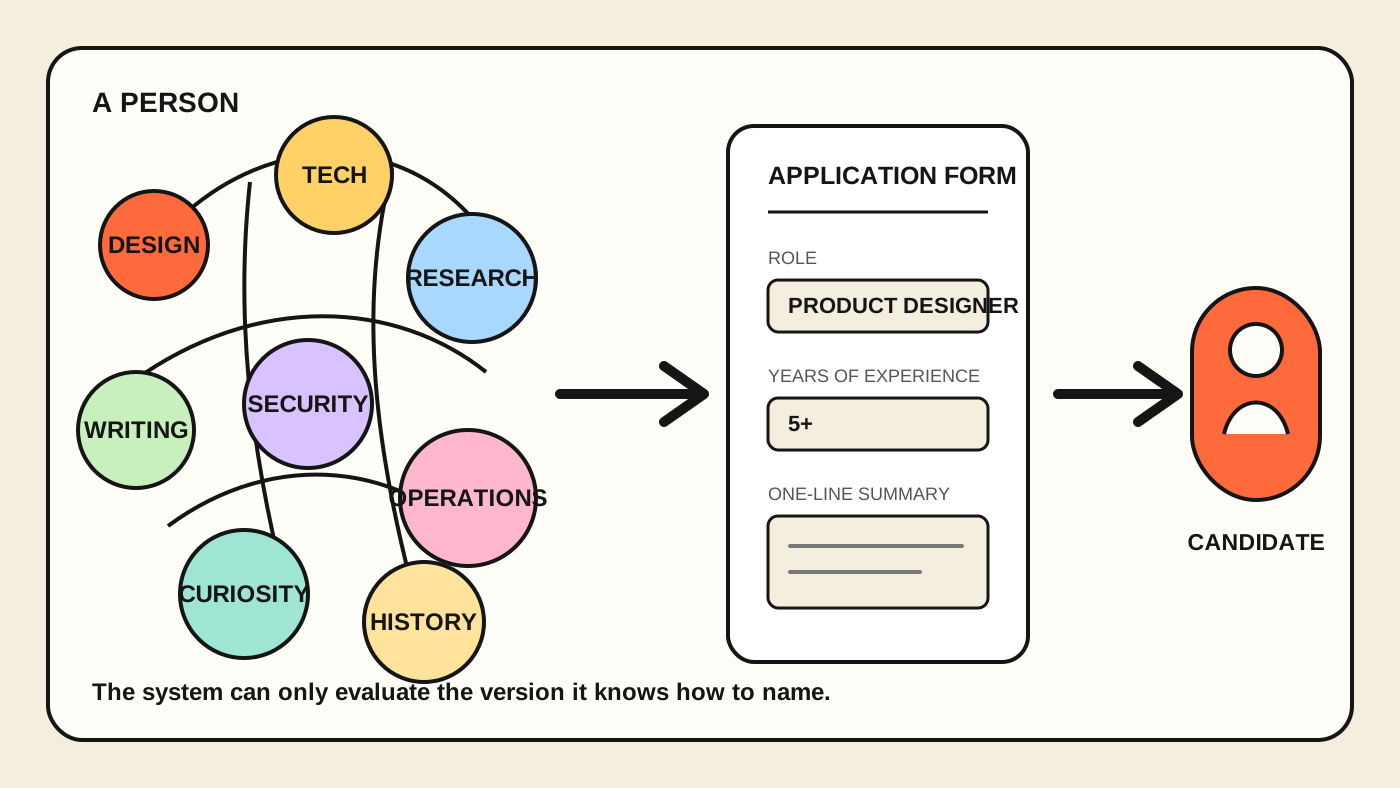
This is probably why job applications can feel strangely theatrical. You are expected to be authentic, but the acceptable version of authenticity has already been outlined by the job description. You must explain why this company is the natural destination of your career, even when you first heard about it a few days ago. Income and stability matter to almost everyone, yet these are rarely considered sufficient reasons to want the job. The candidate performs passion and the employer performs certainty about the person it needs.
There is research behind this feeling. One study followed 202 people after interviews and found that anxiety about self-presentation was associated with more deceptive impression management. People became more likely to exaggerate or manufacture the version of themselves they believed the interview required. I do not read this as evidence that applicants are uniquely dishonest. The interview creates a situation in which a person is asked to be genuine while also being judged on how effectively they produce a desired image.
The application therefore acts as a compression system. A complicated person has to become a readable signal inside a process handling hundreds or thousands of other signals. The résumé cannot contain every version of me, and a hiring manager cannot slowly discover how all my experiences connect. Some simplification is unavoidable. The uncomfortable question is how much simplification can happen before translation begins to feel like self-erasure.
This is particularly difficult for people whose work has never belonged to one discipline. I have moved between design, technology, research, security, operations, writing, and entrepreneurship. From inside my own life, these activities are connected by the same interest: making complicated systems understandable, trustworthy, and functional. From outside, the same history can look like a person who has failed to choose.
A five-year study of 48 plural careerists describes people who hold and identify with several kinds of work at once. The researchers found that authenticity was more complicated for them than presenting one stable identity everywhere. They had to learn how to keep several genuine work identities in relationship with each other. This sounds closer to my experience than the usual advice to find a single personal brand and repeat it until the market remembers.
Hiring systems are built to recognize familiar shapes. A company knows what a senior product designer looks like because it has hired product designers before and can compare titles, portfolios, years of experience, and previous employers. A person who crosses several categories is harder to compare. The value may be real while remaining difficult to encode in the categories the system already uses.
This changes the emotional meaning of rejection. Officially, a rejected application is a decision about fit, timing, experience, or competition. After enough applications, it starts inviting questions about the self. Perhaps my title is wrong, perhaps the story is unclear, or perhaps the range that once felt like a strength has made me impossible to place. The process gradually encourages me to imagine myself from the perspective of a sorting system.
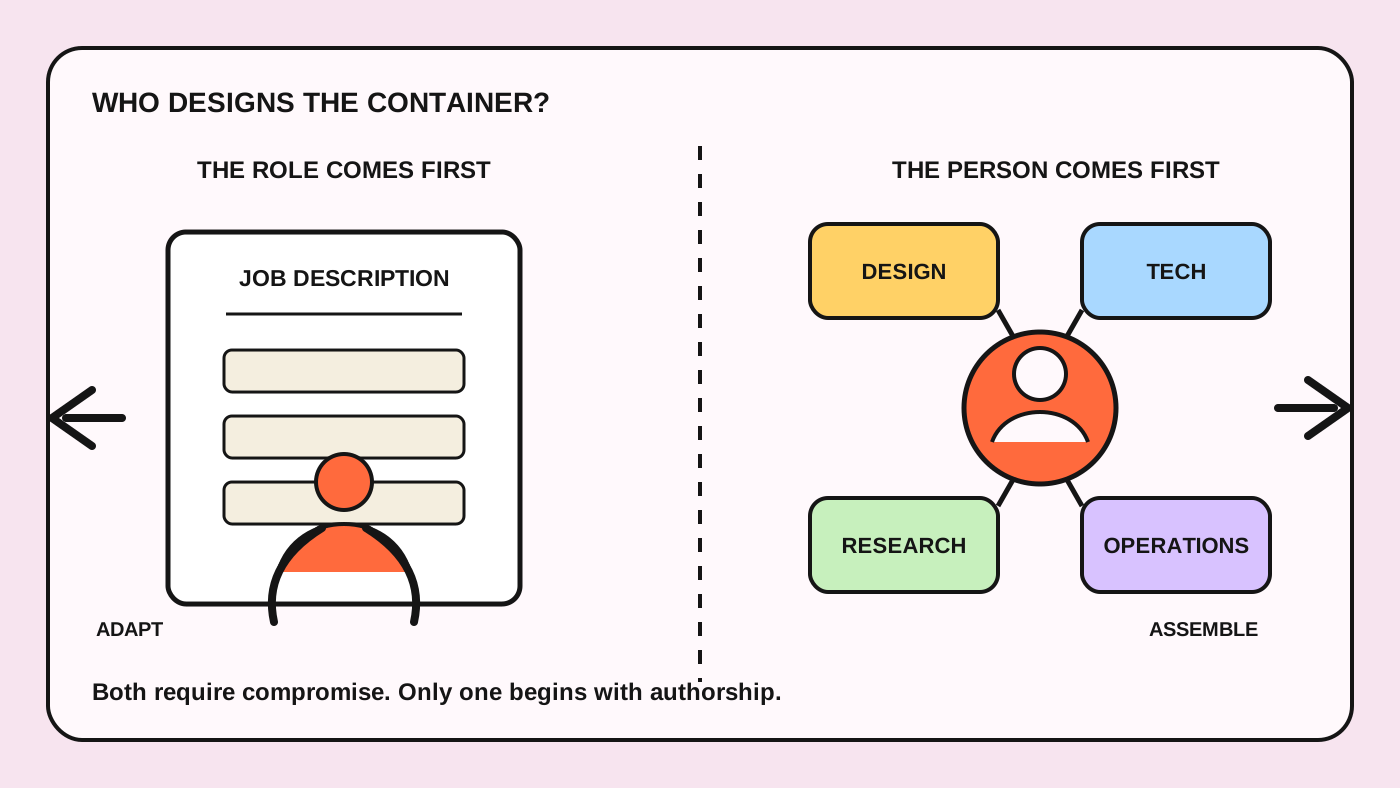
Running my own business feels different because the direction of adaptation is partly reversed. Instead of placing myself inside an existing role, I can create a structure around the way I already think and work. I can follow a problem across the borders between design, technology, and operations. When something falls between departments, I can decide that the space between them is exactly where the work should happen.
This probably explains part of the emotional attraction of entrepreneurship. Pew Research Center found in 2024 that 60 percent of self-employed workers in the United States were highly satisfied with their work, compared with 49 percent of other workers. Earlier international research has repeatedly connected that difference to autonomy, interesting work, and the ability to decide how the work is done. The business can become a form of professional authorship.
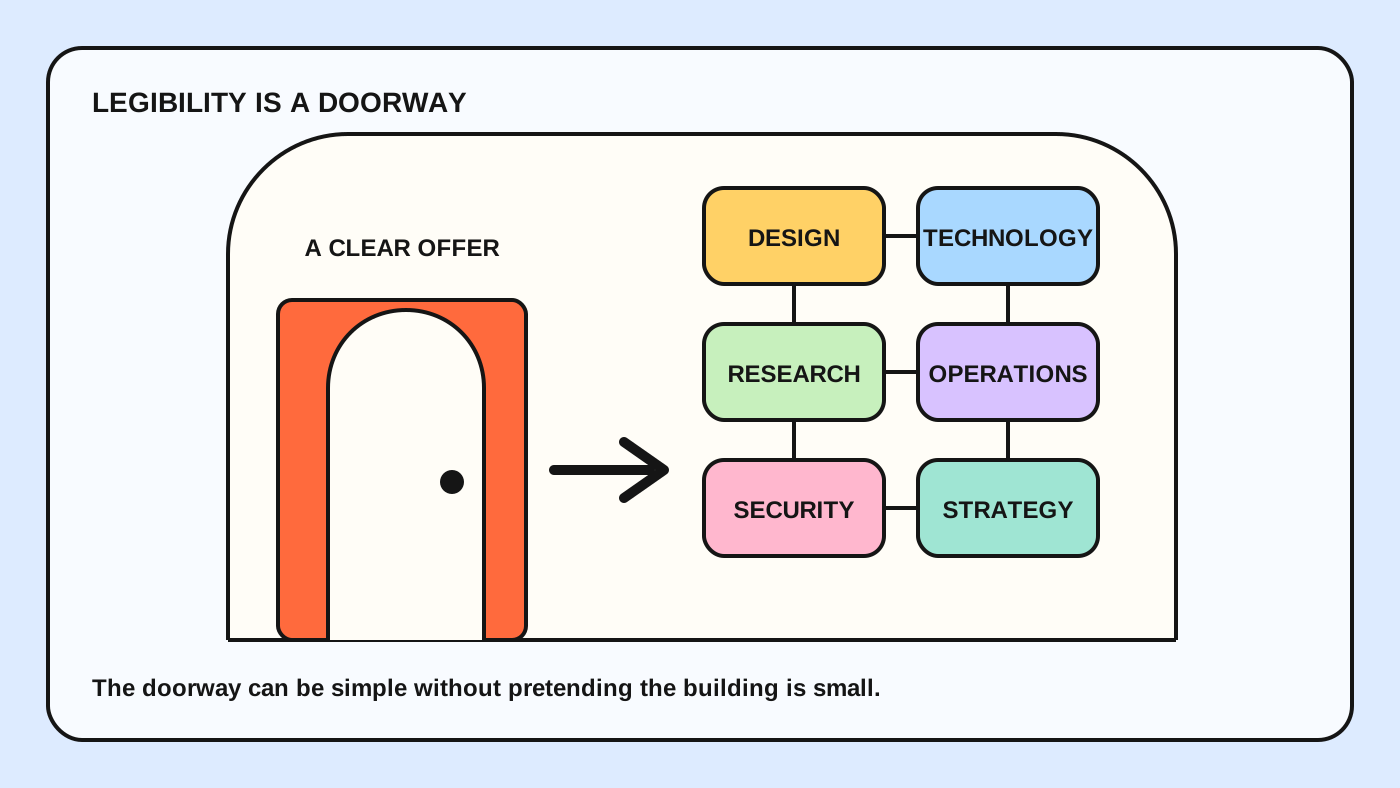
That authorship does not remove the demand for legibility. Clients also need to understand what I do, when they should contact me, what they are buying, and why it is worth paying for. A company that contains every interest of its founder may feel personally honest while remaining commercially unreadable. The market still needs a doorway.
The difference is that, when I run the business, I have more influence over the shape of the simplification. I can design the doorway without pretending that the doorway is the whole building. I can offer a clear point of entry while keeping the larger structure intact behind it. HAAM becomes an experiment in whether I can become legible without becoming smaller.
This may be one of the deeper reasons people start companies. The public explanation usually involves independence, money, flexibility, or the desire to build something. Underneath those motives there may also be a search for a professional identity that does not yet exist. The company becomes a container for a combination of skills that no employer has named, and the market becomes the place where that proposed category is tested.
Entrepreneurship can also produce a harsher form of self-compression. The ideal employee is replaced by the ideal founder, always energetic, visible, confident, and ready to convert another part of life into a marketable advantage. Financial uncertainty follows the work home because there is no organization standing between the person and the next empty month. Research on self-employment has found that financial insecurity can turn autonomy into psychological distress surprisingly quickly.
I do not experience running a business as pure freedom. It still requires translation, performance, repetition, and compromises that can narrow the work over time. Customers may begin to associate the company with one service, and the freedom to choose what to do can become the responsibility to generate work continuously. A box designed by its occupant is still capable of becoming a box.
Still, authorship matters. There is a psychological difference between being reduced by someone else's category and choosing a form that helps other people understand you. Both involve leaving things out. One gives me more control over what is preserved, what remains connected, and what the work is allowed to become later.
I have been thinking about job applications as attempts to prove that I could become useful inside someone else's system. Running HAAM asks whether my own definition of usefulness can survive contact with reality. Can the combination of things I do become clear enough that other people recognize its value? Can I build a business around the connections that a résumé keeps asking me to separate?
I do not know whether the answer is employment or entrepreneurship. A good role can expand around a person once they are inside it, while a business can become restrictive once the market expects one repeatable service. The more useful distinction may be between structures that let a person continue becoming and structures that require them to keep repeating the version that was easiest to classify.
The application process has at least made one desire more visible. I do not only want work. I want a professional life in which I do not have to repeatedly audition as a reduced version of myself. I want to become understandable without editing away the parts that make the work mine.
Connected reading
- The Person Who Decides What Counts as Work
- The Most Important Jobs Don't Exist Yet
- I Want to Work Somewhere the Work Is Already Necessary
- The Business of Making People Compete to Work
AI authorship note
This essay began with Kris Haamer noticing that applying for jobs made him feel as if he were trying to fit inside a box, while running HAAM allowed more of his actual way of working to remain connected. AI helped research job-search self-presentation, multiple work identities, autonomy, job satisfaction, and the psychological costs of self-employment. Kris chose the central tension, redirected the argument away from a simple employment-versus-entrepreneurship comparison, and selected the final language and illustrations for publication.