

HAAM Index / Raw Drafts / Product systems
July 14, 2026 / 8 min read
Essay / July 2026
The Product Is No Longer the Product
Luxury museums, open AI models, and private wealth services all point to the same shift: value is moving from the thing being sold into the system surrounding it.
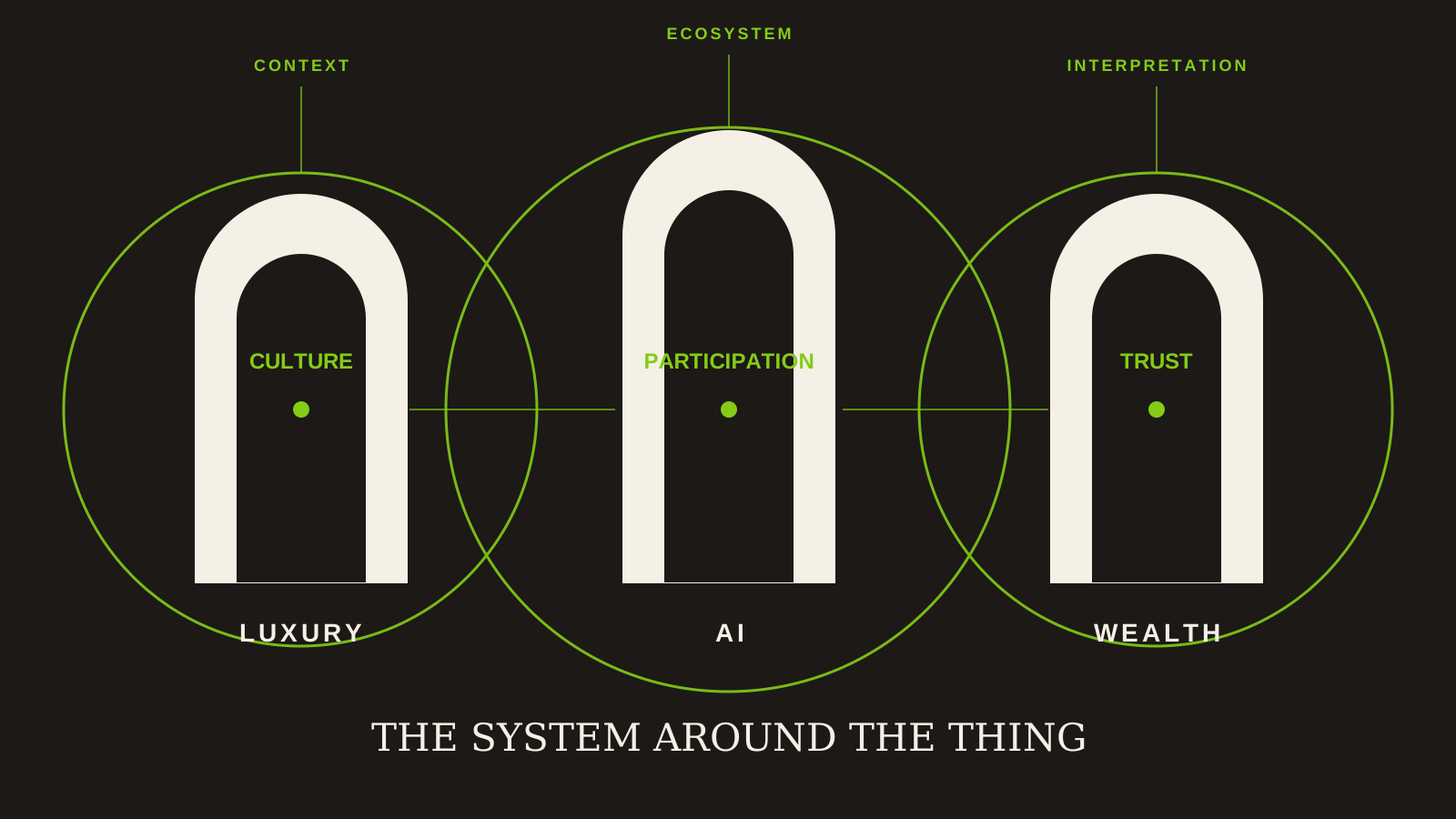
A luxury watch is no longer just a watch. An AI model is no longer just a model. A private bank is no longer simply a place to store and grow money. In each case, the visible product is becoming only one part of the offer. Much of the real value now sits in the system surrounding it: knowledge, access, trust, identity, community, and long-term relationships.
This shift appears across three seemingly unrelated developments in China and Asia. Luxury brands are turning boutiques into museum-like cultural spaces. Chinese AI companies are releasing advanced models openly in order to build larger developer ecosystems. Wealth managers are trying to become full-service partners in the lives of ultra-wealthy clients.
These industries look very different, but they are responding to the same underlying problem. The core product is no longer enough.
When luxury becomes a museum
Luxury has always depended on storytelling, but traditionally the story sat behind the product. A watch was sold through craftsmanship, heritage, scarcity, and status. The object came first, while the narrative explained why it deserved such a high price.
Now the narrative is becoming the environment in which the object exists. Luxury houses are creating exhibitions, archival displays, cultural events, educational programs, private salons, and museum-like spaces. The customer is no longer simply shown a product. They are invited into a world.
This process is sometimes described as the museumification of luxury. It gives brands cultural authority by presenting their products as more than expensive consumer goods. A watch can be framed as an engineering achievement, a piece of jewelry as part of an artistic tradition, and a handbag as a historical artifact rather than a seasonal accessory. The brand begins to resemble an institution.
This matters because expensive objects are becoming easier to discover, compare, and acquire. Wealthy customers can browse collections online, travel to another market, or buy from resellers. The object itself may still be scarce, but access to objects is becoming less scarce.
What remains rare is context. The exhibition, the curator, the craftsperson, the archive, the invitation, the private room, and the feeling of being admitted into something larger than a store are much harder to reproduce. The customer is no longer buying only ownership. They are buying participation.
When openness becomes a competitive moat
At first, open AI appears to follow the opposite logic from luxury. Luxury depends on restricting access, while open-source AI depends on expanding it. Yet the strategic logic is surprisingly similar.
A company that releases a powerful AI model openly gives up some control over the product itself. Developers can download it, modify it, build on top of it, and sometimes use it without paying the creator directly. On the surface, this can look like giving away the most valuable part of the business.
But the model may not be the final product. The ecosystem may be.
An open model can attract developers, researchers, startups, universities, and enterprises. It can become embedded in tools, workflows, infrastructure, and technical standards. Over time, it can train an entire generation of builders to think in its architecture, terminology, and assumptions.
The company gives up some control over the object but gains influence over the environment around it. This is especially important in frontier AI, where no model stays dominant forever. A technical advantage can disappear after the next release. Features spread quickly, quality converges, and competitors learn from one another.
A closed model may produce direct revenue, but an open model may produce dependence. Once enough people build around it, the surrounding ecosystem becomes difficult to replace. Documentation, integrations, developer knowledge, communities, benchmarks, and applications begin to accumulate.
The code is open, but the network becomes the moat. Once again, the core product is not the whole product. The model is the entry point into a much larger system.
What wealthy people buy when they already own everything
The same shift is happening in wealth management. Ultra-wealthy clients already have access to almost every financial product. They can invest in public markets, private equity, property, art, startups, funds, currencies, and complex financial structures. Offering them one more product is unlikely to feel transformative.
Their real problem is not access to assets. It is managing the consequences of having so many of them.
More money creates more options, but it also creates more complexity. Wealthy families need to coordinate investments, businesses, inheritance, education, taxes, property, mobility, reputation, privacy, security, health, and relationships across several countries and generations. A portfolio can perform well while the person behind it remains overwhelmed.
This changes the role of the wealth manager. The traditional model treats the client primarily as an investor. The emerging model treats the client as a complicated system.
The most valuable service is no longer simply producing returns. It is understanding the whole situation, anticipating problems, coordinating specialists, preserving discretion, and reducing the amount of mental energy the client must spend managing life.
The client is not buying another financial product. They are buying fewer decisions. They are buying continuity, trust, access, time, and peace of mind. The wealth manager becomes part adviser, part operator, part curator, and part institutional memory.
Like the luxury museum and the open AI ecosystem, the service expands beyond the visible transaction.
The product is becoming a relationship
The product is increasingly the entrance to a larger relationship.
Across all three examples, value is moving in the same direction. It is shifting from objects to systems, from transactions to relationships, from ownership to access, and from features to meaning.
The luxury brand does not merely sell a watch. It offers entry into a cultural institution. The AI company does not merely release a model. It creates a foundation on which others can build. The wealth manager does not merely manage money. They reduce the complexity created by wealth.
In each case, the core product becomes a gateway.
This is happening partly because products are easier to copy. Design can be imitated. Software features can be generated. Financial products can be replicated. Manufacturing knowledge spreads, distribution becomes global, and AI lowers the cost of producing more alternatives.
As products become more abundant, competitive advantage shifts toward what cannot be reproduced as quickly. Trust, taste, context, community, institutional memory, access to the right people, a sense of belonging, and the ability to interpret complexity all become more valuable.
These qualities are less visible than the product, but they may matter more.
Every company is becoming an institution
There is a broader implication here. Companies once competed mainly by producing better objects and services. Increasingly, they compete by becoming institutions around those objects and services.
A company may become a school by teaching customers how to understand its field. It may become a museum by preserving and interpreting its history. It may become a club by connecting members to one another. It may become infrastructure by allowing others to build on top of it. It may become a trusted operator by coordinating problems across a customer's life.
This is not simply branding. It changes what the organization must know how to do.
A museumified luxury brand needs curators, archivists, researchers, educators, and cultural partnerships. An open AI company needs documentation, developer tools, community governance, standards, and ecosystem support. A modern wealth manager needs an understanding of families, institutions, psychology, logistics, law, culture, and long-term relationships.
The company becomes wider than its original category. It stops asking only what it sells and begins asking what kind of world it is creating around what it sells.
The new scarcity
The industrial economy created value by controlling scarce production. The digital economy created value by controlling scarce information and distribution. The emerging economy may create value through a different kind of scarcity.
The rare thing is no longer necessarily the object. It is the coherent system around the object. The rare thing is not access to information. It is trusted interpretation. The rare thing is not having more choices. It is having someone or something capable of reducing those choices into meaningful direction.
That is why a museum can help sell a watch. It is why giving away an AI model can build power. It is why the wealthiest people may pay most for someone who helps them think less about money.
The product still matters, but it is becoming the beginning of the value rather than its final form. What people ultimately remain for is the world that has been built around it.
Connected reading
Open Models and the Rest of the Work
Why the model is only one layer of the product, and why deployment, trust, workflow, and organizational change become the harder work.
What Happens When Software Starts Making Decisions
How software expands beyond an interface and begins to absorb policy, authority, supervision, and organizational responsibility.
The Gift Box Is a Fandom Interface
How a retail object can become an interface for identity, collectibility, participation, and measurable social belonging.
Every Interface Contains a Business Model
How commercial strategy becomes visible through defaults, friction, incentives, attention, and the shape of everyday interaction.