

2026-07-21 · 6 min read · Raw Drafts / Infrastructure / Systems Design
A Fast Train Trapped in an Old System
What an old Amtrak trip, Taiwan High Speed Rail, and Acela reveal about the difference between upgrading a component and redesigning the system around it.
In April 2017, I took a train from New York to Boston. I did not remember what it was called. Looking back through the photos, it turned out to be an Amtrak Northeast Regional, leaving Penn Station sometime around nine in the morning. The interior was blue and slightly tired. There were electrical outlets by the seats, which I probably considered a nice feature at the time. The train crossed Queens, passed over the Hell Gate Bridge and continued along the coast toward Connecticut and Boston.
I do not remember thinking much about the railway itself. It was a train between two large American cities. It took several hours, but that did not feel especially strange. The United States was big. Trains were slow there. This was simply one of those facts that seemed to belong to the country.
Later, after living in Taiwan, I began to see that trip differently.
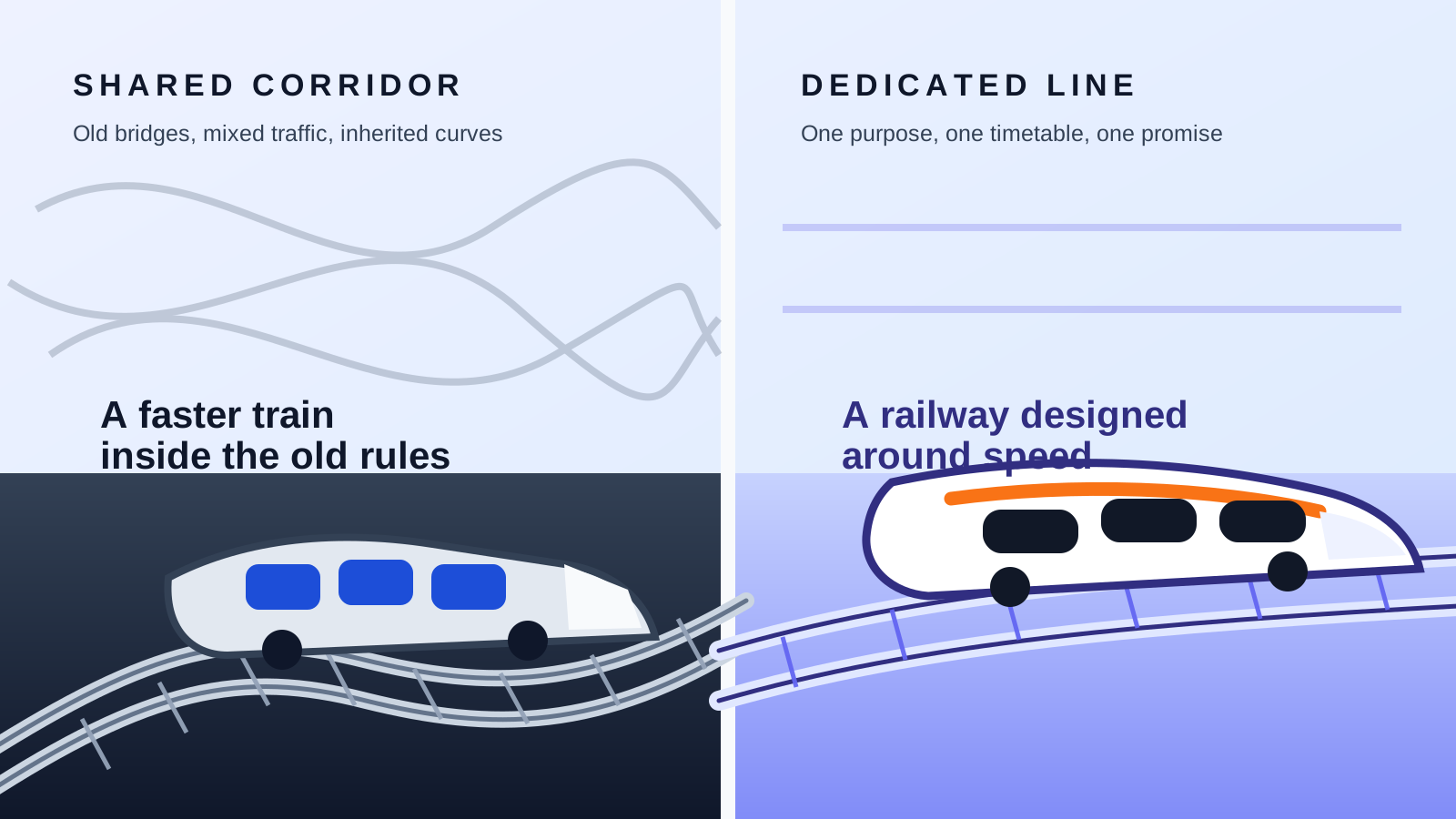
Taiwan High Speed Rail is not just a faster train. It is a separate system. It has its own tracks, stations, signalling, operating model and physical geometry. Freight trains cannot wander onto the line. Local commuter trains do not appear ahead of it. The curves were designed for speed. Roads cross underneath or above it. Everything exists to let the train do the thing its name promises.
Acela, America's high-speed train, runs mostly on the same Northeast Corridor I used in 2017. It shares the larger railway with Northeast Regional trains and a dense web of commuter services. It moves faster, stops less often and receives more priority, but it is still operating inside an inherited system. On some sections the newest Acela trains can reach 160 miles per hour. On other sections they slow for old curves, bridges, junctions and city approaches that were never designed for them.
The difference is easy to describe as a technical one. Taiwan has dedicated tracks and Acela does not. But the more interesting difference is psychological. Taiwan decided that high-speed rail required a new railway. The United States decided, or perhaps gradually accepted, that it could place a faster train inside the old one.
That choice appears everywhere once you begin noticing it.
A company adds an AI assistant to a customer-service process but leaves the databases fragmented, permissions unclear and internal approvals unchanged. A government digitizes a form but still requires the information to be printed, stamped and manually entered by another department. A hospital buys a new interface while the actual workflow continues through phone calls, paper notes and informal knowledge held by a few experienced employees.
The surface becomes modern while the operating structure underneath remains old.
This does not necessarily mean the upgrade is useless. Acela is faster than the Northeast Regional. A digital form can be better than a paper one. An AI assistant may save someone twenty minutes. The problem begins when the improvement is presented as a new system rather than a better component inside the existing one.
The train can go 257 kilometres per hour, but only where the railway allows it.
I think this is why people often misunderstand what design can accomplish. They imagine that a sufficiently polished layer can change the nature of the system beneath it. Sometimes it can hide the system for a while. It can reduce friction at the edges. It can make a confusing process feel less hostile. But it cannot permanently overcome the architecture that governs it.
Acela can tilt through curves. It can accelerate quickly. It can have nicer seats and fewer stops. It still has to cross the same bridges.
Taiwan made a more expensive and politically difficult decision. It created duplication. For much of the western corridor, Taiwan now has two parallel railway systems. The conventional railway enters old city centres and serves many smaller stations. The high-speed railway moves quickly between larger metropolitan areas, sometimes stopping in places that initially felt inconveniently far outside the city. In Tainan, reaching the high-speed station can feel like a separate journey.
But the separation protects the promise. A high-speed train remains a high-speed train even when the conventional network is delayed or congested. The inconvenience is visible instead of being hidden inside unpredictable performance.
Japan made a similar decision with the Shinkansen. China repeated it on an almost absurd scale. France uses a hybrid model, with trains travelling rapidly on dedicated lines before entering older networks near city centres. Germany integrates high-speed trains much more deeply into conventional rail, gaining flexibility but also inheriting more delay and complexity.
These are not simply different railway technologies. They are different answers to a design question: how much of the old system are you willing to keep?
Keeping it feels efficient. The tracks already exist. The stations are already in the centre. The land has already been acquired. People know how to use the network. Upgrading seems more responsible than starting again.
Then every inherited constraint quietly becomes part of the new product.
Old bridges determine speed. Existing operators determine scheduling. Historic property boundaries determine alignment. Political compromises determine which sections are improved and which remain untouched. Eventually the project may still contain a new train, but the old system has designed most of the experience.
This is not only an American problem. Most organizations behave this way because replacement is frightening. A new interface is easier to approve than a new operating model. A pilot is easier than restructuring responsibility. Buying software is easier than deciding who owns the outcome. The organization asks a new tool to behave radically while protecting every condition that made the old system slow.
Then people blame the tool.
The AI is not transformative enough. The dashboard does not create accountability. The service redesign did not change customer satisfaction. The new train is fast, but the journey is still long.
Sometimes the tool genuinely is bad. But sometimes it is an Acela problem. The vehicle has changed and the railway has not.
There is also a kind of institutional pride in extracting more performance from old infrastructure. Engineers make a century-old corridor support speeds its builders could never have imagined. That is impressive. It requires skill, coordination and endless incremental improvement. Not every system should be replaced. Starting again can destroy useful connections, erase history and create expensive duplication.
The problem is not retrofitting itself. The problem is forgetting what retrofitting cannot do.
I probably would not have noticed any of this during my trip to Boston. The Northeast Regional seemed fine. It got me there. Most systems appear reasonable when they are the only version you know.
Taiwan changed my expectations quietly. After becoming used to a train that travels on infrastructure built around its purpose, the American model began to look slightly strange. Not dysfunctional exactly, and certainly not simple. More like a modern object moving through a world that keeps reminding it how old it is.
The train wants to be fast. The railway has other memories.
Connected reading
- The Product Needs a Harness
- The Interface as an Archaeological Site
- The Coding Assistant Is Becoming the Development System
AI authorship note
This essay began with Kris Haamer asking why Canada and the United States have so little true high-speed rail, then identifying an Amtrak Northeast Regional trip from New York to Boston in his 2017 photo archive. AI supported the rail-system comparison, source checking, drafting, editing, illustration and implementation. Kris selected the central comparison with Taiwan, redirected the article away from a global ranking and toward legacy systems, and chose the final version for publication.