

Compare revisions
Version 1 to version 2
Eleven Terabytes Are Not a Story
Version 1
July 29, 2026
Initial draft examining AI-assisted documentary editing through a newly cataloged twelve-terabyte personal archive, with a practical source-linked workflow and original Y3K cyberpunk illustrations.
Version 2
August 14, 2026
Rewrote the explanatory AI-editing essay as a documentary fragment centered on the physical hard drive, memory gaps, the catalog, and the unanswered question of what happened; removed the tooling walkthrough, practical workflow, source list, and most explanatory framing.
Visual changes
Images, SVG diagrams, and embeds are shown as media instead of raw Markdown so the visual meaning of the revision remains visible.
Removed visuals
Graphics and embeds that were present in the earlier revision.
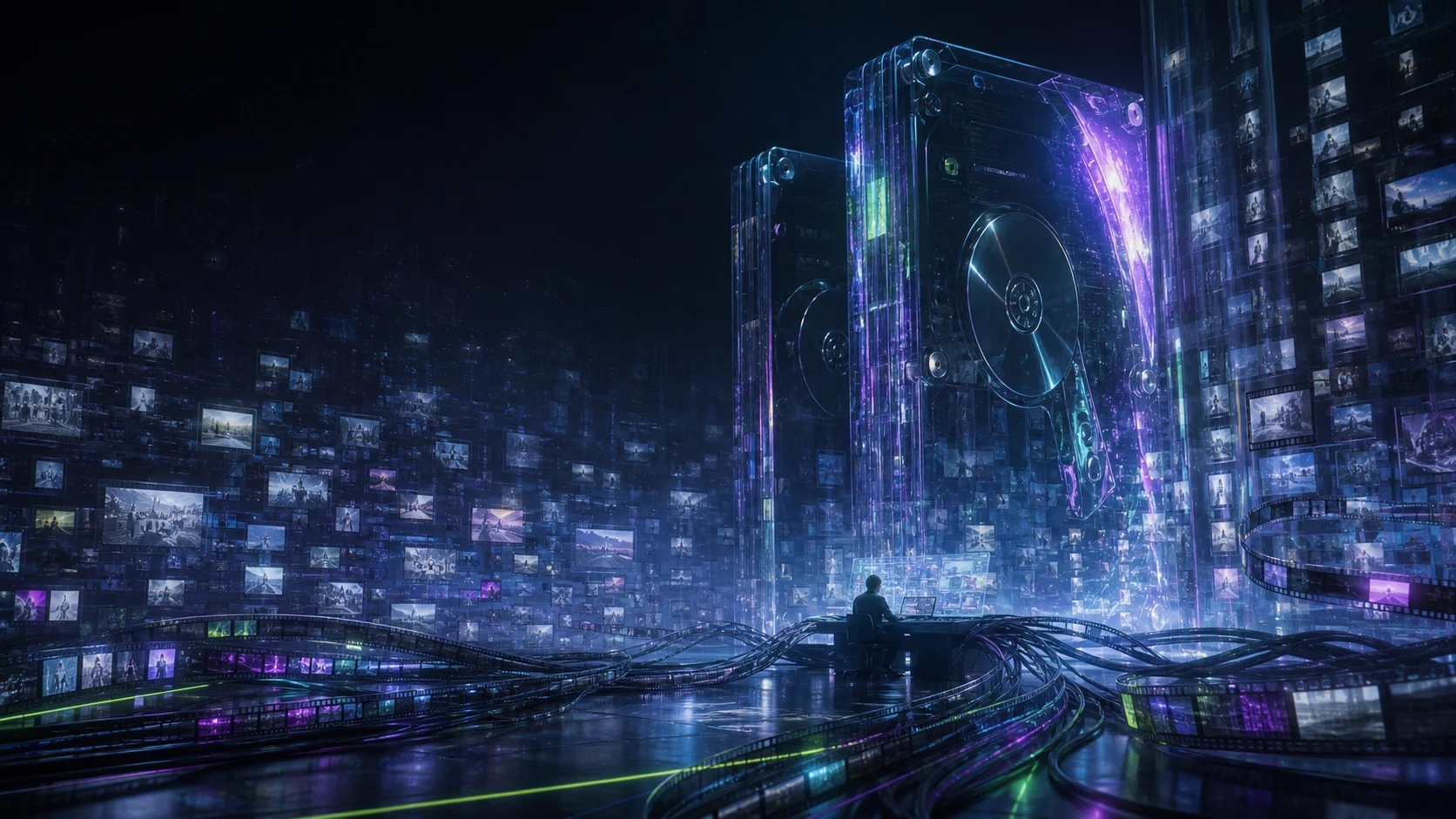
A solitary editor inside a luminous vault of hard drives and suspended documentary frames.
Eleven terabytes can hold thousands of possible films. Storage alone does not decide which one is true.
/blog/eleven-terabytes-are-not-a-story/archive-vault.webp
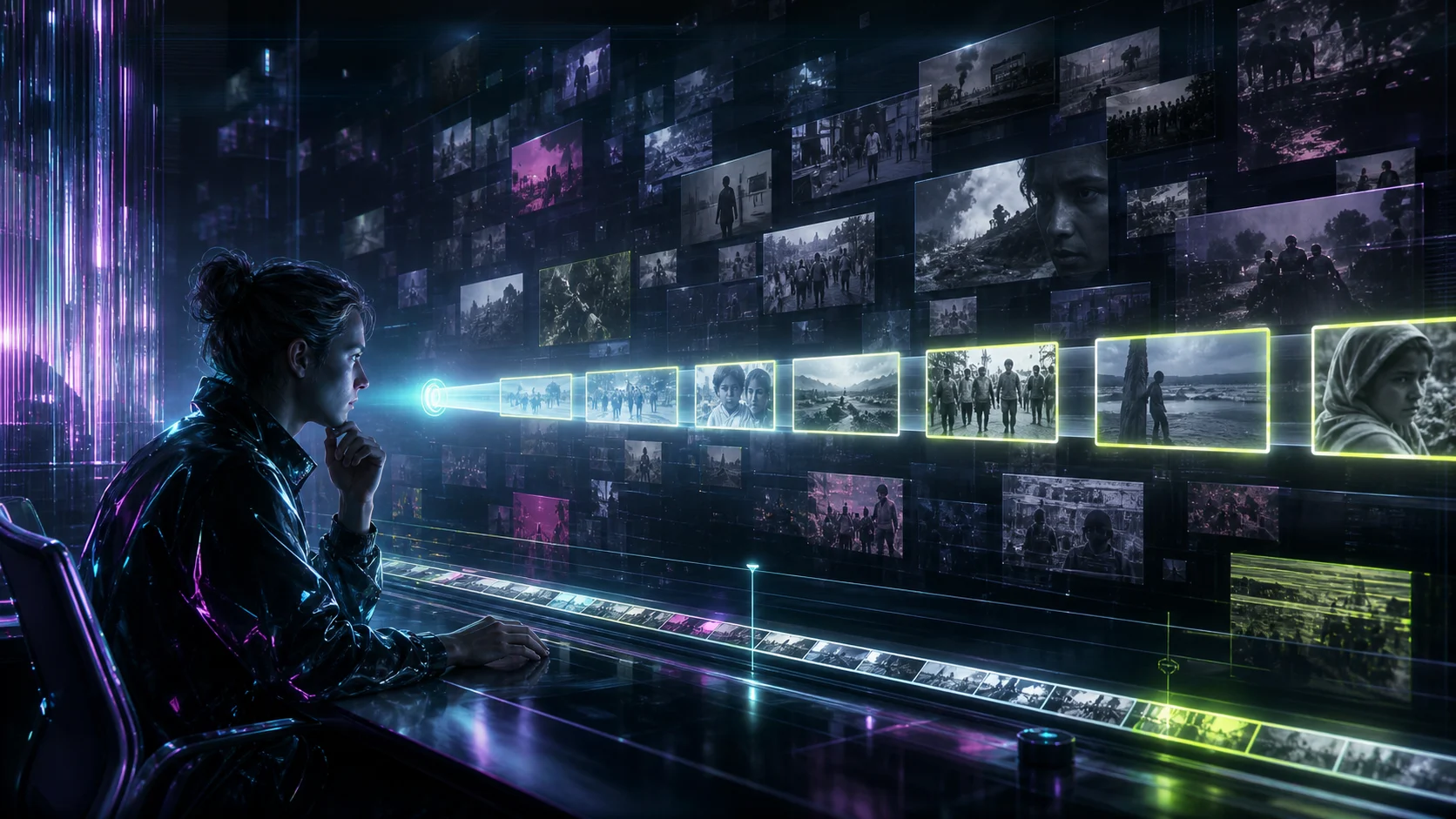
A documentary editor watches a search beam select a narrow row of frames from a much larger visual archive.
A search result is already an edit: it makes one path through the archive bright and leaves the rest in shadow.
/blog/eleven-terabytes-are-not-a-story/search-is-the-first-cut.webp
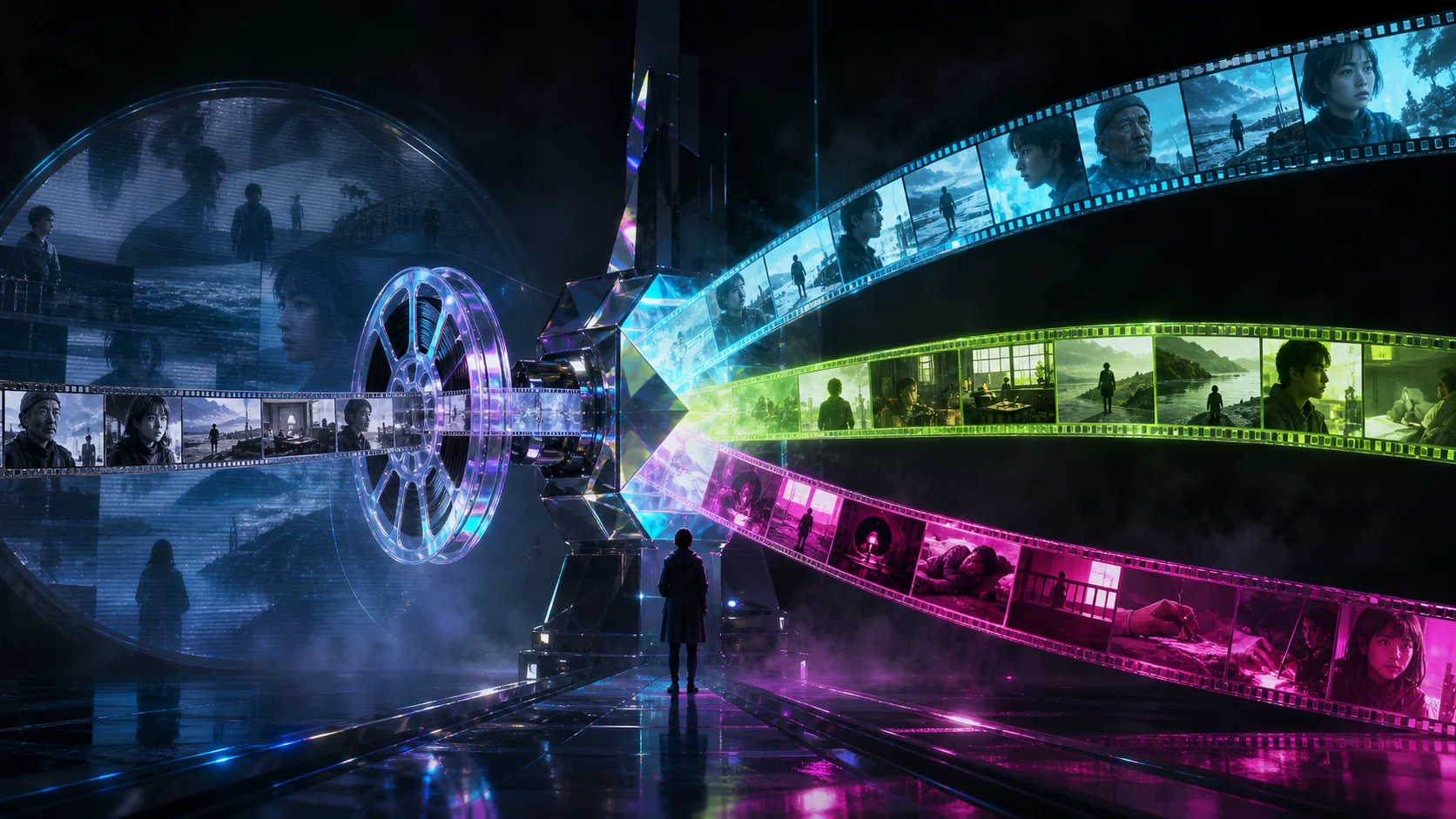
A single reel of documentary footage passes through a crystalline machine and branches into three differently ordered timelines.
The same real frames can support several incompatible stories. Coherence is not the same thing as truth.
/blog/eleven-terabytes-are-not-a-story/competing-narratives.webp
Structure changes
How the article changed as an object, not only as a sequence of sentences.
6 changed measures
Words
-992
Content blocks
+80
Sections
-2
Paragraphs
+87
Images
-3
Lists
-2
Article changes
Visual blocks are rendered as previews; other blocks retain the editorial diff.
200 changed blocks
A solitary editor inside a luminous vault of hard drives and suspended documentary frames.
Eleven terabytes can hold thousands of possible films. Storage alone does not decide which one is true.
/blog/eleven-terabytes-are-not-a-story/archive-vault.webp
I connected a twelve-terabyte hard drive and asked a simple question: what is on this thing?
The disk was 94 percent full. It contained more than seven million accessible files, folders, and links. Five terabytes belonged to a folder called `Footage`, arranged by years from 2010 to 2018. Almost two terabytes lived inside old Final Cut Pro libraries. There were folders called `Estonia`, `Taiwan`, `MinaKia`, `Libraries`, `Backups`, and `__Currr`. Inside them were university projects, documentaries, art projects, interviews, travel, 3D scenes, websites, television downloads, old Mac backups, and the generated remains of edits completed years ago.
At least 26,000 video files were visible to the system index.
The root of the disk looked less like storage than a biography written in folder names.
I had accumulated enough footage to make many films, yet I could no longer say with confidence what most of it contained. I remembered the projects. I remembered some people, locations, and periods. I remembered that certain years had been intense. But memory had compressed the archive more aggressively than any video codec. Entire projects had become one image. Weeks of recording had become a feeling. Thousands of clips had become “Taiwan” or “São Tomé” or “that thing with Elsa.”
Before disconnecting the disk, I made a catalog. A small program walked through every accessible directory and recorded each relative path, file type, size, modification time, and link target. More than eleven terabytes of material became a 96-megabyte compressed index.
The catalog could tell me that a file existed. It could tell me where it was, how large it was, and whether another disk later contained something with the same path, size, and timestamp.
It could not tell me what happened.
It did not know who the people were, why I had filmed them, what had changed since then, whether a conversation was private, which translation was correct, which project had been abandoned, or why one apparently ordinary shot still remained in my memory. It could not distinguish a failed take from the only surviving record of a place. It could not tell whether two people shown together trusted each other, whether the camera had changed their behaviour, or whether the absence of somebody from the footage mattered more than the presence of everyone else.
A catalog is not a memory.
It is an address system for things that may become memories again.
This is where AI-assisted documentary editing becomes genuinely interesting. The newest editing systems are beginning to make large archives answerable. Final Cut Pro can search footage for spoken phrases, objects, and actions. Premiere can analyse clips locally and retrieve visual moments through natural-language descriptions. DaVinci Resolve can search both images and transcripts. Dedicated AI editing tools can turn interviews into logs, paper edits, stringouts, and rough narrative assemblies.
The old archive begins to behave like a new medium.
Instead of opening clips one by one, I could ask for every conversation about leaving São Tomé. I could look for markets at night, people waiting beside roads, empty classrooms, rain on windows, boats approaching shore, someone laughing immediately after a difficult answer, or every time a speaker changes from Portuguese to English. I could ask for the earliest and latest appearance of the same place. I could search across projects that were never intended to belong together.
For most of cinema history, the cost of retrieval shaped the edit. An editor could only watch so much. Assistants created logs, transcripts, cards, reels, bins, selects, and contact sheets because unstructured footage was functionally invisible. Material might exist in the archive and still have no practical route into the film. What could be found could be considered. What could not be found was almost equivalent to what had never been filmed.
AI changes that relationship.
The search field is becoming the first cut.
A documentary editor watches a search beam select a narrow row of frames from a much larger visual archive.
A search result is already an edit: it makes one path through the archive bright and leaves the rest in shadow.
/blog/eleven-terabytes-are-not-a-story/search-is-the-first-cut.webp
That sounds like a productivity improvement, but it is also an editorial intervention. Every search system contains a theory of relevance. A transcript model privileges speech it can recognise. A visual model privileges objects and actions it has learned to name. A face cluster privileges people who appear often enough and clearly enough to become consistent. A summarisation model privileges statements that can be made coherent in text. A rough-cut model privileges footage that resembles the structures it understands as a story.
The interface does not merely help the editor find history.
It begins deciding which history is findable.
This becomes obvious in a multilingual archive. Final Cut Pro's transcript search currently works with English. That is still useful, but it would make the English-speaking parts of my archive dramatically easier to retrieve than the Portuguese, Mandarin, Estonian, Spanish, or other speech around them. English speakers would become searchable characters. Everyone else would remain mostly visual until another transcription system processed them.
The technical limitation could become an editorial bias without anybody deliberately choosing one.
Premiere, Resolve, and specialist transcription systems support more languages, but support is not the same as understanding. Accents, code-switching, local names, overlapping voices, poor microphones, wind, music, and historical context all affect what becomes legible. A mistranscribed place name may disappear from search. A joke translated literally may become evidence of something nobody meant. A speaker label can turn two people into one. A confident summary can remove the uncertainty that made an answer honest.
Documentary editing has always involved interpretation. The difference is that interpretation is moving earlier, into the systems that prepare the material before the editor watches it.
This is why “make a documentary from this footage” is the wrong first prompt.
An AI system can make something that looks like a documentary. It can find emotionally charged statements, alternate interviews with atmospheric images, create escalation, identify a turning point, and end on a line that sounds conclusive. Given enough material, it can probably construct several incompatible films that all feel persuasive.
Coherence is not difficult when the archive is large.
Truth is harder.
A documentary is not a summary of everything on a disk. It is a claim about reality made through selection, sequence, duration, omission, sound, and trust. The same interview can become evidence of resilience, failure, exploitation, nostalgia, hypocrisy, or change depending on what appears before and after it. A pause can become uncertainty or thoughtfulness. A reaction shot recorded at another moment can become judgment. A sentence can become more definite when the qualification before it is removed.
AI is especially good at producing coherence. That may make the first rough cut both useful and dangerous.
The machine does not have to fabricate a frame to create a false account. It only has to assemble real frames into the wrong certainty.
A single reel of documentary footage passes through a crystalline machine and branches into three differently ordered timelines.
The same real frames can support several incompatible stories. Coherence is not the same thing as truth.
/blog/eleven-terabytes-are-not-a-story/competing-narratives.webp
The most valuable role for AI is therefore not autonomous director. It is tireless assistant editor with unusually powerful retrieval.
I would want it to begin by making the archive inspectable. Identify formats, durations, dates, duplicate files, missing media, broken links, languages, likely interviews, long recordings, camera-card structures, and projects that already contain human editorial decisions. Preserve the old Final Cut libraries instead of treating every source clip as if it had never been seen before. Generate proxies on a separate working drive. Keep the original archive read-only.
Then transcribe speech while preserving the source clip and timecode for every word. Separate transcription from translation. Mark uncertain passages rather than smoothing them into confident language. Let a person familiar with the language correct names and consequential statements.
Then build logs, not films.
For each interview, produce themes, people, places, dates, claims, contradictions, strong moments, unclear references, and questions that require follow-up. For visual material, describe shots without pretending that description explains significance. “Three people sitting outside a blue house” may be useful retrieval metadata. It is not yet an interpretation of why they are there.
Then ask for stringouts. Every answer about migration. Every description of the same event. Every moment in which two accounts disagree. Every reference to a person who never appears on camera. Every shot of a place before and after a visible change. Every statement that sounds central, with thirty seconds of context on both sides.
This is where AI could save months.
It can also create a form of documentary query that would have been impractical before. Instead of searching only for evidence that supports an emerging thesis, the editor can ask for counterevidence. Find statements that contradict this claim. Find earlier versions of the story. Find moments in which the same speaker expresses uncertainty. Find footage that suggests the apparent ending was not an ending. Find material excluded from the current cut and explain which themes disappear with it.
The archive can become an argumentative partner rather than a warehouse.
I would still want a record of every AI-assisted decision. Which model created the transcript? Which language was selected? Which query produced the clip? Was the source automatically translated? Did a human verify it? Was the material public, private, commissioned, abandoned, or recorded under assumptions that no longer hold? Does the person shown understand that footage from fifteen years ago may now appear inside a new story?
These questions do not fit naturally inside a timeline, but they belong inside the editing system.
An AI documentary tool should probably contain a claims table beside the cut. Each important assertion would link to the clips supporting it, the clips complicating it, the translation status, the people responsible for verification, and the permissions governing its use. The film would remain an artistic object, but its relationship to the archive would become more inspectable.
This matters because scale changes temptation. When an archive contains a few hours, an editor may remember the context around every scene. When it contains decades, countries, languages, and tens of thousands of clips, the retrieved moment can arrive detached from the conditions that gave it meaning. AI makes the moment easier to find at exactly the same time that it makes context easier to lose.
The archive also contains previous versions of me.
There is the person who pointed the camera, the person who named the folder, the person who made the first edit, the person who abandoned the project, and the person opening the disk years later with different interests and values. AI adds another participant: a system trained elsewhere, arriving now, interpreting material recorded before its categories existed.
That does not make the system illegitimate. Editors have always used tools, assistants, conventions, and institutions that shape what they see. The important difference is whether the shaping remains visible.
I do want to see what AI can make from the footage.
Not because I expect it to discover the documentary hiding intact inside eleven terabytes. There is no documentary hidden there. There are recordings, earlier edits, missing explanations, private memories, duplicate files, technical debris, and several possible stories competing for attention.
The promise of AI-assisted editing is not that the machine finally watches everything so I do not have to.
It is that I can begin asking the archive better questions.
The human work starts with deciding which questions deserve a film.
A practical starting workflow
1. Preserve the original archive and work from a second disk. 2. Build a metadata catalog before changing library formats or folder structures. 3. Create proxies, transcripts, visual indexes, and caches on a separate fast SSD. 4. Divide the archive by documentary question, period, place, or group of people rather than importing everything into one AI project. 5. Ask AI for logs, paper edits, counterevidence, and source-linked stringouts before asking for a narrative cut. 6. Keep original clip names and timecodes attached to every quotation and translated passage. 7. Verify consequential speech with a human who knows the language and context. 8. Track consent, ownership, uncertainty, and contradictory material alongside editorial status. 9. Treat AI assemblies as reversible proposals, not accounts of what happened. 10. Finish the documentary with people who can take responsibility for its claims.
Connected reading
- [The Real Bottleneck Is Human Attention](/blog/the-real-bottleneck-is-human-attention) - [The Biggest Stories in the World Are Not Always in English](/blog/the-biggest-stories-in-the-world-are-not-always-in-english) - [The Algorithm Thinks Your Past Is Your Personality](/blog/the-algorithm-thinks-your-past-is-your-personality) - [The Interface as an Archaeological Site](/blog/the-interface-as-an-archaeological-site) - [Raw Drafts Are a Form of Learning](/blog/raw-drafts-are-a-form-of-learning)
I connected a twelve-terabyte hard drive and asked a simple question.
What is on this thing?
The disk was 94 percent full.
More than seven million accessible files, folders, and links.
Five terabytes inside a folder called `Footage`.
2010.
2011.
2012.
2013.
2014.
2015.
2016.
2017.
2018.
Almost two terabytes inside old Final Cut Pro libraries.
Folders called `Estonia`, `Taiwan`, `MinaKia`, `Libraries`, `Backups`, and `__Currr`.
At least 26,000 video files.
I looked at the folder names and recognized my life.
University projects. Documentaries. Art projects. Interviews. Travel. Websites. 3D scenes. Old Mac backups. Television downloads. Edits I had finished and edits I had apparently never finished.
I remembered the projects.
I did not remember the footage.
I remembered São Tomé.
I remembered Taiwan.
I remembered some people and some rooms and some years that felt very long while I was living through them.
But entire projects had become one image in my head.
Weeks of recording had become a feeling.
Thousands of clips had become names like “Taiwan” or “São Tomé” or “that thing with Elsa.”
I had enough footage to make many films and I could no longer tell you what most of it contained.
So I made a catalog.
A small program walked through the drive and wrote down what it could see.
Path.
File type.
Size.
Modification time.
Link target.
More than eleven terabytes became a 96-megabyte compressed index.
That felt strange.
The computer now knew where almost everything was.
It could tell me that a file existed.
It could tell me how large it was.
It could tell me when it had been modified.
It could later tell me if another disk contained something with the same path, size, and timestamp.
But it could not tell me what happened.
It did not know who the people were.
It did not know why I had filmed them.
It did not know which conversation was private.
It did not know which translation was correct.
It did not know why I had stopped working on something.
It did not know why one ordinary shot had stayed in my memory for fifteen years while another entire project had disappeared.
It could not tell whether two people in the same frame trusted each other.
It could not tell whether somebody behaved differently because I was holding a camera.
It could not tell whether the person missing from a scene mattered more than the people who were there.
The catalog was very good.
The catalog knew nothing.
I started thinking about what would happen if I let AI into the archive.
Not “make me a documentary.”
Something smaller.
Find every conversation about leaving São Tomé.
Find markets at night.
Find people waiting beside roads.
Find empty classrooms.
Find rain on windows.
Find boats approaching shore.
Find someone laughing immediately after giving a difficult answer.
Find every moment when somebody changes from Portuguese to English.
Find the first time a place appears.
Find the last time the same place appears.
Find people I filmed years apart.
Find things I have forgotten enough that I no longer know how to search for them.
That last one is harder.
You can only ask a machine for something if you have some language for it.
Maybe the archive contains the most important scene I ever filmed and I remember it only as a color.
Maybe I remember the person but not the place.
Maybe I remember the place but not why we were there.
Maybe I remember nothing.
The search field would already be part of the edit.
What I ask for becomes visible.
What I do not ask for stays buried.
The machine adds another problem.
Some parts of the archive are easier for it to understand than others.
English is easier than Portuguese in some tools. Clear speech is easier than wind. One person speaking is easier than people talking over each other. A common object is easier than a local reference. A sentence is easier than a silence.
If the English-speaking people become searchable first, they become easier to put into the film.
Nobody has decided they are more important.
They are just easier to find.
The technical limitation quietly becomes an editorial decision.
I imagined asking for every answer about migration.
Then every answer that contradicts those answers.
Every time the same person tells the story differently.
Every moment of uncertainty before a statement that later sounds certain.
Every reference to a person who never appears on camera.
Every shot of a place before and after something changed.
Every clip that would make the film I am currently imagining harder to defend.
That is the part that interests me.
Not AI making the film.
AI making it harder for me to pretend I already know what the film is.
The archive contains older versions of me too.
There is the person who pointed the camera.
The person who named the folder.
The person who made the first edit.
The person who abandoned it.
The person opening the hard drive years later.
They do not necessarily agree.
One of them thought something was important enough to film for three hours.
Another one never used it.
Another one forgot it existed.
Now I am asking a machine trained somewhere else to look through all of them.
At first I wanted to know if AI could watch everything so I would not have to.
That now seems like the least interesting version of the idea.
Watching everything is not the same as knowing what happened.
A system could probably find emotional statements, put beautiful images between them, locate a turning point, and end on something that sounds final.
The archive is large enough that many incompatible films could be made from it.
All of them could use real footage.
All of them could feel convincing.
That is what makes it dangerous.
You do not need to fabricate a frame to make something false.
You only need to put real frames together with too much certainty.
So I do not want the machine to tell me what the archive means.
I want it to tell me where things are.
Show me the source clip.
Show me thirty seconds before the quote.
Show me thirty seconds after it.
Show me the first version of the story.
Show me the other person describing the same day.
Show me what I left out.
Show me what contradicts the sentence I am beginning to believe.
The hard drive was still sitting next to me.
Twelve terabytes.
94 percent full.
More than seven million entries.
At least 26,000 videos.
I had started with the question: what is on this thing?
The computer had answered.
Then I had another question.
What happened?
I disconnected the drive.
The catalog stayed on my computer.
Ninety-six megabytes.
Eleven terabytes had become searchable.
I still did not know what the story was.
AI authorship note
This essay began when Kris Haamer connected a nearly full twelve-terabyte archive, asked what it contained, created an offline catalog of more than seven million accessible entries, and then asked whether AI could edit the footage into a documentary. AI supported the disk analysis, current product research, argument development, drafting, editing, illustration, and publishing workflow. Kris supplied the archive, lived context, documentary question, and publication direction, and retains responsibility for reviewing the claims and choosing whether the piece is published.
This piece began when Kris Haamer connected a nearly full twelve-terabyte archive, cataloged more than seven million accessible entries, and asked whether AI could help turn years of footage into documentary material. This version was rewritten with AI from Kris's original draft and archive notes, preserving the reported details while moving the writing closer to memory, field notes, and reconstructed thought. Kris remains responsible for the account and for deciding what, if anything, becomes a film.