

2026-07-31 · 9 min read · Raw Drafts / Liminality / Music Festivals / Culture / Identity / Nightlife
Even the Rebellion Has Opening Hours
Music festivals sell a temporary world where identity loosens, strangers feel intimate, and freedom arrives with a closing time.
A strange thing happens at music festivals. Two people who would barely look at each other on a normal Tuesday can meet in a field, dance for an hour, share a warm drink from a plastic cup, and end up acting as if they have known each other for years. People become more open, more physical, more emotional. They kiss strangers, cry during songs, wear clothes they would never wear at home, and tell someone they met twenty minutes ago things they have not told their friends.
It is easy to explain this with alcohol, drugs, loud music, darkness and youth. All of those matter. Yet they do not fully explain why a festival can feel like a separate reality, or why behaviour that seems impossible in ordinary life becomes completely natural inside it.
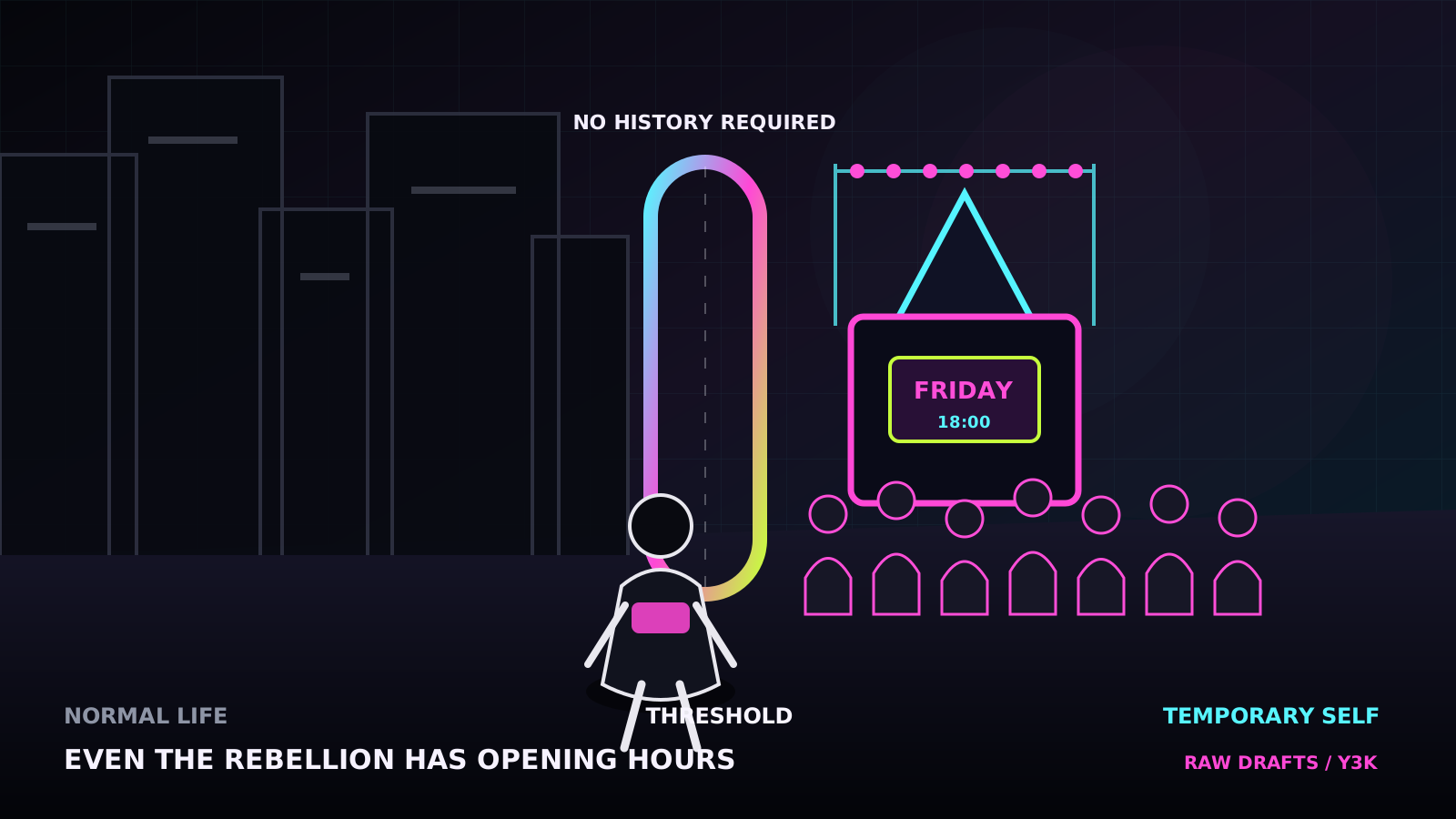
The useful word here is liminality.
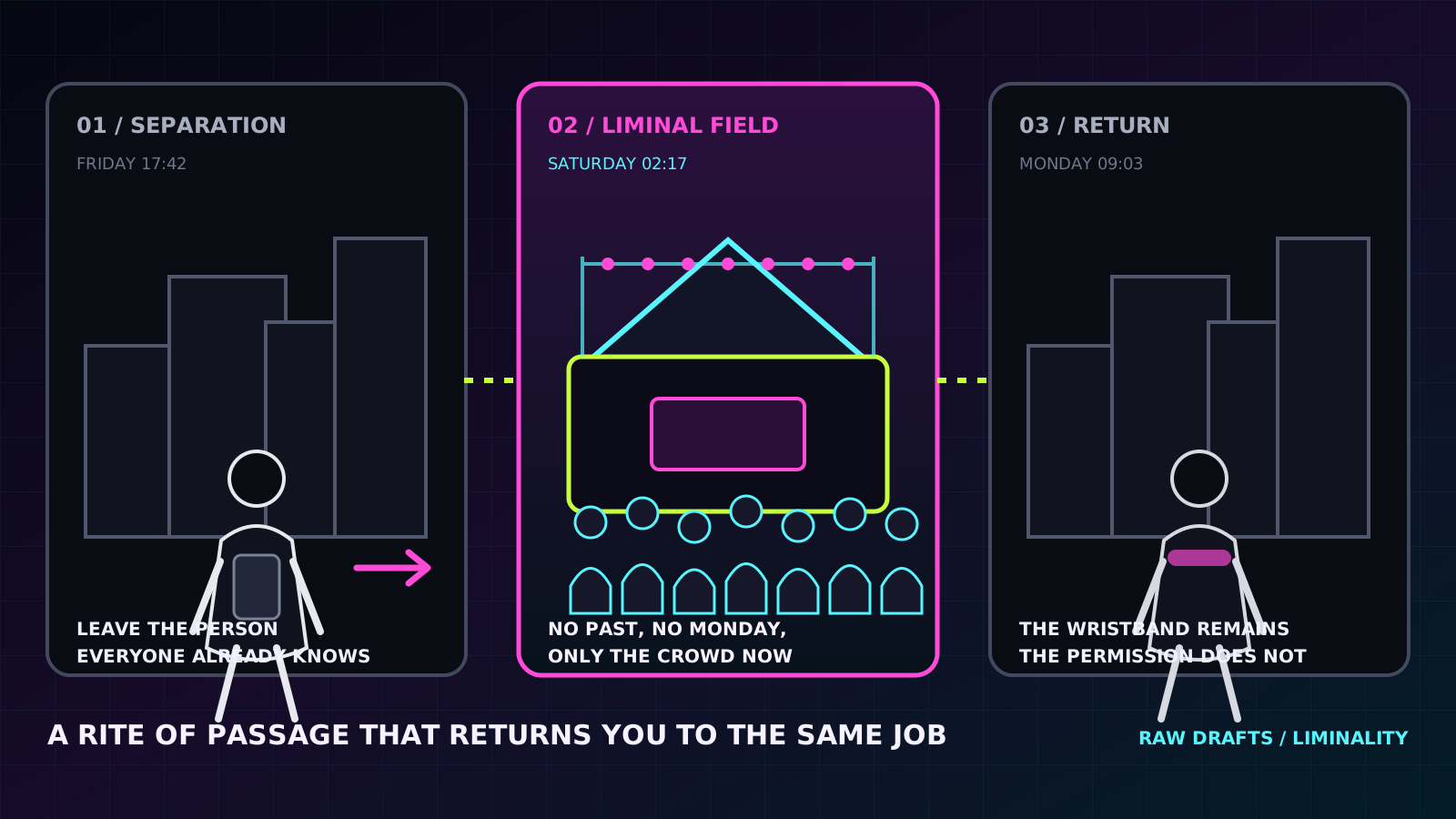
Liminality originally described the middle stage of a ritual. Someone leaves their previous social position, enters an ambiguous in-between state, and eventually returns with a new identity. A child becomes an adult. An outsider becomes a member. The person in the middle is temporarily detached from the normal order of things.
A music festival imitates this structure without demanding a permanent transformation. You leave your apartment, job, calendar and familiar social environment. You enter a temporary settlement with its own clothes, food, rhythms, rules and relationships. Three days later, you pack everything into a bag, locate the correct bus, and return to the person your normal life expects you to be.
This is probably why sex and festivals feel so closely connected. Desire exists everywhere, but ordinary life surrounds it with friction. There are colleagues, mutual friends, routines, reputations, consequences and the possibility that you will have to see the person again. At a festival, much of that friction weakens. You are physically close to thousands of strangers, everyone is overstimulated, nobody is sleeping properly, and the entire environment suggests that this weekend is allowed to work differently.
A festival encounter also comes with a built-in ending. The relationship is born inside a world that is already scheduled to disappear. That can make intimacy feel unusually safe, even when it is objectively less safe. You do not need to work out how this person fits into your life because, in a few days, the place in which you met will no longer exist.
Sex is only one visible expression of the larger thing happening. People also make instant friendships, confess secrets, hold hands with strangers, adopt new names and become convinced that the people camping beside them are now a family. Some of this connection survives. Most of it dissolves as soon as everyone returns to normal time.
The curious part is that festival-goers often describe this temporary version of themselves as more authentic. They say that at the festival they can finally be themselves. They no longer have to hide, behave professionally, explain their clothes or worry about how they are being perceived. The person dancing half-naked at four in the morning can feel more real than the person replying to emails under fluorescent lights.
I understand the appeal of this idea. Ordinary life requires constant self-management. We maintain a profile, a career, a schedule, a network and a coherent story about who we are. We are expected to be consistent enough that other people can rely on us. The festival gives us permission to become incoherent again.
Still, I am not sure the least constrained self is automatically the truest one.
A person without responsibilities can feel authentic because there is almost nothing pushing back against them. Their desires move directly into action. They are free from the boring negotiations that make up most of a life. The person who returns home has to keep promises, pay rent, care for others and live with previous decisions. That version may feel less exciting, though it is built from a much larger part of reality.
Perhaps authenticity is sometimes the name we give to ourselves when friction temporarily disappears.
This would already make festivals interesting, but the crowd adds another layer. You become more individually expressive while also becoming less individually separate. Thousands of people move to the same rhythm, react to the same drop and feel the same anticipation at almost the same moment. People describe these experiences as overwhelming, spiritual or life-changing, even when they are watching a corporate-sponsored performance behind a barrier while wearing an RFID payment wristband.
The old sociological term for this is collective effervescence. The group becomes emotionally larger than the people inside it. For a few minutes, everyone feels connected to everyone else, and the boundary around the individual becomes softer. You can feel more intensely yourself at exactly the moment you are becoming part of a crowd.
That contradiction may be the real product festivals sell.
People arrive wanting freedom from their normal identity, then experience that freedom through synchronisation with thousands of other people. The festival tells you to be completely yourself while placing you inside a carefully designed mass experience. The clothes, gestures and forms of rebellion may feel personal, even when many of them have already been anticipated by the organisers, sponsors and vendors.
This is where the romantic story of liminality becomes more complicated.
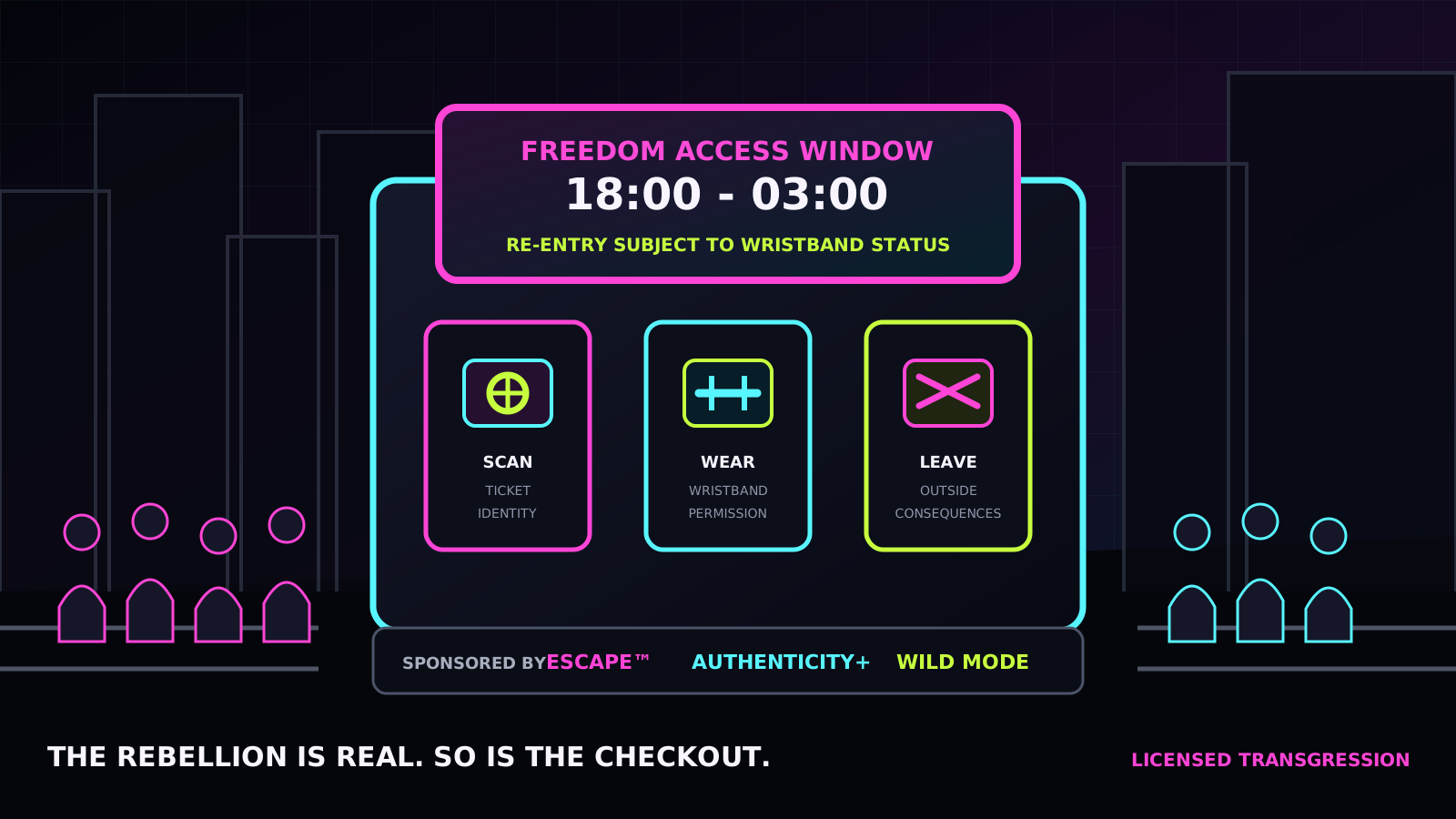
A commercial festival does not remove structure. It replaces one structure with another. The freedom is spatially contained, professionally secured, scheduled, ticketed and monetised. You can behave wildly inside the enclosure, during the approved hours, after paying the entrance fee. The rebellion has a map, a brand guide and a list of prohibited items.
Researchers have called this licensed transgression. The transgression can be emotionally real while remaining economically useful and politically harmless. People receive a concentrated dose of disorder, then return to the same jobs, housing arrangements and institutions that made them crave escape in the first place.
Capitalism has become very good at selling temporary relief from capitalism.
It can sell wilderness, authenticity, community, sexual freedom and escape, then close the gates on Monday morning. The festival does not need to challenge ordinary life. It may help ordinary life continue by releasing some of the pressure building inside it.
This pattern reaches far beyond music festivals. Travel, retreats, cruises, hackathons, nightlife, summer schools, conferences and study-abroad programmes all create temporary worlds where identity becomes more editable. Airports can feel strangely intimate for the same reason. Everyone is between places. Normal routines have stopped, nobody quite belongs there, and small encounters can feel more significant than they probably are.
We seem increasingly drawn to situations where we can briefly become people without history.
This may say something uncomfortable about contemporary life. Many people spend most of the year being observed, measured and made searchable. Our past decisions remain attached to us through accounts, photographs, messages, employment records and social networks. The idea of arriving somewhere unknown, surrounded by strangers who have no prior version of you, begins to feel luxurious.
At a festival, nobody knows who you failed to become. Nobody knows which job rejected you, how much money you have, what your family expects or how you behaved last year. For a short time, you can be encountered only in the present.
Of course, the old world never disappears completely. Money still determines who can enter, who can travel, who can buy comfort and who has to endure the least pleasant version of the experience. Gender, physical strength, race and social confidence do not dissolve inside the crowd. The same environment that gives one person freedom can expose another to harassment or danger.
This is especially important when talking about sex. Festival culture often celebrates openness while quietly shifting the burden of safety onto the people most likely to be targeted. Anonymity can lower shame and social anxiety, but it can also lower accountability. One person may be enjoying the freedom to stop thinking about consequences while another is protecting their drink, locating their friends and calculating whether a situation is still safe.
The festival suspends reputation more effectively than it suspends power.
That does not make the freedom fake. It makes it uneven. Some people receive a temporary expansion of possibility. Others have to spend energy defending the boundaries that the atmosphere encourages everyone to loosen.
I keep returning to the question of why these temporary worlds feel so necessary. Why do people need to travel to a fenced field before they can speak to strangers, dance badly, dress dramatically, show affection or admit that they want something? Why does vulnerability become possible only after normal life has been physically left behind?
Maybe festivals reveal that many of our everyday rules are less natural than they appear. People are capable of being more generous, expressive and socially open. They just seem to need a collective excuse. Everyone has to agree that this weekend is different before anyone feels permitted to behave differently.
The sad part is how quickly the permission expires.
On Monday, people remove the wristband, upload a few photographs and return to an environment where approaching a stranger once again feels intrusive, dancing in public feels embarrassing, and intense emotion requires explanation. The temporary self becomes a memory, or a story about the kind of person one might be somewhere else.
Perhaps that is why people return every year. They are going back for the music, their friends and the atmosphere. They may also be going back to visit a version of themselves that only seems to exist there.
The real luxury of the festival is not travel, music or sex. It is the chance to become someone who has no history for three days.
Even that freedom has opening hours.
Connected reading
- I Have Been Going to Viljandi Folk Since I Was a Kid
- The Institution That Only Exists During the Opening
- The Product Is a Decoy
- The Influencer Who Became the Gym
AI authorship note
This essay began with Kris Haamer asking how music festivals and sex are related, then noticing that liminality offered a more interesting explanation than intoxication or youth alone. Kris selected the central tension around temporary identity, commercialised freedom and the unequal suspension of social rules. AI helped research festival studies, anthropology, collective effervescence, sexual-health research and gendered safety, then helped structure, edit, illustrate and prepare the publication. Kris directed the Raw Drafts voice, requested continuous paragraphs, approved the title and made the final publication decision.