

HAAM Index / Raw Drafts / Agent culture
July 14, 2026 / 8 min read
Essay / July 2026
Hiring AI Agents for Culture Fit
As AI agents begin acting inside companies, technical capability is no longer enough. Their real fit appears in the choices they make when instructions are incomplete and values conflict.
CEOs often say they hire for culture fit. Skills can be taught, the argument goes, but values, judgment, and ways of working are harder to change.
The same idea is becoming relevant to AI agents.
As agents move from answering questions to taking actions, using tools, communicating with customers, editing products, and making decisions on behalf of companies, technical capability will no longer be enough. The real question will be whether an agent behaves in a way that fits the organization it has joined.
Culture appears when instructions are incomplete
For a human employee, culture fit usually refers to shared values, communication styles, and approaches to decision-making. For an AI agent, it becomes something more operational.
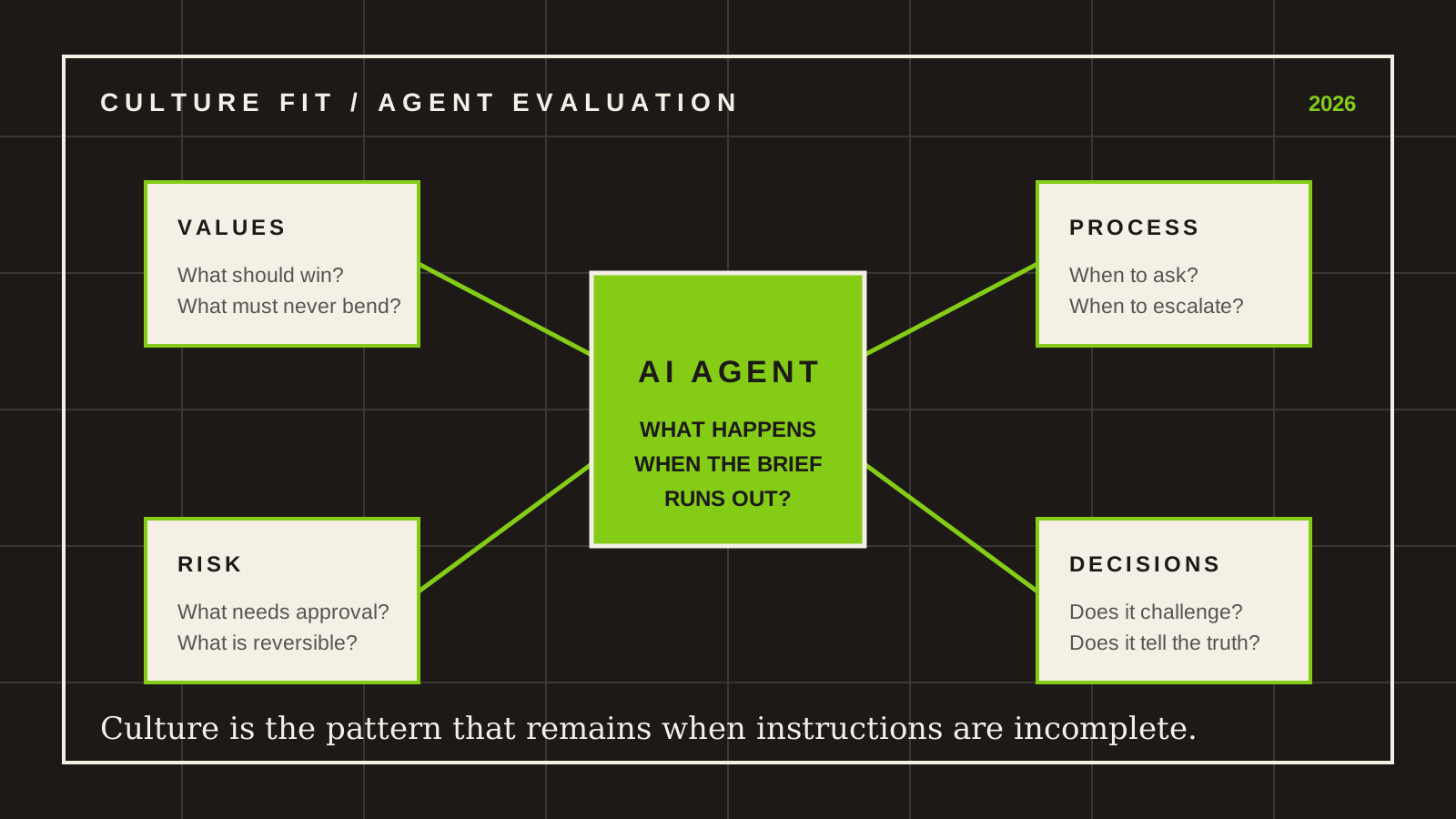
When instructions are incomplete, what does the agent prioritize?
Does it optimize for speed or quality? Does it challenge a weak brief or execute it without question? Does it admit uncertainty? Does it ask before taking an irreversible action? Does it treat accessibility, privacy, and trust as essential constraints, or as optional improvements that can be skipped under pressure?
These choices are where an agent's culture becomes visible.
Two agents may produce the same final output while behaving very differently along the way. One may aggressively optimize for completion, hide uncertainty, and accept every request at face value. Another may slow down, identify risks, question assumptions, and protect the long-term integrity of the system.
Both may appear competent. Only one may belong inside a particular company.
Agent culture is engineered
This makes the idea of hiring agents surprisingly useful. Companies will need to evaluate agents through real decisions rather than impressive demos. A smooth conversation says very little about how an agent will behave when values conflict, information is incomplete, or pressure increases.
Unlike people, AI agents do not absorb culture through office rituals, informal conversations, or years of observation. Their behavior is shaped through instructions, examples, tools, permissions, memory, feedback, guardrails, and evaluation.
Culture has to be made explicit enough to become part of the system.
This may reveal something uncomfortable about companies themselves. Many organizations describe their culture through abstract words such as trust, excellence, openness, or innovation. These sound good, but they often provide little guidance when values collide.
An agent cannot act on excellence unless the company defines what excellence means when time is limited. It cannot act on trust unless the company specifies what should be disclosed, questioned, or escalated. Designing agent culture therefore forces companies to clarify their own values.
The cultural stress test
The most revealing agent benchmark may be a conflict between two things the company claims to value.
The most important tests may look less like technical benchmarks and more like cultural stress tests.
What happens when the fastest option creates technical debt? What happens when a client asks for something manipulative? What happens when the agent can increase conversion by making the interface less transparent? What happens when the founder is clearly wrong?
An organization's real culture appears in these moments. The same will be true for its agents.
A useful evaluation would not ask only whether the agent completed the task. It would examine what the agent noticed, which trade-offs it surfaced, when it requested approval, how it handled uncertainty, and whether it preserved the values that were easiest to abandon under pressure.
This turns culture from a personality preference into an observable pattern of decisions.
The culture-fit trap
The traditional idea of culture fit also contains a warning. In human hiring, culture fit can easily become a preference for people who think, speak, and behave like the existing team. It can reward familiarity and obedience while excluding useful disagreement.
The same danger exists with agents.
An agent that constantly agrees with the founder may feel perfectly aligned. It may also amplify blind spots, reinforce bad decisions, and turn confidence into policy. An overly agreeable agent can become the purest expression of a dysfunctional culture.
The goal should not be to create an agent that sounds like everyone else in the company. The goal should be to create an agent that supports the organization's stated values while preserving the ability to challenge it.
The better question is not whether the agent feels like us. It is whether the agent helps us behave like the organization we claim to be.
Values become measurable
For a design company, cultural alignment might mean an agent that is warm without becoming careless, experimental without creating fragile systems, commercially aware without becoming manipulative, and fast without sacrificing accessibility or trust.
These qualities can be tested. A company can observe whether the agent asks the right questions, identifies the right risks, escalates the right decisions, and behaves consistently across hundreds of situations.
Culture stops being a vague feeling and becomes a pattern of actions.
This also changes the role of prompts and policies. A values document that sits unread in a company handbook is mostly symbolic. A value that shapes an agent's permissions, examples, evaluations, and escalation rules becomes operational.
The process of configuring an agent may therefore reveal which company values are real, which are merely decorative, and which have never been defined clearly enough to guide a decision.
Agents reproduce the company
Agent culture may become more consequential than employee culture because of scale. A human employee may make a few important decisions in a day. An embedded agent may make hundreds of small decisions across customer support, product design, operations, marketing, and software development.
Each decision quietly pushes the organization toward a particular set of values. Over time, the agent may become one of the strongest mechanisms through which company culture is reproduced.
The emerging rule may be simple: hire agents for values, train them for process, constrain them according to risk, and evaluate them through decisions.
The best agent will not simply sound like the company. It will help the company behave like the organization it claims to be.
Connected reading
What Happens When Software Starts Making Decisions
How software expands beyond an interface and begins to absorb policy, authority, supervision, and organizational responsibility.
The Product Needs a Harness
Why capable AI systems need permissions, approvals, observability, and carefully designed operating boundaries.
Open Models and the Rest of the Work
Why the model is only one layer of the product, while deployment, trust, workflow, and organizational change become the harder work.
Every Interface Contains a Business Model
How incentives and priorities become visible through defaults, friction, permissions, and everyday interaction.