

HAAM Raw Drafts · July 21, 2026 · 12 min read
The Ambulance Is Becoming an Interface
Estonia's planned two-person crews and Taiwan's regional hospital networks reveal a larger shift: emergency care is becoming a coordinated information system, not only a vehicle service.
01
The staffing story is actually a systems story
Estonia's plan to move toward mostly two-person ambulance crews sounds like a staffing reform. It is actually a redesign of the whole emergency-care system.
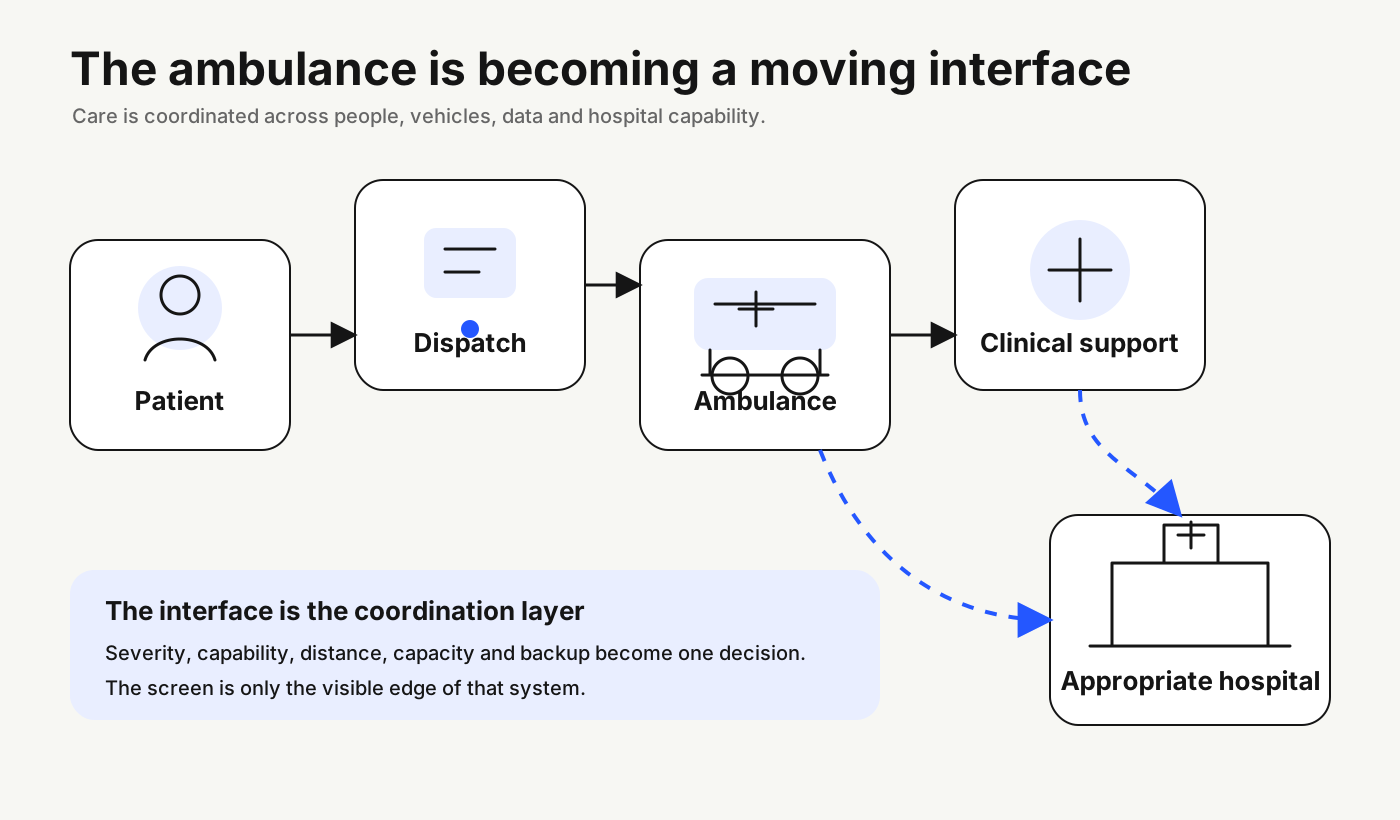
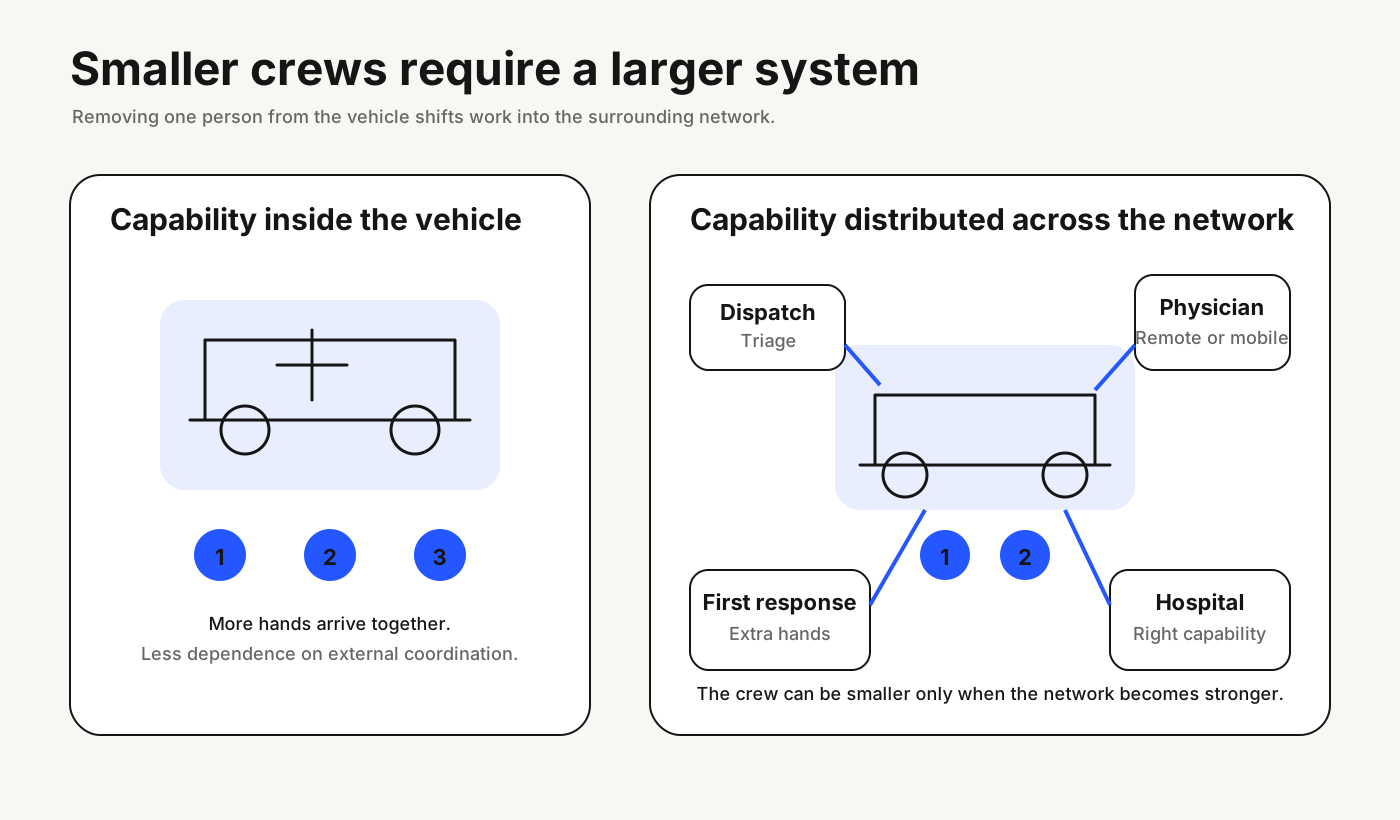
When one person disappears from the vehicle, documentation, communication, lifting, monitoring, medication preparation, hospital coordination, and scene management still need to happen. The work moves into software, dispatch protocols, specialist response units, hospital networks, and the hands of other responders.
The ambulance stops being a self-contained unit. It becomes the moving interface of a regional healthcare network.
02
The old mental model is a vehicle
Most people imagine an ambulance as a small emergency room on wheels. A call arrives, a crew drives to the patient, the crew provides treatment, and the patient is taken to a hospital.
The quality of the system appears to depend on three visible things: how quickly the ambulance arrives, how many people are inside it, and how quickly it reaches a hospital.
Modern emergency care is increasingly organized as a layered system. A basic crew may arrive first. A physician, specialist unit, fire crew, or helicopter may join later. The ambulance may transmit an ECG before moving. Dispatch may recommend a destination based on the patient's condition, specialist coverage, travel time, and hospital availability.
The important unit is no longer the ambulance. It is the network.
03
Estonia is moving capability out of the vehicle
Estonia's emergency medical strategy proposes four stronger operational regions and a network designed to maintain or improve access across the country. The controversial part is the planned shift toward mostly two-person crews.
The weak version of the reform removes one person and expects the remaining two to do the same work. The stronger version distributes more crews geographically, improves dispatch, adds clinical support, uses telemedicine, and sends additional capability when a case requires it.
Evidence on crew size is mixed. Some simulation research has found little difference between two-, three-, and four-person crews for several resuscitation measures. Other research has found three-person teams faster at time-critical actions. A recent scoping review concluded that two-person advanced resuscitation can work, but often depends on adaptations such as rapid backup, mechanical compression equipment, prefilled medication, and protocols designed specifically around smaller teams.
Two people can be enough. But two people is not a complete operating model.
04
Taiwan shows why the destination is part of the interface
Taiwan offers another side of the same transformation. Its regular ambulances are commonly operated by fire departments with small firefighter-EMT crews, but the more interesting development is the regionalization of emergency care.
Taiwan introduced nationwide emergency-care regionalization and a three-tier categorization of hospital emergency capability. Hospitals are not treated as interchangeable destinations. They are nodes with different levels of capability for trauma, cardiac emergencies, stroke, and critical care.
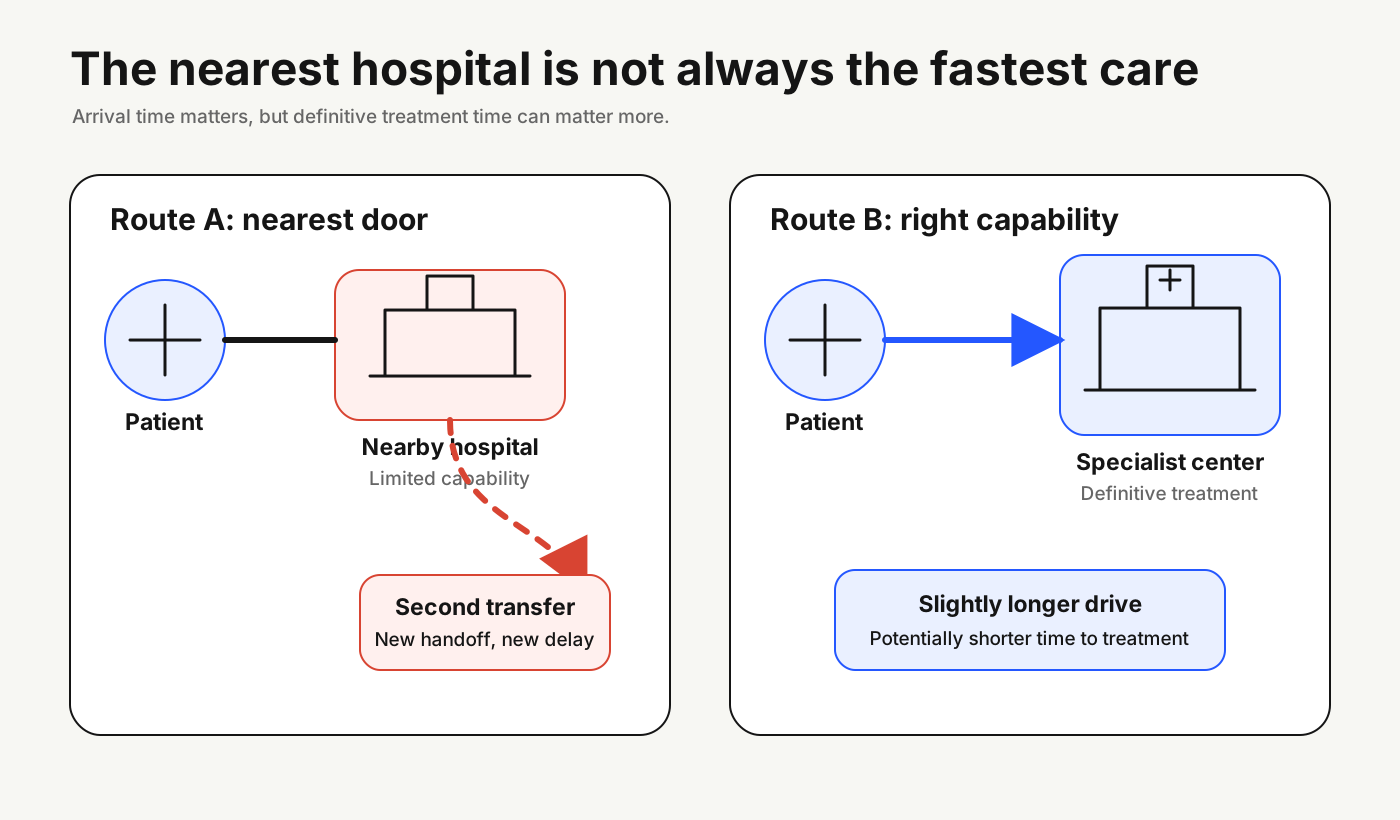
This changes the question inside the ambulance. The old question is which hospital is closest. The newer question is which reachable hospital can provide the treatment this patient is likely to need.
For a major heart attack, a nearby hospital without a catheterization laboratory may be geographically closer but clinically farther away. The patient can arrive quickly, wait for assessment, wait for another hospital to accept the case, be loaded into another ambulance, and then travel again.
A slightly longer direct journey to a specialist center may produce a shorter time to definitive treatment.
05
Capability and capacity are different
A hospital may own the correct equipment but still be unable to help at that moment. The specialist may not be on site. The operating room may be occupied. The intensive-care unit may be full. The scanner may be unavailable. The emergency department may be overloaded.
A destination screen therefore cannot simply show hospitals sorted by driving time. It must distinguish theoretical capability from live capacity, while also showing the uncertainty behind the recommendation.
A useful recommendation explains why a hospital was selected, which required capability it has, how much additional travel time is involved, whether the hospital has accepted the patient, and what alternative remains if the assessment changes.
This is not a route-planning app with a medical skin. It is safety-critical decision support.
| Decision | Old interface | Networked interface |
|---|---|---|
| Where to go | Nearest emergency department | Nearest appropriate and available capability |
| Who to send | Closest ambulance | Suitable crew plus predicted backup |
| What to show | Full patient record | Information needed for the next decision |
| When to escalate | Crew manually requests help | System anticipates complexity |
| How to measure speed | Time to hospital door | Time to definitive treatment |
06
Finland and Denmark show the surrounding system
Finland is probably the most relevant comparison for Estonia. Finnish ambulances commonly use two-person crews, while field commanders, first-response units, advanced clinicians, and physician-led helicopter teams add capability when required.
Denmark follows a similar network logic. Dispatch centers assess calls, ambulances work alongside paramedic and physician units, and prehospital information can be transferred directly to the receiving hospital.
These systems do not prove that smaller crews are automatically safe. They show what must exist around them: visible backup, reliable medical consultation, shared patient information, destination flexibility, and a receiving hospital that understands what has already happened before the doors open.
The crew size is visible. The coordination architecture is not.
07
Bad software can make the crew smaller twice
Healthcare digitization often promises to reduce workload. It can also create a second workload layered on top of the first.
A major UK study of electronic ambulance records found clinicians still writing observations on gloves, notebooks, or scraps before entering them into a device. The systems often worked mainly as stores for patient data rather than as useful tools for decisions, information transfer, or clinical handover.
A clinician can be treating a patient in a moving vehicle while the official digital interface is so poorly matched to the work that the glove becomes the real interface.
When an organization removes human capacity, it cannot compensate by adding forms. The interface must remove coordination work from the crew.
08
What the ambulance interface should actually do
The future ambulance interface should behave less like an electronic clipboard and more like a shared operational picture.
01
Prioritize the next decision
Show what needs attention now, not every field that may eventually be required.
02
Separate capability from capacity
Show whether a hospital can theoretically provide a service and whether it can accept this patient now.
03
Make backup visible
Show who is responding, their estimated arrival, and what skills or equipment they add.
04
Preserve the patient story
The caller, dispatcher, crew, remote physician, and hospital should not reconstruct the same case from zero.
05
Explain recommendations
The crew should understand why a destination or escalation is recommended, especially when it adds travel time.
06
Work in physical reality
Gloves, vibration, darkness, noise, interrupted connectivity, and divided attention are the environment, not edge cases.
07
Support reversal
The plan must be easy to revise when the patient's condition changes, without losing context or accountability.
09
The final interface is the behavior of the network
It is tempting to describe emergency care as a journey from a patient to a building. That is becoming the wrong diagram.
The ambulance now sits between the caller's incomplete description, the dispatcher's risk estimate, the crew's evolving assessment, remote clinical advice, live hospital capability, regional fleet coverage, and the needs of the next emergency that has not happened yet.
Sending the nearest ambulance may leave a rural area uncovered. Sending the patient to the largest hospital may overload a specialist center. Sending a two-person crew without early backup may save staffing on paper while increasing risk at the scene.
These are interaction-design decisions because they define how the system behaves when people try to act under pressure.
The final interface is not the tablet mounted inside the ambulance. The final interface is the behavior of the whole emergency-care network.
Sources and further reading
- Estonian Ministry of Social Affairs: Kiirabi arengusuunad aastani 2035 ↗
- Taiwan emergency-department regionalization and categorization policy evaluation ↗
- Two-member advanced life-support teams: 2024 scoping review ↗
- Taiwan STEMI emergency quality-improvement study ↗
- Taiwan trauma-center bypass and survival study ↗
- Finnish Rescue Services: Prehospital emergency medical care ↗
- Healthcare Denmark: Emergency medical services ↗
- NIHR: Electronic health records in ambulances ↗