

2026-07-29 · 4 min read · Raw Drafts / Interaction Design / Automation / Retail / Human Factors
The Checkout Robot Accused Me Before I Started Shopping
A self-checkout machine mistook an empty shopping bag for an unscanned product because it had already decided the setup phase was over. The error reveals how automation turns ordinary human variation into exception work.
The checkout robot did not understand that I had two shopping bags. The second bag was folded inside the first, so I placed the nested pair on the bagging area and pulled the inner one out. The machine immediately detected a weight change and decided that something had gone wrong.
In its model of the checkout, the bagging area had already been prepared. Any new weight now had to be a product. I had not scanned anything yet. I was still opening the bags. The machine had started the transaction before I did.
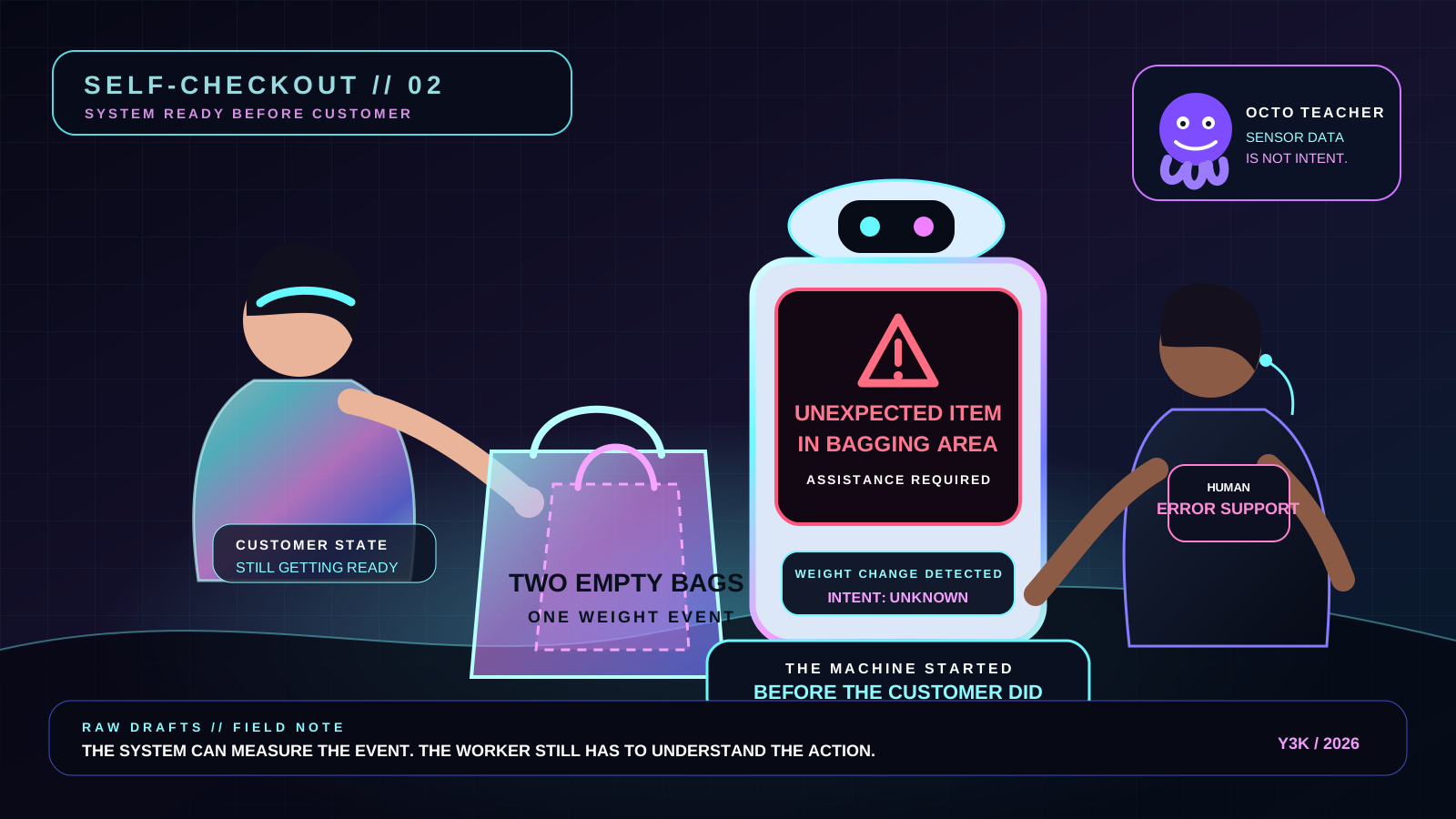
A human cashier would understand the situation instantly. Two bags were nested together, and I separated them. Nothing had been added, hidden or taken. I was simply getting ready. The machine did not see two bags or a person preparing to begin. It saw a weight baseline followed by a deviation from that baseline.
That is the gap between sensing and understanding. The checkout robot could measure what changed, but it could not understand why it changed. It knew the weight was different. It did not know that one bag had been inside another, that both bags were empty or that the customer was still setting up. Its interface did not appear to contain a state for someone who was not ready yet.
The system had already assigned me a stage in its flow. According to its logic, I had placed the bag, established the weight and moved on to scanning products. Any later change was suspicious. My actual sequence was slightly different: I placed two nested bags, pulled one out, opened both, arranged them and only then intended to start scanning.
The machine could not accommodate that tiny variation. Reality diverged from the expected sequence, so reality became an error. The checkout stopped and summoned a worker.
This is a useful way to understand retail automation. The cashier has not disappeared so much as changed jobs. Instead of handling one complete checkout, a worker now moves between several machines and resolves the moments their models cannot explain. Bags, damaged barcodes, unexpected weights, produce, children touching the scale and customers changing their minds all become exceptions waiting for human interpretation.
Automation absorbs the predictable part of the transaction and concentrates the ambiguity into a new kind of support role. One person can supervise several machines, but that efficiency depends on the person being available whenever ordinary life escapes the flowchart. The machines can process the ideal sequence. The worker carries the situational awareness that makes the system usable.
The more interesting problem is not that the machine made a mistake. The problem is that it treated normal behaviour as incorrect because I did not perform the task in the order its designers imagined.
Interfaces claim to help us complete tasks, yet many automated systems require us to make our behaviour legible to them first. We pause where the machine expects us to pause, place objects where it expects them and wait for permission before moving. We learn which harmless actions trigger warnings, then quietly adjust ourselves so the system does not panic.
The customer is operating the machine, but the machine is also training the customer. It teaches a choreography designed around its sensors and rules. The process feels smooth when we already know the choreography and strangely hostile when we improvise.
There was no control for saying that I was still arranging my bags. The machine did not ask whether the weight change came from another empty bag. It declared that the bagging area contained an unexpected item and stopped the interaction until a worker could override it.
The failure was small, but the assumption behind it was large. Because the system could detect an event, it behaved as though it understood the action. It had sensors, rules and anti-theft logic, but no curiosity about what the person in front of it might actually be doing.
A human eventually came over and cleared the warning. The person did more than unlock the checkout. They supplied the missing interpretation that the automated system had removed from the transaction.
That tiny scene contains a larger pattern. The machine detects changes, the human explains them, and the customer learns to behave in ways that reduce the distance between the two. Whenever measurement is mistaken for understanding, someone still has to come and unlock reality.
Connected reading
- A Toggle Is Not an Explanation
- The Last Obstacle Was a Popup
- When Systems Teach Us Not to Try
- The Product Needs a Harness
AI authorship note
This essay began with Kris Haamer describing a self-checkout failure and then clarifying the detail that made the interaction interesting: the second empty bag had been folded inside the first, and the machine interpreted its removal as the addition of an unscanned product. AI helped develop the argument around setup states, sensing without understanding and the human labor hidden inside retail automation. It also produced the Y3K editorial illustration. Kris directed the angle, corrected the sequence of events, selected the final text and made the publication decision.