

2026-07-25 · 9 min read · Raw Drafts / Urban Ecology / Cities / Animals / Public Space
The City Had to Invent the Sheep Again
I kept photographing animals at the edge of European cities. Geneva treated sheep as ecological infrastructure, Viimsi preserved them as heritage, Portugal barely explained its horse, and Tartu now presents an old relationship as urban innovation.
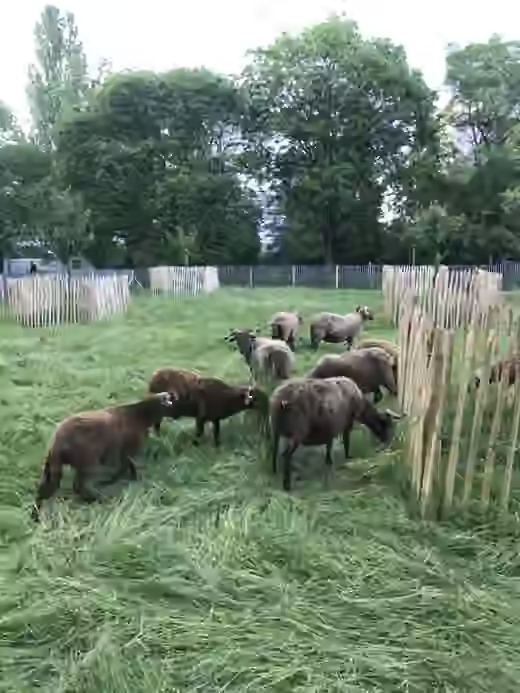
A headline about sheep and cows in Tartu reminded me of some sheep I saw in Geneva in 2019.
I did not remember the name of the park at first. I remembered the interruption. There was an ordinary city around me and then, inside it, a small group of sheep eating grass. I photographed them because the scene felt slightly misplaced, although the sheep looked much less confused about their location than I was.
Seven years later, Tartu announced that sheep, goats and young cattle would spend the summer maintaining several urban green areas. The animals would eat invasive Canadian goldenrod, support biodiversity, bring nature closer to residents and provide something pleasant for people to visit. An opinion article on Delfi treated the experiment almost as proof that other Estonian cities should stop discussing the idea and do it now.
The proposal sounded new. The memory did not.
The animal had been translated into infrastructure
When a city uses sheep to manage grass, the sheep become easy to describe in the language of systems. They are quiet mowers. They use no petrol while they are eating. They reach slopes and awkward edges. They remove some plants more eagerly than others, carry seeds, trample patches of soil and return nutrients through manure. Unlike a machine cutting everything to one height, they produce an uneven landscape.
That unevenness can be useful. A meta-analysis comparing grazing with annual mowing across semi-natural grasslands found that grazing generally produced somewhat better conservation outcomes, although the effects were usually small to moderate and varied between grassland types. Research on urban lawns also shows that intensive mowing tends to reduce plant and invertebrate diversity. Sometimes the ecological improvement attributed to the sheep may simply begin with the city stopping its habit of cutting every piece of grass every week.
But the animal is not only a substitute for a machine. A machine performs one operation. A sheep enters a relationship with the place.
It needs water, shade, fencing, transport, veterinary care and protection from dogs. It has preferences. It may eat the flowers the project hoped to preserve. Too many animals can compact soil, disturb nests and turn a varied patch into another short lawn. Too few may barely change the vegetation. The timing matters. The season matters. The species matters. An urban grazing project is ecological only when the whole arrangement is ecological.
This is one reason the language of innovation is not entirely fake. The old practice cannot simply be dropped into the modern city unchanged. The city has traffic, liability, dog walkers, playgrounds, procurement procedures and residents who may try to feed bread to a cow. The sheep may be ancient infrastructure, but the system around them has to be designed again.
I had photographed three different explanations
The Geneva sheep were one version. They appeared inside a European city as managed ecology. Even before my visit, Geneva had experimented with sheep as a form of ecological mowing in its parks. The animal returned as a nature-based service.
I had also photographed sheep near Restaurant Paat in Viimsi. They were beside the Viimsi Open Air Museum, surrounded by rough wooden fences, an old farm building and a landscape maintained as a visible fragment of coastal rural life. Directly beside them was Paat, the enormous overturned-boat-shaped restaurant made of glass and metal.
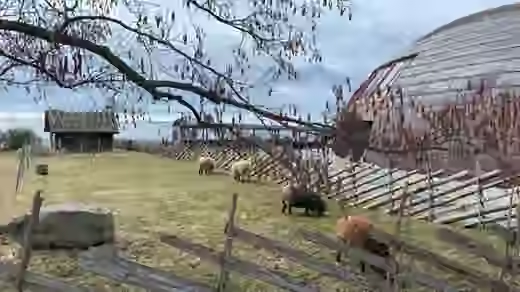
The contrast looks almost too deliberate. On one side, the animal survives because the old landscape has become heritage. On the other, the restaurant performs technological modernity at the scale of a building. The sheep have not remained because Viimsi failed to modernize. They remain because someone decided that the earlier relationship between buildings, fences, grass and animals deserved to be preserved.
Then there was a horse in Portugal, tied to a tree beside a pedestrian crossing and a roundabout.
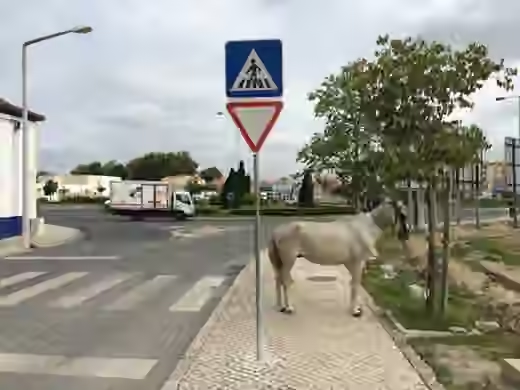
There was no museum frame and no sustainability sign. The horse occupied a sidewalk inside infrastructure designed almost entirely around cars. It looked stranger than the sheep, but it may also have been the least conceptual of the three scenes. Nobody seemed to need to explain it as heritage or ecological innovation. The animal was simply still part of everyday life.
Looking at the photographs together, I started to see a spectrum.
In Portugal, the animal persists without a theory. In Viimsi, it is protected as heritage. In Geneva, it becomes ecological management. In Tartu, the same old practice returns through a European project, a city press release and the vocabulary of urban biodiversity.
Modernity does not make the animal disappear in one clean movement. It changes the conditions under which the animal is allowed to remain.
Maybe the mower was the strange technology
A short urban lawn feels neutral because I have seen so many of them. It is not neutral. It is a highly maintained visual standard.
The grass must remain low, even and legible. A city pays workers to drive machines across it repeatedly. Fuel is burned. Noise is produced. Insects and flowers are removed before many of them complete their cycles. The result often has no clear use beyond communicating that somebody is in control.
Then sheep arrive and are treated as the experiment.
This reversal is easy to miss. The animal eating grass is older than the city. The unusual system is the one in which large machines repeatedly cut empty ground so that nature continues to resemble a surface in a rendering.
That does not mean every lawn should become pasture. People need places for football, picnics, play and movement. Short grass can be useful. A city is not improved by replacing one universal maintenance rule with another. The more convincing ecological approach is probably a mosaic: some frequently used lawns, some areas cut once or twice a year, some left as refuges, and some grazed at carefully chosen times.
The real change is not sheep instead of mowers. It is the city accepting that every green area does not need to look equally finished.
Maintenance becomes an event
The Tartu press release does not only describe vegetation management. It repeatedly describes contact. Residents can meet the animals. Children can see them. People are warned not to feed them. The animals are presented as workers and as public experience at the same time.
This second function may be harder to measure, but it is not imaginary. A UC Davis pilot placed twenty-five sheep on a central campus lawn and studied people who watched them. A broad web questionnaire did not find a significant overall difference in stress between observers and non-observers. A momentary smartphone measure did suggest temporary stress relief and improved mood, while comments described relaxation, community and a stronger sense of place. It was a small pilot rather than proof that sheep are a mental health intervention, but the project captured something recognizable.
I remember the Geneva sheep. I do not remember the mower that would otherwise have cut the same grass.
Animals make maintenance visible. They turn a background operation into a reason to stop. They move, group together, ignore us, look back at us and occasionally do the wrong thing. They make the park feel less like a completed design and more like a system that is still alive.
This may be one of the most important differences between an animal and a machine. A machine hides the relationship by completing the task quickly. An animal reveals the relationship because its life remains present while the task is happening.
The sheep can also become a very good advertisement
The emotional appeal creates another problem. Sheep are photogenic evidence of sustainability.
A city can put a few animals in one visible field while continuing to mow most of its land intensively, destroy habitats elsewhere or treat biodiversity as decoration around development. The sheep may be doing useful work, but the image can carry a much larger environmental claim than the project has measured.
I do not think this makes Tartu's experiment fake. The city is trying different grazing combinations in several locations, including areas affected by invasive goldenrod. It has expanded the work after an earlier summer and connected it to broader urban-nature projects. That is more substantial than placing two sheep beside city hall for a photograph.
Still, the strongest version of the project would measure the parts that the photograph cannot show. Tartu could compare grazed plots with conventionally mown and infrequently mown plots over several years. It could track plant diversity, flowers, pollinators, invasive species, soil compaction, maintenance costs, emissions, public response and animal welfare. It could show where grazing failed as well as where it worked.
Without that evidence, the sheep may be useful and joyful, but some of the ecological meaning remains assumed. With it, Tartu could demonstrate not merely that animals can exist in a city, but when they actually improve one.
The city had to invent the sheep again
The sentence that stayed with me was not that sheep are sustainable lawnmowers. It was that the modern city first removed animals from ordinary life and then brought them back as innovation.
The sheep are not new. What is new is that the city now needs a strategy, a pilot project and a sustainability argument before it can tolerate them.
Perhaps that is unavoidable. The Portuguese horse beside the roundabout is not automatically a better relationship. An unexplained animal can also mean poor welfare, danger and the survival of practices nobody has examined. Heritage can freeze a landscape into performance. Ecological grazing can become branding. Every version contains its own awkwardness.
But the photographs still make the modern boundary between city and countryside look less natural than I once assumed. Geneva, Viimsi, Portugal and Tartu are not four stages on one path. They are four ways of negotiating the same unresolved question: where do animals belong after the city has been designed as though they do not?
Maybe bringing sheep back is progress. Maybe it is nostalgia with environmental data attached. Maybe it simply exposes how strange the supposedly normal city had become: large machines cutting quiet grass every week while the animal capable of doing similar work was classified as belonging somewhere else.
The city did not invent the sheep. It invented a world in which the sheep needed to be introduced again.
Connected reading
- The City Is an Interface
- The City Is a Matchmaker
- The Smart City Breaks Between the Systems
- A Tomato Is a Map of Power
- The Places I Lived Became Games
AI authorship note
This essay began with Kris Haamer reading about Tartu bringing sheep, goats and cattle into urban green areas and connecting it to photographs he had taken of sheep in Geneva in 2019, sheep beside the Viimsi Open Air Museum and Restaurant Paat, and a horse tied beside a roundabout in Portugal. Kris supplied the photographs, memories and central observation that cities classify similar animal encounters as ordinary life, heritage, ecology or innovation. AI supported scientific research, source verification, drafting, editing, image preparation and implementation. Kris developed the Raw Drafts angle and approved the article for publication.