

July 31, 2026 · 13 min read
The Future Had a Queue
A few days at Expo 2025 Osaka, and what happens when everyone arrives at the future at once.
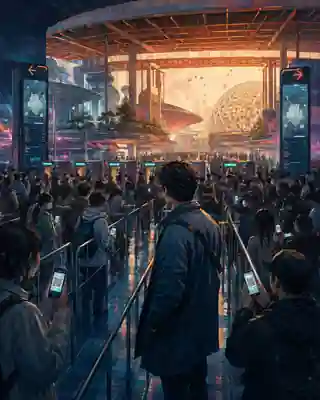
My inbox remembered the infrastructure
A year later, Osaka survives in my inbox as a sequence of permissions. One digital ticket for April 13, 2025 at 11:00 through the West Gate. Two more tickets for the following morning at 9:00 through the East Gate. There were emails inviting me to enter lotteries for pavilion reservations, reminders to take a screenshot of my QR code, instructions to charge my phone, warnings about luggage, security inspections, and cashless payments. On the morning of the opening, I received a verification code for the Expo Digital Wallet. The following day, an automated email thanked me for coming.
This is how large experiences are remembered now. The inbox keeps the infrastructure after the feeling has faded. It knows which gate I was supposed to enter and that I had been warned about the crowds. It knows when I signed into the wallet. It does not know what the Expo felt like.
I flew from Kaohsiung to Incheon on April 11, crossed the night through an airport connection, and continued to Kansai the next morning. The trip was short enough to require planning and long enough to create the illusion that I could see everything. My calendar simply said, “Japan EXPO Opens,” as though the future were an ordinary appointment that could be placed between birthdays and restaurant reservations.
Opening day was an access problem
Four days before my visit, the organisers sent a warning. Opening day was expected to be extremely crowded. Transport and the areas around the gates could remain congested until around three in the afternoon. People with morning reservations were told they could arrive later. West Gate visitors were advised to prepay for the shuttle bus or consider other transport. The email was unusually direct for an event still trying to sell anticipation.
I went anyway.
The first day was so crowded that I did not manage to see much. That was the sentence I wrote afterward, and it is still the simplest description of the experience. There were many countries, buildings, exhibitions, and promises somewhere inside the site, but the practical experience was a continuous negotiation over access. Which pavilion had a queue? Which one required a reservation? Which lottery had already closed? How much of the day was worth exchanging for the possibility of entering one building?
The Expo presented itself as a place to think about the future. The future, on opening day, was a charged smartphone, a QR code, and a series of unavailable time slots.
The organisers had anticipated this. Visitors were told to save screenshots in case connectivity failed and to bring a mobile battery because the phone had become the key, ticket, map, wallet, and reservation system. Cash would not be accepted. Large rolling luggage would not be allowed. Bags would pass through X-ray machines. Every layer made sense individually. Together, they created a strangely accurate exhibition about the systems we are building.
A future designed around convenience becomes extremely inconvenient when everyone tries to use it at once.
A voice in the Romania Pavilion
Inside the Romania Pavilion, the scale finally became smaller. There was a hall arranged almost like a cinema, with people sitting together in rows. Upstairs was a modest exhibition. At one point, a soprano performed with a pianist.
I remember the human voice more clearly than most of the technology.
National pavilions are asked to compress an entire country into architecture, screens, slogans, and a visitor route. They need to communicate identity quickly to people who might wait an hour and stay for ten minutes. The Romania Pavilion briefly escaped that compression. A singer and a piano filled the room. There was no need to explain that this represented culture, tradition, or national spirit. It simply happened in front of us.
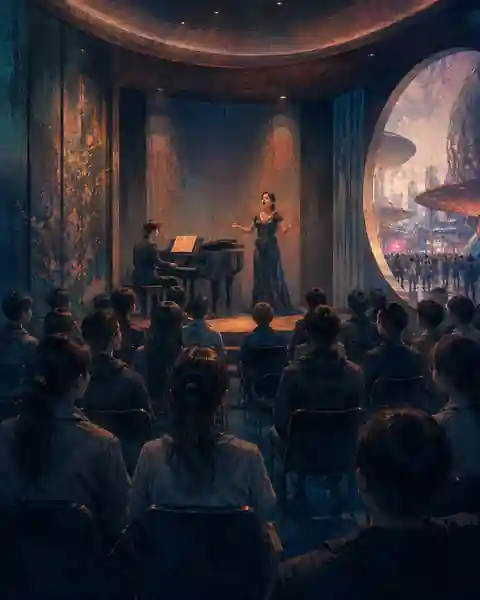
Perhaps that is why it stayed with me. The Expo was built around enormous abstractions: humanity, sustainability, innovation, life, and the future. A voice in a room did not require an account or a reservation strategy. It was one of the few things that felt complete.
Inconvenience is how scarcity becomes visible
Most of the Expo remained incomplete for me. There were too many people and a limited number of entrances, seats, performances, and hours. Afterward, I tried to describe this as a crisis of inconvenience. The phrase sounded almost trivial. Inconvenience is normally the word we use for a delayed train, a broken app, or a shop closing earlier than expected. It does not sound serious enough to describe a crisis.
But inconvenience may be how many crises first become visible in everyday life. A shortage rarely introduces itself as an elegant diagram showing the relationship between supply and demand. It appears as a queue. A reservation you cannot obtain. A product that is always sold out. A hospital appointment six months away. A train that technically exists but cannot carry everyone who needs it. A resource remains present in the abstract while becoming inaccessible at the moment you try to use it.
The Expo had plenty of exhibitions. I still could not see many of them. The limitation was access. The same problem appears when we talk about natural resources. A country may have water, food, energy, or land in aggregate while particular people cannot reach enough of it when they need it. The future may contain extraordinary technologies while their benefits remain concentrated behind prices, infrastructure, geography, technical knowledge, and waiting lists. We can build abundance at the level of prototypes and scarcity at the level of experience.
The object is easy. The system around it is hard
At the Mozambique Pavilion, one sign connected environmental preservation and resilience to climate change with agriculture, artificial intelligence, drones, smart irrigation, and food security. These combinations matter. Climate change is already making agriculture less predictable. Crops need to survive unfamiliar temperatures, shifting rain, drought, flooding, pests, and soil degradation. Farmers need better information and more precise ways to use water, fertiliser, and energy. AI may help detect disease, predict yields, analyse satellite images, or decide where irrigation is needed.
The technology is plausible. The question is whether it reaches the farms and communities that are most exposed.
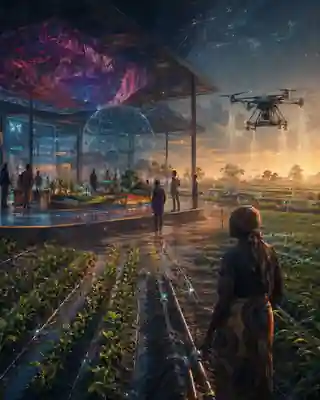
A drone shown inside a pavilion is easy to admire. A functioning agricultural system requires maintenance, training, connectivity, financing, local knowledge, replacement parts, reliable institutions, and someone taking responsibility when the model is wrong. The gap between those two things is where most of the future disappears.
World Expos are very good at showing the object. The harder part is showing the system around it. Perhaps that is unfair. An Expo cannot solve the problems it displays. It can introduce ideas, create encounters, and give countries a temporary place to tell stories about themselves. Yet its own operational reality became part of the exhibition. The queues demonstrated what happens when a desirable resource has limited capacity. The reservation lotteries demonstrated how systems allocate scarcity. The app demonstrated how access increasingly depends on owning the correct device, maintaining its battery, and navigating a sequence of interfaces correctly.
Even attention was scarce. Every pavilion competed with every other pavilion, as well as with the map, the weather, hunger, tiredness, and the knowledge that another line might be shorter. An exhibition could be excellent and still disappear because the visitor had already spent too much of the day standing elsewhere.
The city became the way out
I had bought two tickets for the next morning. Planning assumed that the solution to an unfinished first day was another day. More time should have produced more Expo. Yet I am no longer sure that seeing more pavilions would have changed the central impression. The opening day had already revealed the thing beneath the exhibition.
The future had a queue.
While I was still in Osaka, my searches began moving away from the Expo. I looked for less crowded things to do. I searched for independent cinemas. By the final day, I was searching for matcha cafés and traditional wooden tea houses. My browser history suggests that after flying to another country to see an enormous global event, I wanted a quiet room and a cup of tea.

That does not feel like a rejection of ambition. It may be a reaction to scale. A World Expo asks visitors to process the aspirations of dozens of countries in a single day. A small cinema asks you to sit in one place and pay attention to one film. A tea house asks you to notice water, temperature, texture, movement, and time. One experience attempts to contain the world. The other gives the world enough space to become visible.
At five in the afternoon on opening day, I had a table reserved for two at a restaurant in Osaka. The reservation email contains the usual precision: date, time, number of guests, and address. It sits in the inbox beside the Expo tickets, structurally equal to them. One was an international event about designing future society. The other was dinner. Memory does not respect their official importance.
The test begins when everyone arrives
On April 15, shortly before midnight, I flew from Kansai back to Taipei. The email systems continued working after I left. Expo newsletters arrived for months, counting visitors and days remaining until the closing ceremony. In October, the final newsletter announced that the Expo had ended after receiving more than twenty million visitors.
The event closed. Its ideas returned to their countries, companies, ministries, universities, and forgotten presentation folders. The buildings were always temporary. The harder question is what survives after the spectacle.
I do not think the most useful lesson from Osaka was hidden inside one pavilion. It was visible between them, in the gaps where people waited. We often imagine the future as a collection of inventions: better batteries, smarter farms, synthetic biology, robots, new materials, immersive rooms, responsive cities. Each one can be impressive on its own. Yet a future is experienced as a system. It includes the route to the building, the price of admission, the capacity of the train, the clarity of the interface, the availability of the appointment, and the ability to participate without already understanding how everything works.
The real test arrives when the system becomes crowded. Can it remain understandable when people are tired? Can it serve someone whose phone is nearly dead? Can the benefits reach places without perfect connectivity? Can essential resources remain available when demand rises? Can an experience designed by experts still work for someone arriving without a strategy?
Opening day at Expo 2025 did not answer those questions. It accidentally staged them.
The future is easy to prototype for one person. The test is what happens when everyone arrives.