

2026-08-03 · 8 min read · Raw Drafts / aesthetics and AI
The New Aesthetics Will Not Be Prompted
Patrick Collison's Book of Kells experiment shows the difference between recovering a visual style and rebuilding the cultural systems that give beauty meaning.
I noticed that Patrick Collison cares about aesthetics.
It is visible in Stripe, where design has never felt like decoration added after the serious infrastructure was finished. The documentation, typography, language and small interactions all seem to come from the same belief: complicated systems become more useful when people can understand them, trust them and perhaps even enjoy entering them.
More recently, Collison and Tyler Cowen made this interest explicit through their New Aesthetics programme. They asked artists, architects and designers what the twenty-first century should look like, taking the Bauhaus seriously not only as a visual style but as a movement that connected art, technology, industry and everyday life. Their call is open to AI, but it also says something revealing: they have not seen much great work made only with AI.
Then Collison gave the Book of Kells to an AI agent.
He had been reading Victoria Whitworth's new book about the manuscript and became curious about how its pages may have looked before roughly 1,200 years of fading, moisture, handling and repair. He downloaded a scan and asked the agent to process every page with an image model. The work was divided between 48 workers. The agent then built a comparison website, deployed it and added a machine payment for downloading the complete interleaved PDF.
Much of this happened before he finished his coffee.
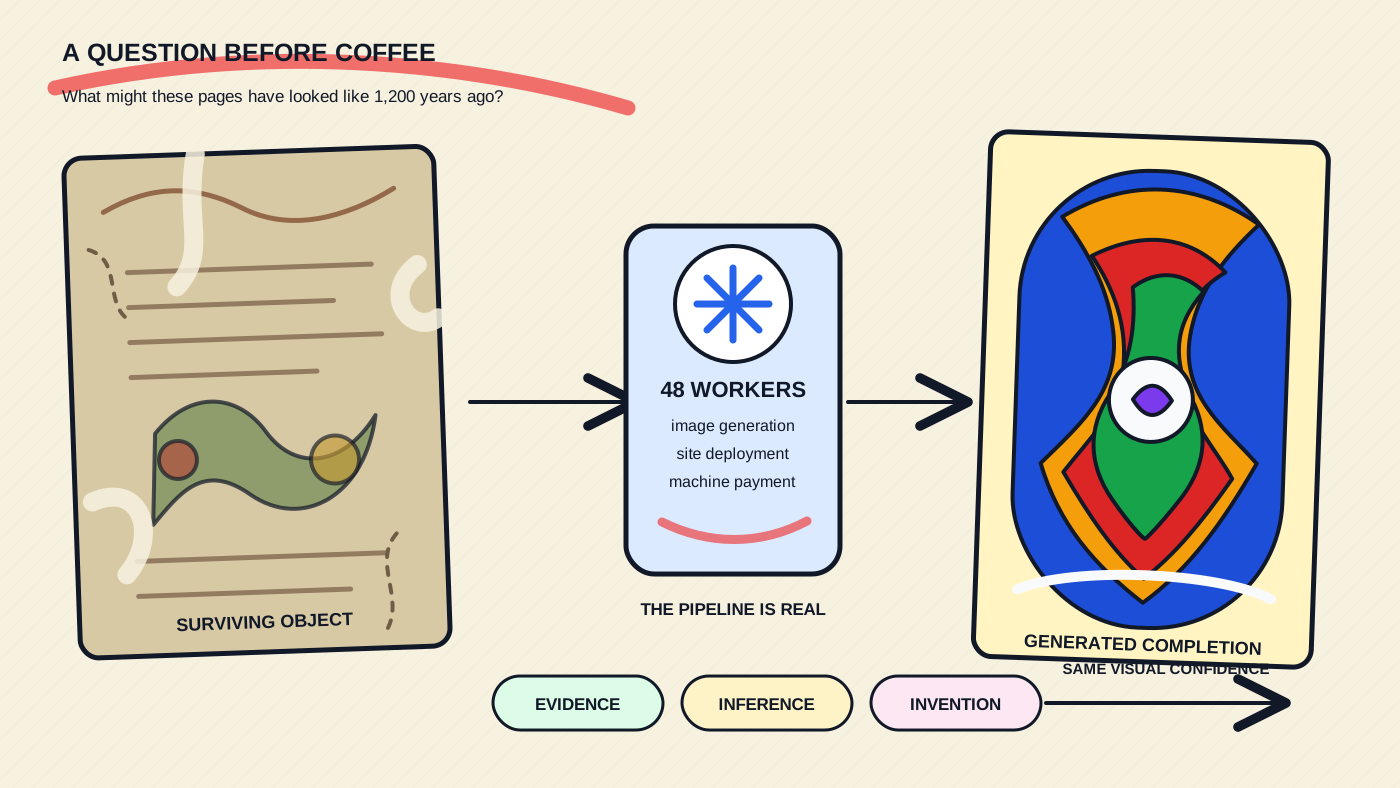
I understand why this is exciting. A small question became a public object almost immediately. Research, image processing, software, publishing and payments were temporarily assembled around one person's curiosity. Software begins to feel less like permanent infrastructure and more like a sketchbook. We can build one small tool for one book, one afternoon or one question, then keep only what we learned from it.
For people who make things, this matters. Many ideas used to die inside the distance between feeling something and having enough time, money or technical capacity to make it real. AI can reduce that distance. It can help more people move from curiosity into action before the idea becomes heavy.
But when I looked at the reconstructed Book of Kells pages, the speed was not what stayed with me. What stayed with me was how complete they looked.
The colours became stronger. Damaged lines returned. Figures emerged from worn surfaces. Empty areas filled with ornament. The manuscript began to look less like an object that had travelled through centuries and more like an image that had finally been repaired.
The problem is that the machine does not know what was originally there.
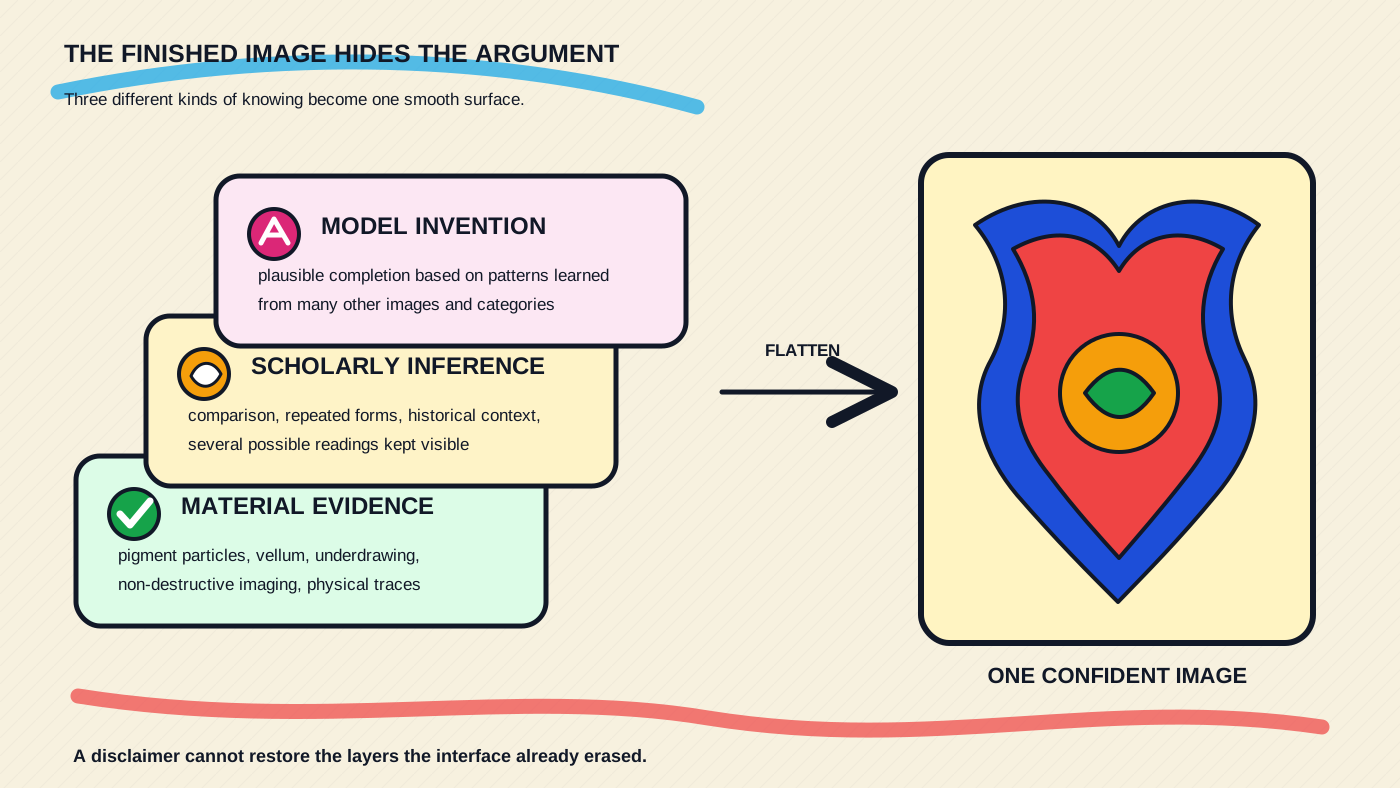
Some parts of the manuscript can be studied through physical evidence. Conservators can identify pigments, inspect the vellum and use non-destructive imaging to reveal marks that are difficult to see with the naked eye. Trinity College's research has identified materials including indigo or woad, orpiment, red lead, organic reds, copper green and lichen-derived purple. The artists sometimes layered several pigments to produce effects that still feel intense today.
Other parts are less certain. A mark may be decoration, damage or the trace of an earlier repair. A colour may have faded, chemically changed or disappeared. A missing form may be inferred from another page, but several reconstructions may remain possible. Some information is simply gone.
The image model treats all of these conditions in the same way. It produces pixels.
Evidence, historical inference, visual convention and invention arrive with the same sharpness. Nothing in the finished page tells us which colour is supported by material analysis, which line was inferred from another folio and which detail appeared because the model had learned what an important medieval manuscript was supposed to look like.
The model even introduced the appearance of gold, although the Book of Kells does not use gold leaf. This makes sense statistically. Gold belongs to our broad visual idea of medieval sacred luxury. It is familiar, convincing and wrong for this particular object.
The model understands the category better than the thing.
This is where the Book of Kells experiment connects back to the search for a new aesthetics. If aesthetics contain inherited knowledge, we cannot recover that knowledge by reproducing the surface alone. A style is not the same thing as the culture, materials, skills, beliefs and relationships that produced it.
The Book of Kells is not important only because it is beautiful. It brought together language, religion, pigment, animal skin, geometry, storytelling, labour and ceremonial use. Its ornament was not separate from its meaning. The visual intensity helped create authority, wonder and belonging.
The surviving manuscript is also more than a damaged copy of a perfect original. It carries the effects of movement, moisture, violence, repair, neglect and care. The missing areas are part of what history did to the object. When AI fills them, it may produce something that looks closer to the imagined past while moving us further away from understanding what actually survived.
This does not make Collison's experiment useless. He describes it as an experiment and acknowledges its limitations. The generated pages may help people feel that the Book of Kells was not originally a quiet brown antique, but something vivid, strange and almost psychedelic. The reconstruction can open curiosity.
The problem begins when imagination is designed to look like recovery.
A before-and-after comparison suggests that we are moving between two states of the same object: damaged and restored. But one side is a surviving historical object. The other is a contemporary interpretation produced by a model, its training data and a prompt written in 2026.
A more honest interface could separate the layers. It could show the current page, measured pigment information, details revealed through imaging, scholarly interpretations and unrestricted model imagination. The visitor could see where evidence ends, where disagreement begins and where the machine is simply proposing one possible image.
Uncertainty would become something we can explore instead of something the software quietly removes.
This matters beyond cultural heritage. AI systems now complete our sentences, summarize meetings, create user personas, reconstruct photographs and turn scattered evidence into coherent stories. Their usefulness often comes from making unresolved situations feel manageable. But unresolved things can carry important information. A contradiction may reveal that two communities experience the same system differently. A blank section in a report may show that an institution has never measured what it claims to value. An unfinished design may mean that nobody has yet decided who should have agency.
The system often gives us the shape of an answer before the underlying conflict has been understood. It exports confidence while keeping uncertainty inside.
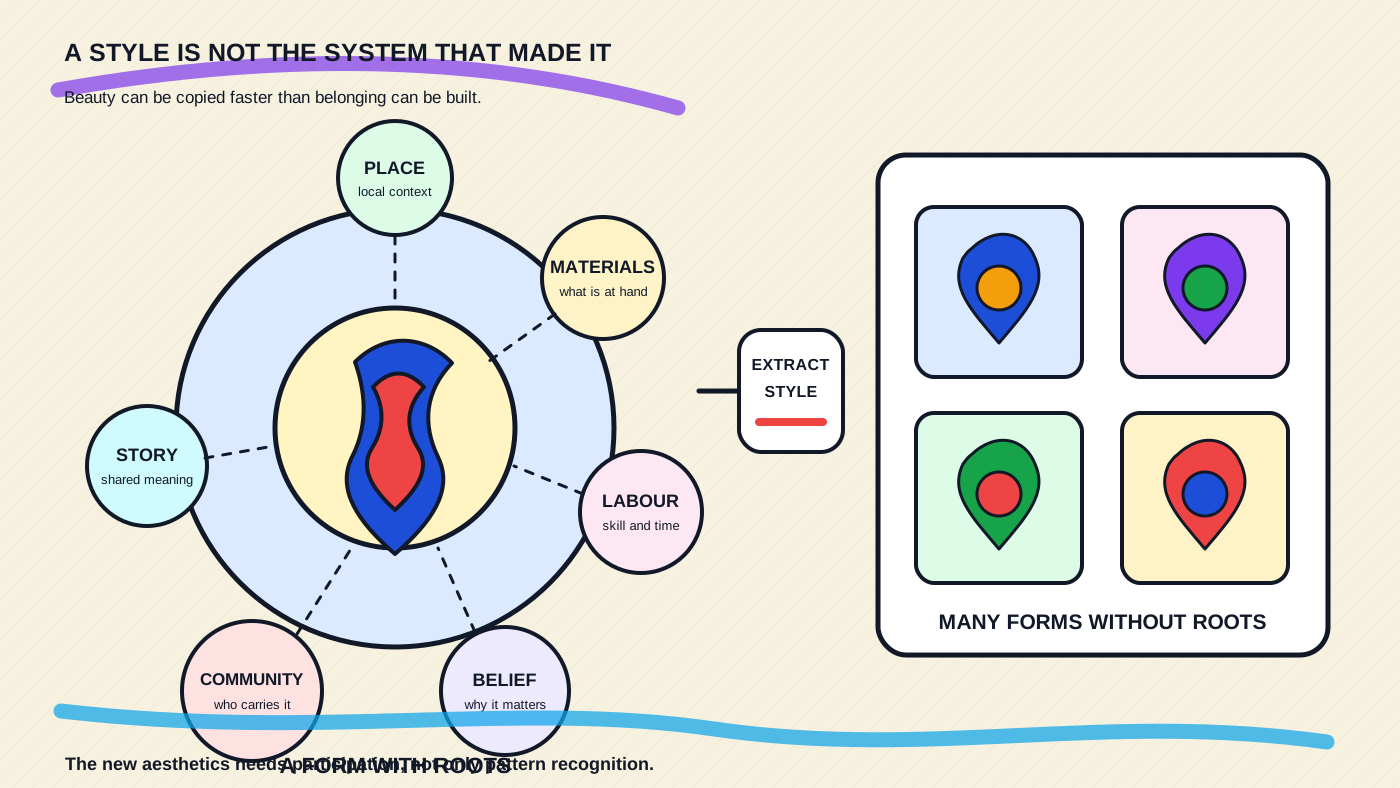
I think this is also why prompting alone has not yet produced the new aesthetics Collison and Cowen are looking for. Bauhaus did not define the twentieth century by generating attractive surfaces. It built schools, workshops, methods and new relationships between craft and industrial production. The Book of Kells also emerged from a living system of people, materials, faith, knowledge and place.
Generative AI often works in the opposite direction. It extracts the visible style from those systems and makes it available without the conditions that gave it meaning. We can generate a Taiwanese temple, an Estonian farmhouse, a São Tomé street or a medieval manuscript while quietly mixing places, periods and symbols into one plausible scene.
The result may be beautiful. It may also be beauty without belonging.
I do not think the answer is to reject AI, reconstruction or the desire for beauty. I share that desire. I feel tired of the assumption that craft, ornament and emotional intensity are somehow less serious than optimization. Technology should help us make a world people can love, not only one that operates efficiently.
AI can support that work. It can reveal hidden structures, make archives accessible, compare patterns, connect people and help a curious person create an exploratory tool before finishing breakfast. But it cannot inherit responsibility for what a form means, where it came from or who should have agency over its future.
Collison's experiment shows that the cost of execution has collapsed. The cost of knowing what is true has not collapsed with it. Hundreds of reconstructed pages can be generated during breakfast. Understanding whether one mark is historically defensible may still require conservators, historians, material analysis and years of accumulated knowledge.
The scarce part is no longer producing the image. It is knowing what belongs there.
Perhaps the new aesthetics will emerge when contemporary tools help us build new relationships between material, culture and purpose, not only new surfaces. That cannot be prompted into existence by one person or one model. It has to be made with people, places, memory, disagreement and care.
AI authorship note
This essay began with Kris Haamer noticing Patrick Collison's interest in aesthetics and connecting it to Collison's Book of Kells experiment. AI supported research, synthesis, drafting, illustration code and implementation. Kris is responsible for the framing, argument, source selection and decision to publish it.