

2026-08-02 · 11 min read · Raw Drafts / Design and belonging
Who Gets to Remain Complicated?
Othering begins when a category arrives before a person. Forms, media, design research and AI can all compress a life until the label starts to look like the truth.
When I move between countries, people often want to place me quickly.
Estonian. European. White. Designer. Foreigner.
Sometimes these labels are useful. They explain which passport I carry, what language might work, which line I should join at the airport, or why I may see something differently. They help a system decide what to do with me. They do not explain very much about who I am.
No category tells anyone about the schools I went to, the years I spent in Taiwan, the people I have loved, the work I have failed at, the places where I felt unexpectedly at home, or the different person I become depending on which language I am speaking. It cannot show the parts of myself that still surprise me.
Most of us understand this about our own lives. We experience ourselves as layered, contradictory and unfinished. We know there were reasons behind our choices and stories behind our fears. We know that one more detail can change the meaning of everything that came before it.
The strange thing is how easily we forget this when we look at someone else.
A person crosses a border and becomes a migrant. A family asks for asylum and becomes part of a wave. Someone grows up in poverty and becomes a demographic. A Taiwanese person becomes Asian culture. A Muslim becomes religion. A foreign worker becomes labour. A refugee becomes a number attached to a policy debate.
The person is still there. The category has arrived first.
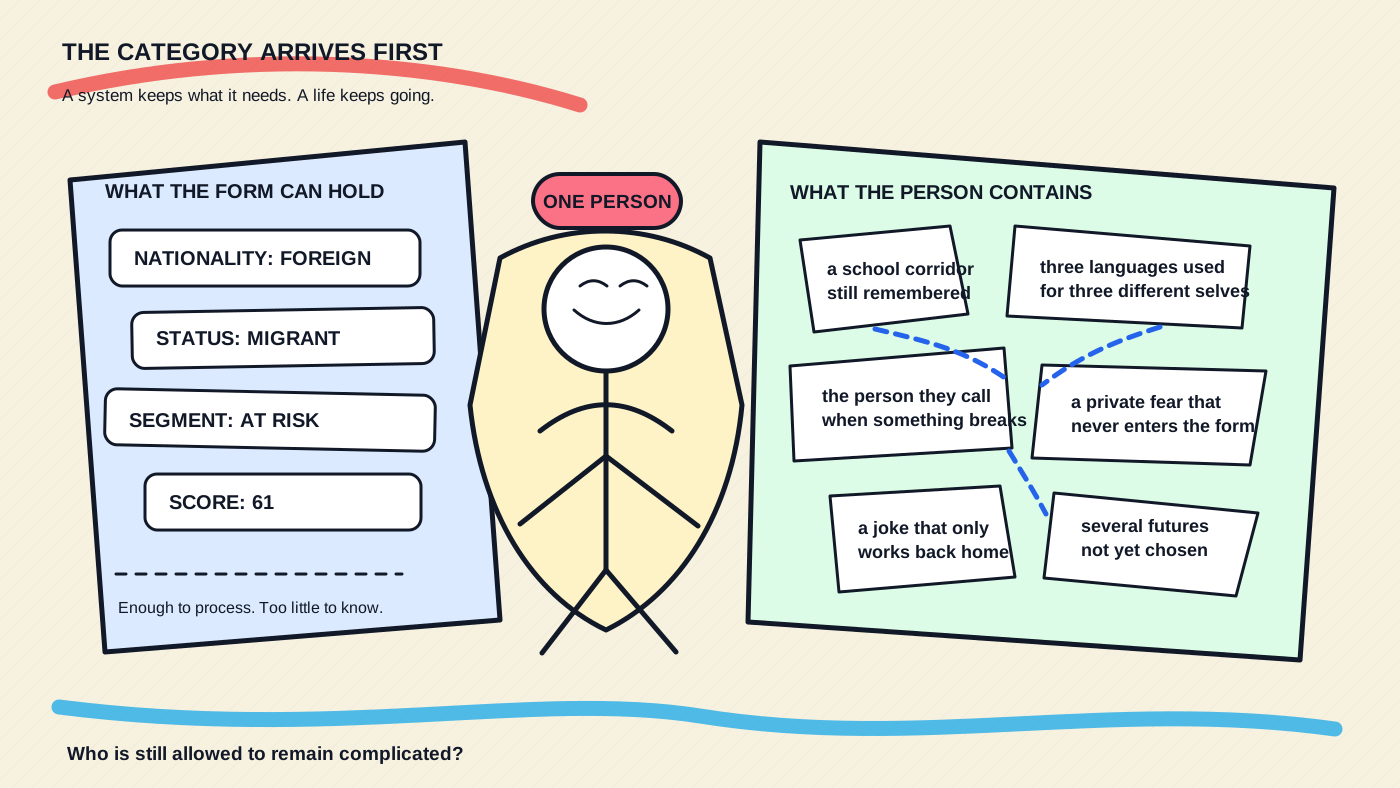
This process has a name: othering.
The idea has a long history in philosophy, feminism and postcolonial thought. Simone de Beauvoir wrote about woman being positioned as the Other while man was allowed to stand for the neutral human subject. Edward Said examined how European accounts of the Orient created a distant, simplified world that helped Europe imagine itself as rational, modern and entitled to rule. Gayatri Chakravorty Spivak used othering to describe how imperial power did more than misrepresent colonized people. It assigned them a place inside a world organized by someone else.
These ideas matter because othering is more specific than noticing difference. People have different languages, histories, religions, bodies and experiences. Understanding those differences can be a form of respect. Othering begins when difference becomes a complete explanation, when the group becomes more visible than the person, and when one side is allowed to remain normal while the other must account for its existence.
The deepest question may be simple: who gets to remain complicated?
Who receives a biography?
I have been thinking about this while reading European reporting about migration. People are regularly described as flows, waves, pressure and numbers arriving at a coastline. The language can sound technical and calm. The image it produces is physical. Something is moving towards us. Something is rising. Something may overwhelm us.
A wave has no name. It has no memory, profession, family argument, favourite song or explanation for why it came. A wave can only arrive, rise or be stopped.
At the same time, Europeans who move abroad are often given a very different vocabulary. We become expats, travellers, founders, researchers, digital nomads or people seeking a new life. We are allowed a reason. We are allowed curiosity. We can be brave, restless, ambitious, privileged, confused or lost.
The movement may be similar. The story changes depending on who is moving.
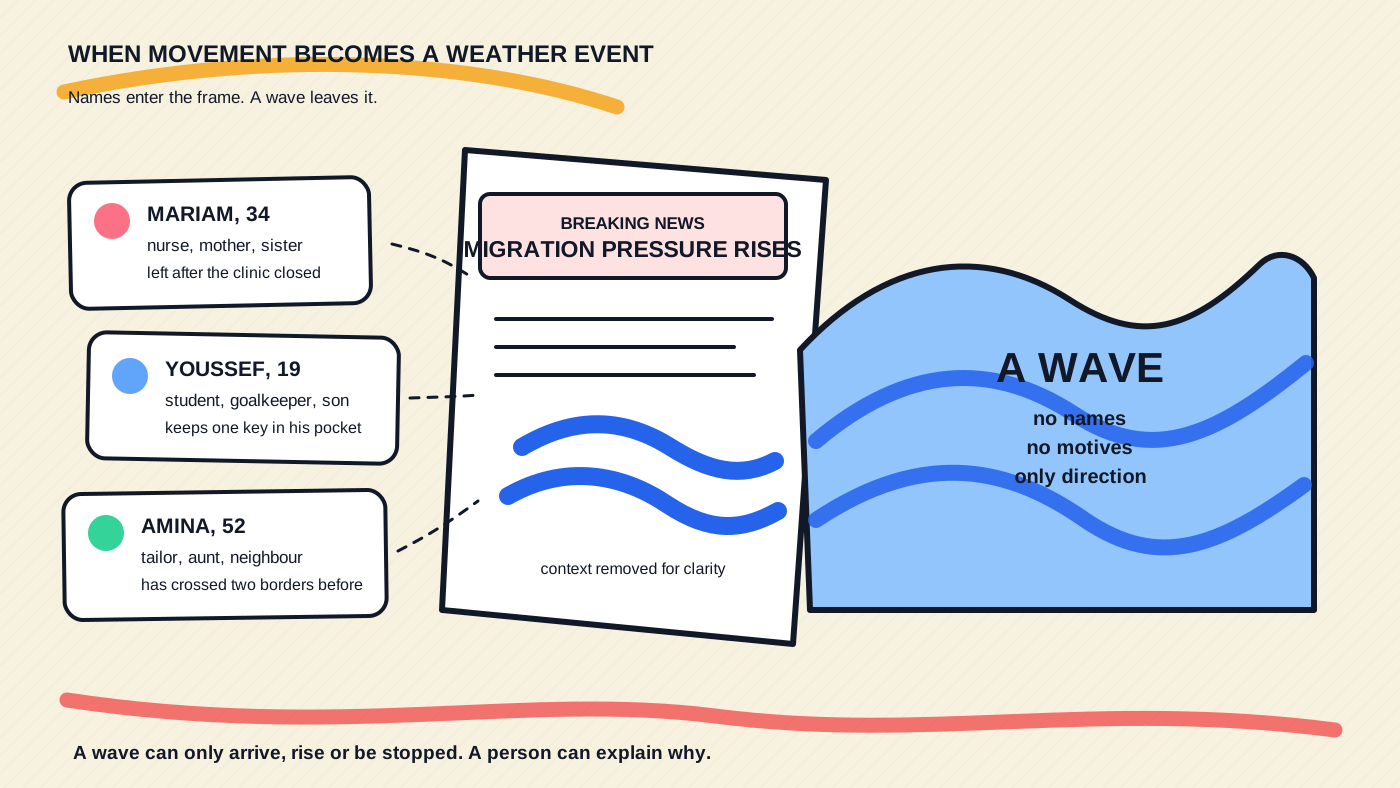
This is one of the quietest ways othering works. Some people receive biography. Others receive a category.
Some people are treated as individuals whose actions belong only to them. Others are made to represent everyone who shares their nationality, religion or appearance. When an Estonian commits a crime, we usually do not ask what the act reveals about Estonian civilization. We understand that a particular person did something. Their psychology, circumstances and decisions may be examined.
When someone from an already othered group does the same thing, the act can become evidence about the group. Culture enters the explanation. Religion enters. Origin enters. One person's behaviour suddenly carries millions of people behind it.
The dominant group gets individuals. The other group gets patterns.
Othering can also sound admiring. We may call people naturally spiritual, exceptionally hardworking, close to nature or untouched by modern life. The praise still freezes them into a type. The person is valued for performing the identity we have prepared for them. Their contradictions become inconvenient.
This is why the word is useful. It helps us see a process that may continue even when nobody is openly expressing hatred. A person can be reduced through fear, pity, fascination, bureaucracy or a compliment. The emotional tone changes. The unequal distance remains.
Othering is also a design problem
Our world runs on classification.
Forms ask us to select a nationality, gender, income bracket and level of education. Governments divide people into citizens, residents, visitors, workers and undocumented migrants. Hospitals turn patients into symptoms and risk profiles. Researchers divide participants into segments. Newsrooms compress events into headlines. Banks turn financial histories into scores. Algorithms turn behaviour into probabilities.
These systems cannot process every person as an entire life. They need categories to function. A border system needs to know what document someone carries. A hospital needs to record symptoms. A researcher needs to compare experiences. A designer needs enough structure to make decisions.
The moral question begins with what happens after the category is created.
Does it remain a temporary tool, or does it become the explanation for the person?
A migration database may need to record someone's legal status. The problem appears when migration becomes who that person is in every other context. A medical record may need a diagnosis. The problem appears when every new complaint is interpreted through it. A designer may need a persona. The problem appears when the fictional persona begins to feel more real to the team than the people it claims to represent.
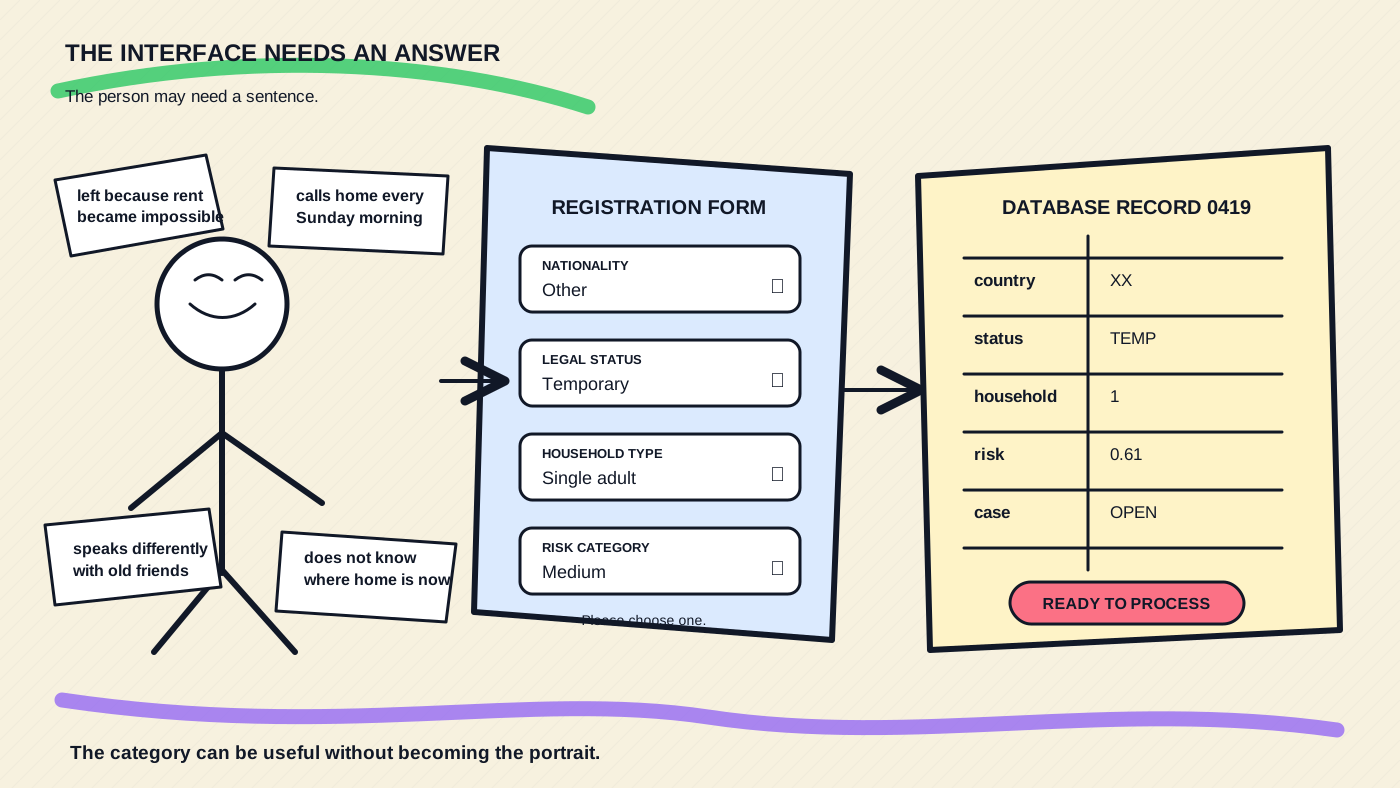
Designers are trained to simplify. We build personas, user journeys, audience segments, archetypes and behavioural models. This is necessary work. Without simplification, design becomes difficult to coordinate. Yet every simplification makes a decision about what is worth keeping and what can disappear.
A label such as low-income user, elderly user, migrant user or emerging-market consumer can quietly become the answer to every question. The category starts as a way to see a need. It becomes a reason to stop looking.
I have seen a version of this in research. A participant says something that does not fit the persona. Instead of allowing the surprise to challenge the category, the team treats the person as an exception. The category is protected. The human being is adjusted.
This is how systems become more confident than the lives they describe.
Every interface contains a hidden theory of the person using it. A dropdown says that one of the available answers should be enough. A required field says the system's need is more urgent than the person's uncertainty. A risk score says the past can be compressed into a prediction. A dashboard says that what cannot be measured may be safely ignored.
Most of these choices are made for practical reasons. Practical choices still shape how institutions see people. Repetition gives them moral weight.
The form eventually becomes a portrait.
A machine does not need to hate
Artificial intelligence makes this problem more urgent because AI is built to find patterns. It takes enormous amounts of human expression and compresses them into relationships, probabilities and categories.
A machine does not need to hate anyone to reproduce othering. It only needs data in which some people repeatedly appear as full individuals while others appear mainly as problems, victims, threats, stereotypes or anonymous crowds.
If one group is usually named and another is usually counted, a model learns from that difference. If one country is represented through art, business, food, personal stories and political debate while another appears mainly through war and disaster, the model learns from that too. If a hiring system sees historical patterns in which certain people were rarely promoted, it can turn an old exclusion into a calm prediction about future success.
The result may sound neutral. It may even sound helpful. Neutrality can carry an old hierarchy with remarkable efficiency.
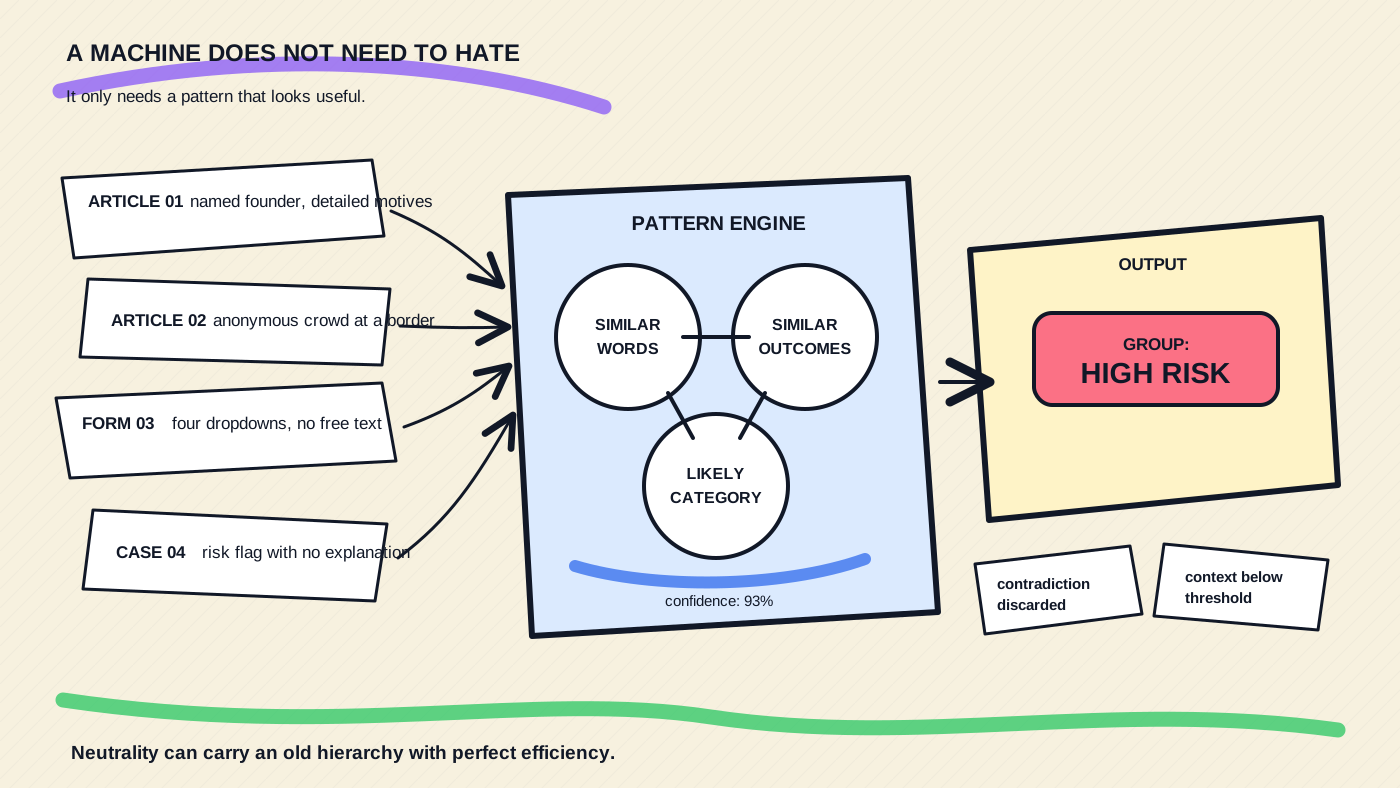
An algorithm can deny someone a loan, rank them as less employable, flag them as suspicious or decide which neighbourhood deserves attention. No person inside the system needs to wake up intending harm. The structure can continue making unequal decisions through the language of optimization.
This is why othering belongs in discussions about interfaces, forms, databases, media systems and machine learning. It cannot be confined to obviously hateful speech. A system can flatten people while speaking in the most professional language available.
The problem is also difficult because pattern recognition is often genuinely useful. Medicine, fraud detection, public planning and accessibility all depend on finding meaningful similarities. Refusing to see groups can hide discrimination as easily as careless grouping can create it. The answer is not to pretend that every person exists outside history and structure.
The task is to keep the pattern open to correction by the person.
Can someone see how they were categorized? Can they contest it? Can the system hold uncertainty? Can a researcher preserve a statement that does not fit? Can a journalist describe scale while still giving people names and motives? Can an interface offer enough room for someone to say that none of the available answers is true?
These may sound like small product decisions. They determine whether a category remains a tool or becomes a cage.
The rooms with no doors
People can eventually begin to understand themselves through the limited roles institutions repeatedly offer them.
Refugee. Foreigner. Minority. At risk. Underdeveloped. Vulnerable.
These words can describe real conditions. They may be necessary for accessing protection, resources or political recognition. They can also become rooms with no doors. A person enters because the category explains something important about their situation. The system keeps them there because it no longer knows how to see anything else.
Belonging requires more than allowing someone into an existing structure. The Othering and Belonging Institute at the University of California, Berkeley describes belonging as the ability to participate meaningfully in designing the structures that shape one's life. This moves the question beyond representation. A person is no longer only visible inside the system. They have some power over what the system asks, records and decides.
That distinction matters to design. Inclusion can mean adding another option to a dropdown. Belonging may require asking why the dropdown controls the decision in the first place.
The response to othering is not a world without difference. Difference is real. History is real. Power is real. Pretending everyone is simply the same can erase the specific harms that people experience.
We need to notice difference without turning it into destiny.
We need journalism that can describe scale without erasing names. We need research that allows a participant to contradict the persona. We need interfaces that let people explain themselves beyond a required field. We need AI systems that can recognize patterns while remaining uncertain about what those patterns mean for a particular life.
Most of all, we need to recover curiosity.
Othering often begins when curiosity ends. It begins when we believe we already know why someone acts as they do because we know where they come from. It begins when a label feels sufficient. It begins when a group becomes predictable.
Curiosity reopens the person. What happened before this moment? What do they call themselves? What would they say is missing from this description? What parts of their life have nothing to do with the category I placed them in?
Uncertainty matters because certainty is often a privilege of distance. From far away, an entire group can look simple. Up close, every person begins to escape the story prepared for them.
Perhaps dignity begins there.
A person always contains more information than the system needs. More memory than the form can hold. More contradiction than the category can explain. More possible futures than the model can predict.
The task is not to build a world without names, borders, groups or differences. It is to stop mistaking these things for complete descriptions of human beings.
We should remain suspicious whenever a person becomes easy to explain.
And we should ask, again and again: who is still allowed to remain complicated?
AI authorship note
This essay began with Kris Haamer's questions about othering, migration language and the way design systems turn people into categories. AI supported research, synthesis, drafting, illustration code and implementation. Kris is responsible for the framing, argument, source selection and decision to publish it.