

2026-08-02 · 10 min read · Raw Drafts / Interaction Design / Service Design / Museums / Labour
The Water Fountain Exists, but the System Does Not Let You Reach It
The V&A East Storehouse opened its collection to public requests, but the strike by the workers delivering that access reveals where friction, power, and bodily cost moved behind the interface.
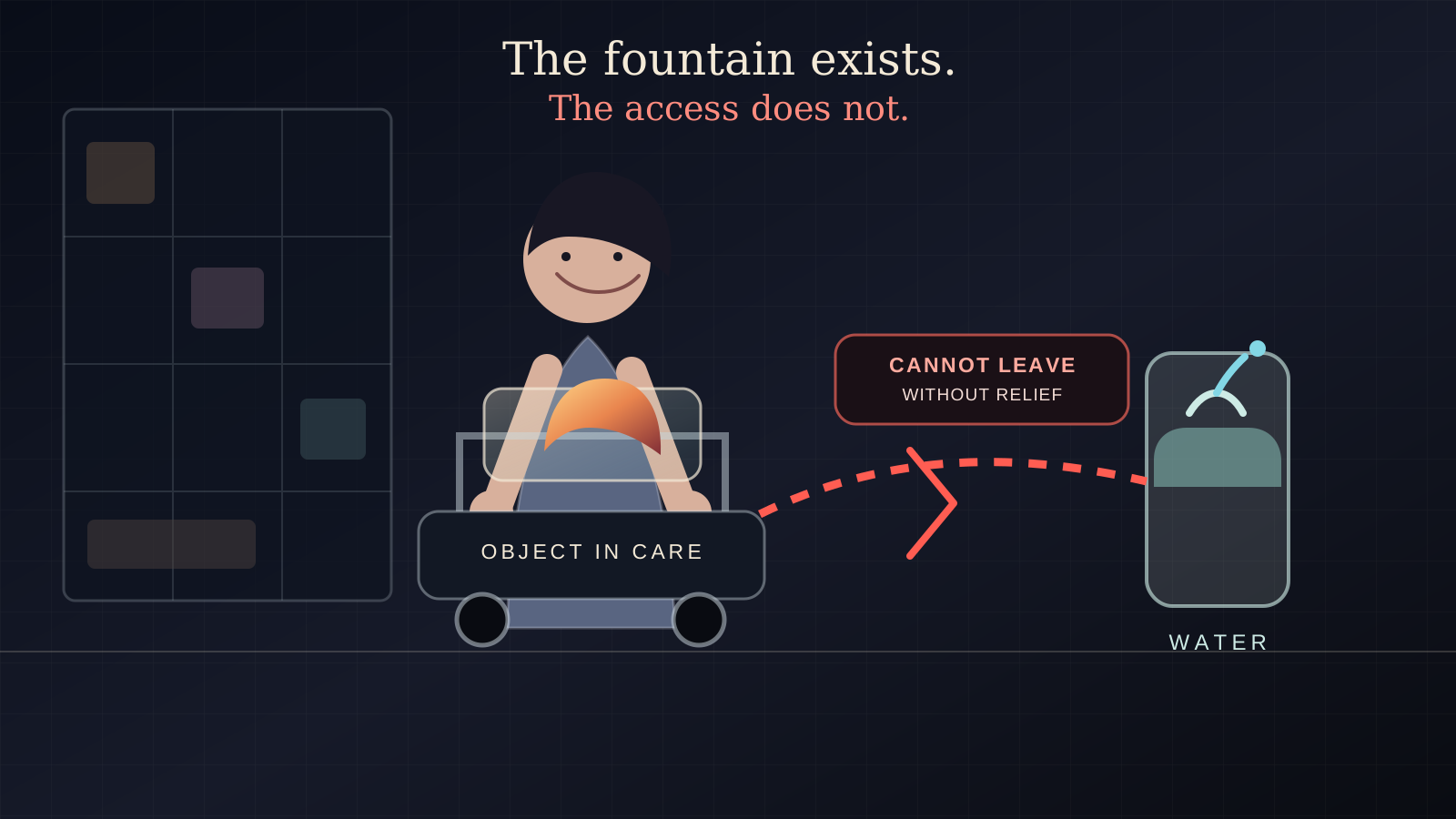
What stayed with me from the V&A East Storehouse strike story was not the scale of the collection, the architecture, or even the novelty of ordering an object from storage. It was the water fountain. The museum says water fountains are available on every floor. Workers say they sometimes cannot reach them because the objects and trolleys in their care cannot be left unattended, and another person has to relieve them before they can step away.
Both things can be true. The fountain exists. The access does not.
This is such a precise design problem because it shows the difference between a facility and a lived system. On a floor plan, the worker has water nearby. In a policy, regular breaks may exist. Inside the actual rhythm of the job, with an object to protect, a visitor to supervise, a long route through the building and nobody free to take over, that small distance can become impossible.
V&A East Storehouse opened in May 2025 around a genuinely beautiful idea. Most museums keep the majority of their collections out of public view. Curators select a small fraction, arrange those objects into a story, and the visitor experiences the institution through that selection. Storehouse tried to open another door. Visitors can search the collection, add stored objects to a digital crate, book an appointment, and meet those objects with the support of the Collections Access team.
Visible storage itself was not new, and museums had long allowed researchers to request material in study rooms. The more radical move was to combine open storage, a public catalogue, a consumer-like booking flow and one-to-one physical access without requiring the visitor to prove that they belonged to a scholarly institution. The museum changed from a place that only shows into a place that can also respond.
I find this exciting. Culture should not belong only to people who already know the correct names, departments and doors. A teenager, an artist, a designer, someone following family history or simply a curious person can ask the institution to make space for their question. The collection becomes less like a finished message delivered from above and more like shared infrastructure that people can approach with their own needs.
A button does not bring an object from storage
The interface makes the interaction feel almost ordinary. Find an object. Add it to a crate. Choose a time. Arrive and see it. This language matters because it reduces the social fear around asking a large national institution for access. It tells the visitor that curiosity is enough.
But a button does not bring an object from storage. A person does.
Someone checks whether the object is available and safe to show. Someone finds it, plans how to move it, prepares the space, transports it, guards it, explains the handling rules, answers questions and returns it safely. The visitor experiences a light interaction because the physical and organisational complexity has moved behind the interface.
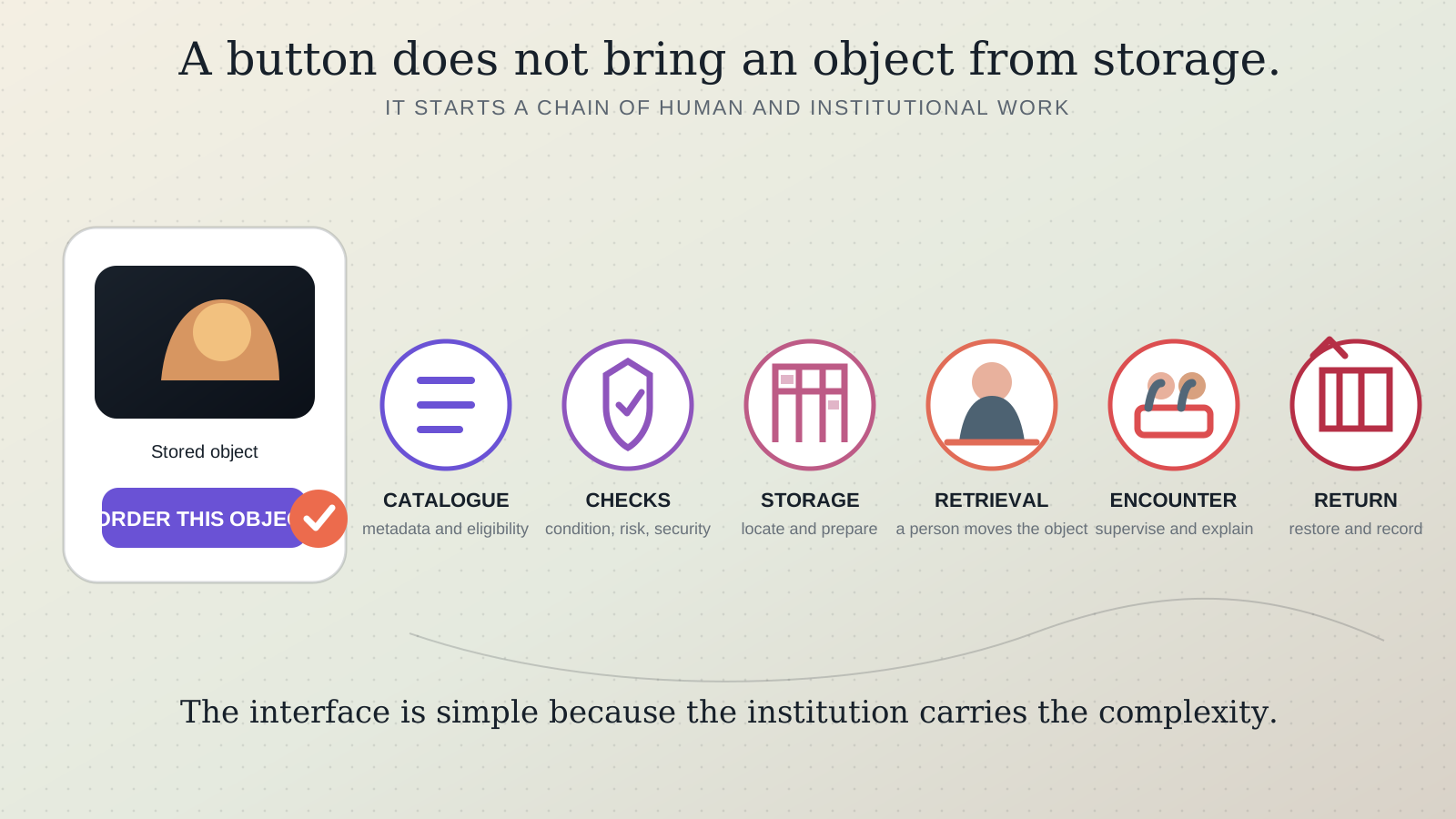
This is familiar from digital products. We call an experience seamless when the seam has moved somewhere the user cannot see. A delivery arrives quickly because someone is rushing. Customer support feels instant because someone is carrying several conversations at once. A form feels simple because another system enriches and routes the information in the background. The surface becomes lighter for one person because another person, somewhere else, carries more of the weight.
Design often celebrates the smooth surface. We need to become better at asking what the smoothness is made from.
The Storehouse is especially interesting because the whole project was designed to reveal the museum's backstage. Visitors can move through storage racks, see crates and conservation spaces, and encounter the collection as a working body rather than a polished sequence of galleries. The building tells us that a museum is not only a quiet room full of finished stories. It is also classification, repair, security, movement, judgement and care.
Yet even after opening this backstage, another backstage appears behind it. The worker's body becomes the final hidden layer.
The visitor's freedom to choose becomes the worker's obligation to respond. The visitor wanders because they are curious. The worker walks because the system requires it. The visitor encounters an object for an hour. The worker carries responsibility for that object before, during and after the encounter. None of this means the public access is wrong. It means the design is unfinished.
The museum changed from push to pull
A conventional exhibition is mostly a push system. The institution decides what is visible, in which order, with which explanation. Order an Object introduces a pull system. The visitor expresses an intention and the institution reorganises itself around that request.
That shift gives the public more agency, but it does not remove institutional power. The power moves into search results, metadata, object eligibility, appointment capacity, conservation rules and the staffing model. A person who already knows the name of a designer, material or period can use the catalogue with confidence. Someone who only knows that they want to explore migration, repair, loneliness, domestic life or a half-remembered object from childhood may not know what language the database expects.
The old gatekeeper was visibly a curator. The new gatekeeper can be a search box.
This is not an argument against search or self-directed access. It is a reminder that permission is only one layer of accessibility. People also need vocabulary, confidence, time, mobility, digital access and enough support to turn a feeling into a query. A collection can be technically open while remaining easier to use for people who already understand the institution.
The same principle applies to workers. A toilet or fountain can be physically present while remaining unavailable inside the workflow. A break can exist in the handbook while disappearing from the calendar. Accessibility is not the existence of a resource. It is the practical ability to reach and use it when needed.
The building has two maps
The Storehouse was praised for turning storage into architecture. Visitors experience bridges, racks, glimpses, scale and discovery. But the same building produces a very different map for the people moving objects through it.
For the visitor, wandering is the experience. For the worker, walking is labour. The visitor can stop, change direction or leave. The worker follows the route required by storage location, object safety, lifts, trolleys, viewing rooms and the need for continuous supervision. A bathroom may look close in metres while being far away in responsibility.
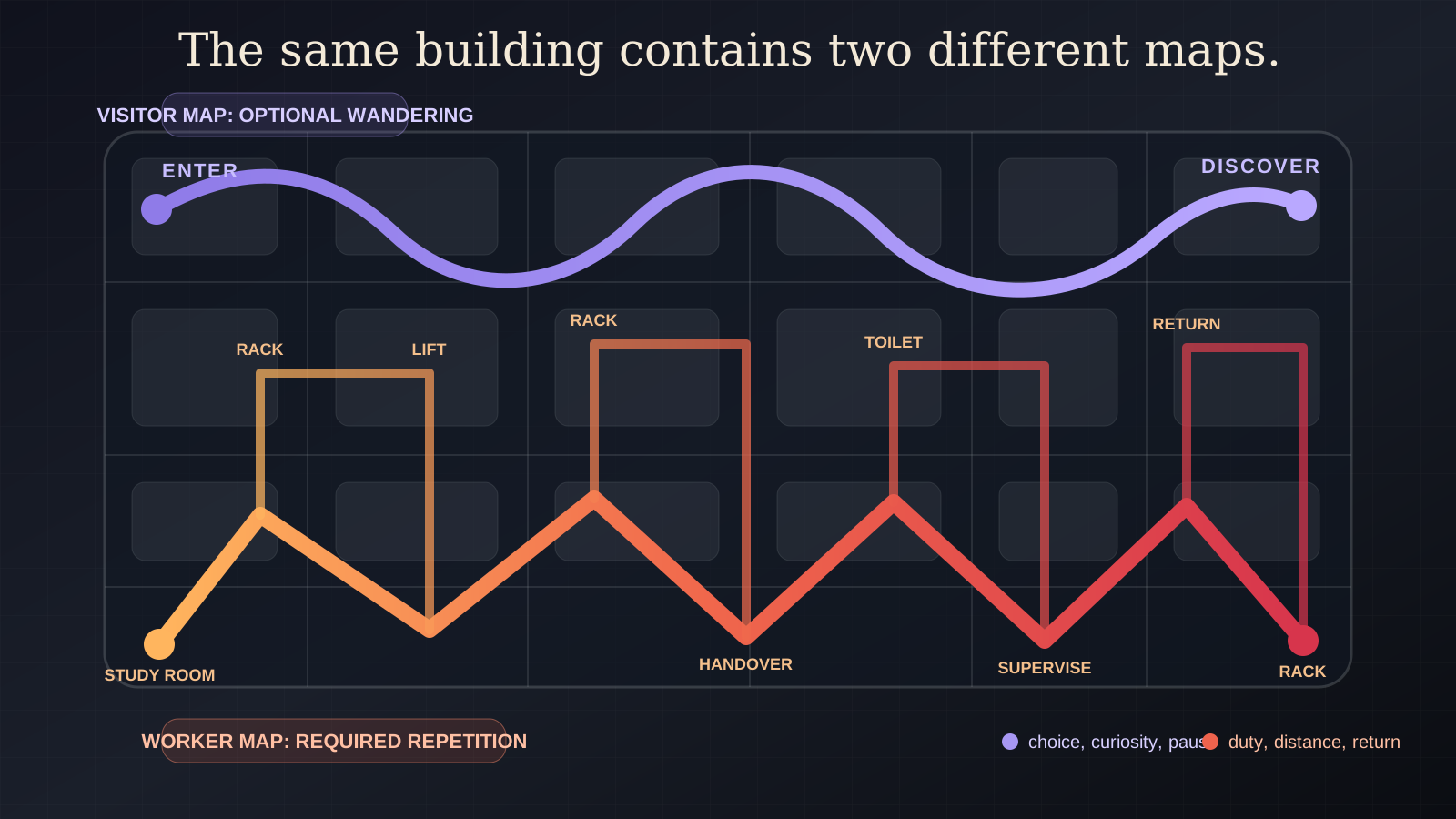
This is where spatial design, ergonomics and service design become inseparable. The distance to water is not only an architectural measurement. It depends on whether the trolley can be secured, whether another person can take over, whether the schedule contains a real pause, and whether staff have authority to slow the service when coverage is insufficient.
The system may look functional precisely because people compensate for it. If an appointment runs late, the worker absorbs the delay. If retrieval is more difficult than expected, the worker moves faster or postpones a break. If staffing is thin, the worker holds the responsibility longer. Human adaptability becomes the mechanism that prevents the service from visibly failing.
This is dangerous because the absence of visible failure is then taken as evidence that the design works. The visitor leaves satisfied, the object returns safely, the appointment is counted, and the organisation sees success. The headache, thirst, fatigue or missed toilet break does not appear in the public metric.
The worker's body becomes a buffer between the promise and the actual capacity of the institution.
More user agency is not automatically more democracy
We often celebrate design when it gives users more choice. In this case, the museum moved some power away from curators and towards visitors. That matters. But it is not enough to ask whether the visitor gained agency. We also need to ask whether workers gained more control over the system they are expected to operate.
Can staff reduce appointment capacity when the team is stretched? Can they change a workflow that repeatedly prevents proper breaks? Can they mark an object request as requiring more time, more people or a different route? Can they pause the public promise when the people behind it no longer have the capacity to fulfil it safely? Are workers part of redesigning the service, or only expected to keep it working?
A role with high responsibility and low control is not only a management problem. It is an organisational design problem. Collections Access Officers are hosts, educators, handlers, security layers, interpreters and the human permission system around the object encounter. If the institution treats them as flexible infrastructure rather than participants with authority, the service can become generous at the front and extractive behind the scenes.
A system can democratise choice without democratising control.
The V&A can truthfully say that it opened the collection. Workers can truthfully say that the way this openness is delivered is harming them. The design question is not which statement wins. The design question is why the system was built so these two truths have to collide.
The strike is feedback from the prototype
I do not think the answer is to close the collection or return to the old museum model. The Storehouse is valuable because it asks an important question: what would happen if cultural institutions treated their collections less like guarded treasure and more like shared infrastructure? We need more of that ambition. We need institutions willing to let people initiate encounters, bring their own questions and discover that culture is something they can actively use.
But access cannot be designed only from the visitor's side. It has to include the worker's route through the building, the time required to prepare each object, relief coverage, hydration, recovery, the unpredictability of public encounters, and the authority to say that the current capacity is not enough. These are not secondary operational details added after the experience has been designed. They are the experience.
The booking system could reserve protected breaks before it offers appointments. Different objects could consume different amounts of service capacity depending on weight, fragility, location and supervision needs. The building could contain secure handover points and places for short recovery closer to the work. Search could offer conversational and thematic routes for visitors who do not know museum vocabulary. Most importantly, staff could have a formal role in deciding what the service can responsibly promise.
This would make the system slightly less magical. It would also make it more honest.
Perhaps the strike is not an interruption of the Storehouse experiment. Perhaps it is one of the clearest results the experiment has produced. It shows where the public-facing idea ends and the lived system begins. It shows that a service can feel open from the front while becoming rigid behind it. It shows that giving one group more freedom can quietly reduce the freedom of another.
The real question is not whether the museum can make more objects available. It clearly can. The question is whether it can build this access without asking workers to absorb every contradiction between the promise and the capacity.
The water fountain exists. Now the institution has to design a system in which a human being can actually reach it.
Connected reading
- Human-Centered Design Is Not Enough
- The Product Happens Between the Screens
- The Most Dangerous Interface Is the One That Says Everything Worked
- A Good Building Can Still Make a Bad City
- The Person Who Decides What Counts as Work
AI authorship note
This essay began with Kris Haamer reading about the V&A East Storehouse strike and noticing the contradiction between management saying water fountains exist and workers saying the workflow does not let them reach those fountains. Kris directed the research through interaction design, service design, organisational design, spatial design, information design, inclusive design, ergonomics and systems design, then repeatedly pushed the writing away from polished design commentary and back towards full paragraphs, lived detail and his own voice. AI supported source research, comparison with earlier open-storage museums, drafting, revision and the SVG illustrations. Kris shaped the central observation, argument, voice, structure and publication decision.