

HAAM Index / Raw Drafts / Platform rituals
July 14, 2026 / 15 min read
Essay / July 2026
Why Does LinkedIn Keep Pushing Puzzle-Solving as a Skill?
LinkedIn Games turn a casual daily puzzle into professional self-improvement. The deeper product is a retention loop designed through identity, timing, and institutional meaning.
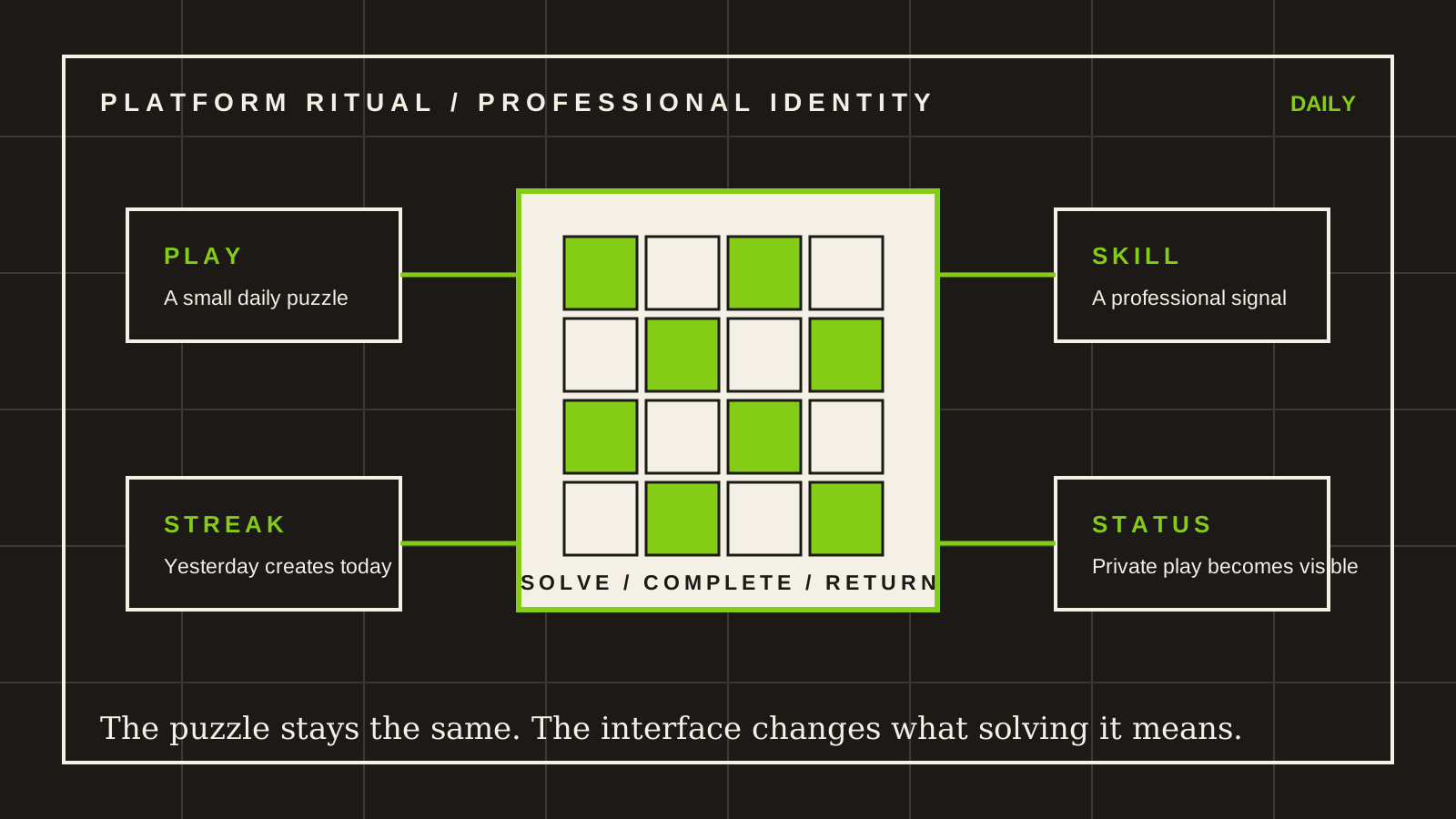
LinkedIn keeps asking me to solve puzzles. That would not be strange on a newspaper website, a gaming app, or a platform designed to fill three spare minutes while waiting for a bus. It feels stranger on LinkedIn, where almost every activity is surrounded by the language of professional development.
A puzzle is rarely allowed to remain just a puzzle. It becomes a thinking exercise, a way to keep the mind sharp, a demonstration of problem-solving, a friendly competition between colleagues, or a small ritual of professional self-improvement. Even when LinkedIn does not literally add puzzle-solving to the skills section of a profile, it places the activity inside the semantic world of skills, cognition, work, and career identity.
That framing is doing more work than the game itself. LinkedIn is not merely distributing small daily puzzles. It is showing how interaction design can take an ordinary action, place it inside a different institution, and quietly change what the action means.
A retention system dressed as a skill
LinkedIn now offers eight daily games: Pinpoint, Crossclimb, Queens, Tango, Zip, Mini Sudoku, Patches, and Wend. The company describes them as daily, thinking-oriented games that let people exercise their minds, compare results, spark conversations, build streaks, and appear on company or school leaderboards. New puzzles arrive every day, notifications encourage people to return, and the interface makes it easy to see which connections have already played.
The results suggest that the system is working. When LinkedIn introduced Wend in June 2026, it said that billions of puzzles had been solved since Games launched in 2024, that 86 percent of players returned the following day, and that 82 percent were still playing after seven days. Those numbers describe something more strategically important than a successful side feature. They describe a daily habit.
The obvious explanation is that LinkedIn wants engagement, but that is only the beginning of the interaction-design story. The more interesting question is how an engagement mechanism becomes acceptable inside a professional environment. LinkedIn cannot simply copy the loudest techniques of mobile gaming, add flashing coins, and ask executives to spin a wheel every morning. The activity has to be translated into the identity of the platform. It has to feel compatible with ambition, intelligence, self-improvement, and work. The puzzle has to become a skill.
LinkedIn needs a reason to open every day
LinkedIn has always had an episodic-use problem. People have strong reasons to open it at particular moments: they may be searching for a job, researching someone before a meeting, hiring an employee, announcing a promotion, contacting a potential customer, or updating a profile after changing roles. These actions can be important, but they do not necessarily happen every day. A person does not need to rewrite their work history every morning or apply for a new position every afternoon.
The feed partially solves this problem, but the LinkedIn feed has its own friction. Posting requires reputation management, commenting can feel professionally risky, and even passive scrolling can become tiring because ordinary observations are often packaged as leadership wisdom, entrepreneurial lessons, or public performances of ambition. The user is never only scrolling. They are also being reminded that everyone else seems to be building, hiring, learning, growing, speaking, launching, or becoming a better version of themselves.
Puzzles offer a cleaner reason to arrive. They provide a small, finite, low-risk activity that does not require the user to create content or perform a professional identity in public. A person can open LinkedIn, solve a puzzle in two minutes, compare a score, and leave. Yet once they have arrived, the rest of the platform is only one tap away: messages, jobs, notifications, advertising, courses, recruiter tools, and the feed are all waiting behind the game.
The Financial Times reported shortly after LinkedIn Games launched that the company explicitly wanted to build a daily habit. That phrase explains the product more precisely than any claim about cognitive exercise. LinkedIn does not need every player to spend an hour gaming. It needs the game to become the reason the app enters the morning routine at all.
The sequence is the product
This connects to a recurring Raw Drafts idea: when content becomes cheap, sequencing becomes valuable. An AI system can now produce a lesson, explanation, image, quiz, or logic puzzle almost instantly. The difficult product question is no longer only what content should exist. It is what should appear now, what should remain hidden, what should return tomorrow, and how one interaction should lead into the next.
The individual LinkedIn puzzle is not the full product. The sequence around it is. LinkedIn gives the user one puzzle today, replaces it tomorrow, records whether the user returned, shows who else played, and turns the activity into a shared daily event. A permanent archive containing thousands of puzzles would probably be less effective because abundance would weaken the rhythm. People could solve ten puzzles on one day and forget about the platform for the rest of the month.
The daily limitation creates time, anticipation, and a mild sense of obligation. It creates a shared present in which many people are solving the same challenge on the same day. Today’s Queens belongs to today, much like a newspaper front page, the weather, or a question discussed at the office coffee machine. Tomorrow, the object changes and the social clock resets.
This is why daily puzzles work differently from ordinary entertainment libraries. They are not simply collections of content. They are scheduled social objects. The puzzle can be simple because the more valuable design is the cadence that surrounds it. The lesson is cheap. The sequence is the product.
Every interface contains a business model
Another Raw Drafts argument is that every interface contains a business model. An organization’s incentives eventually appear in what its interface rewards, remembers, interrupts, hides, and asks the user to repeat. Sometimes the request is money. Sometimes it is data, labor, content, dependence, or attention. The surface may look neutral, but the interaction quietly translates an organizational need into user behavior.
LinkedIn’s puzzle interface asks for only a few minutes, and that smallness is part of its intelligence. A twenty-minute game would compete with work. A two-minute puzzle can be framed as preparation for work. It becomes a mental warm-up, a healthy break, or a lightweight form of connection. LinkedIn does not need to become a place where people disappear for hours. It only needs to become a place where people reliably arrive.
The puzzle therefore performs several functions at once. It is entertainment, but also a retention mechanism. It is a private activity, but also a social object. It is a finite challenge, but also a recurring invitation. It gives LinkedIn a place in the user’s daily routine even when the user has no immediate professional task to complete. The visible object is small, but the system operating through it is much larger.
This resembles another Raw Drafts theme: the most interesting products are often not the visible objects but the coordinated motives around them. A celebrity gift box can function simultaneously as merchandise, media, community participation, commerce, identity, and an analytics instrument. A city bench can be seating, public policy, accessibility infrastructure, social control, and a signal about who is welcome. A LinkedIn puzzle similarly compresses recreation, cognition, competition, networking, professional identity, and platform retention into one small interaction.
The institution changes the action
The grid stays the same. The institution changes what solving it means.
The language LinkedIn uses around the games matters because LinkedIn is not a neutral container. The same action changes meaning when it moves between institutions. Solving Sudoku in a newspaper is leisure. Solving it in a classroom may be learning. Solving it in a cognitive assessment becomes measurement. Solving it on LinkedIn becomes professional self-maintenance. The grid has not changed, but its institutional frame has.
This is one of the central powers of interaction design. Design does not only determine whether someone can complete an action. It also tells the person what kind of action they are completing. A streak can mean addiction, discipline, learning, exercise, sobriety, health, or commitment. The number itself cannot decide. The interface, institution, language, and community around it assign the meaning.
LinkedIn is especially effective at this because the entire platform is built around making human capacities legible. A career becomes a timeline. Experience becomes job titles. Knowledge becomes skills. Relationships become connections. Reputation becomes endorsements and recommendations. Interest becomes following. Professional existence becomes a structured profile that can be searched, ranked, compared, and sold through recruiting products.
The puzzle enters this machinery already surrounded by a question: what does this reveal about me? Even a playful result can be presented as comparative competence. A user can feel clever for solving quickly, performing better than peers, or maintaining a longer streak than colleagues. None of this is a serious assessment of intelligence or professional ability, but it does not need to be. It only needs to feel like a flattering signal.
The professionalization of everything
LinkedIn Games belong to a broader cultural movement in which ordinary life is continuously translated into professional value. Reading becomes continuous learning. Talking to people becomes networking. Posting becomes thought leadership. Curiosity becomes personal development. A hobby becomes a side project. Rest becomes recovery. Walking becomes step completion. A personality becomes a personal brand. Even play needs an explanation.
These translations are not always false. Games can train pattern recognition, hobbies can produce useful knowledge, informal relationships can lead to professional opportunities, and rest can improve performance. The problem begins when an activity seems legitimate only after it has been connected to productivity. Play is allowed because it sharpens the mind. A break is allowed because it may improve output. Curiosity is valuable because it might become a marketable skill.
LinkedIn is the ideal institution for this because it is where people maintain public evidence of their economic usefulness. The platform has also strongly promoted a skills-first view of the labor market, arguing that demonstrated capabilities can reveal more than degrees or previous job titles alone. That shift can be valuable because it recognizes people who learned through work, independent study, unconventional careers, or movement between fields.
Yet a world organized around skills also creates pressure to classify more of the self as a skill. Everything becomes potential evidence. The puzzle sits at the almost comic edge of that system. It is not a certification, an assessment, or a hiring signal. It is simply framed in a way that lets a few minutes of play feel connected to the larger project of professional improvement. That feeling makes the engagement easier to accept.
Closed puzzles in an open world
There is another reason puzzles feel attractive now. A well-designed puzzle contains an answer. The rules are defined, the relevant information is present, progress can be felt, and the system confirms when the task is complete. Intelligence appears to produce closure.
Most meaningful work is not like this. The problem may be badly stated, important information may be missing, and stakeholders may disagree about what success means. Every solution may create another problem. The person with the most authority may be wrong, the available metric may measure the wrong thing, and a technically correct answer may still fail socially, ethically, politically, or commercially.
Puzzles offer a temporary world in which thinking feels clean. There is a grid, a pattern, a moment of insight, and a satisfying completion state. That may be particularly comforting during the current AI transition, when professional life increasingly asks people to prove that their judgment, creativity, adaptability, and problem-solving remain valuable even as machines perform more visible forms of cognitive work. The puzzle lets the person feel their own thinking happen.
It can also blur important distinctions. Being good at a structured logic puzzle is not the same as understanding an organization, designing a public service, conducting research, navigating conflict, or recognizing that the stated problem should not be solved at all. Puzzle-solving rewards accepting the rules. Advanced interaction design often begins by questioning who wrote them.
This connects directly to another Raw Drafts argument: the further someone goes in UX, the less the work resembles arranging screens and the more it becomes the design of incentives, organizations, policies, models, and possible futures. Junior design problems are often presented like puzzles. Senior design work begins when the designer asks whether the product is solving the right problem, whose interests the system serves, and what behavior the interface is normalizing.
A humane form of capture
It would be too simple to describe LinkedIn Games as another manipulative addiction machine. The games are finite. They can be completed, they do not require money, and they do not immediately produce another puzzle beneath the first one. Compared with infinite feeds, this is almost humane. The player enters, encounters a bounded challenge, finishes it, and can leave.
That finiteness creates an interesting ethical ambiguity. The system respects the user’s immediate attention better than endless scroll, but it may capture the user’s future attention more effectively. It does not ask for another ten minutes today. It asks the user to return tomorrow. Scarcity prevents bingeing while strengthening habit.
The streak is central to this. A streak is tiny infrastructure for obligation. At first, the player returns because the puzzle seems interesting. Later, they may return because yesterday happened. The value of the current activity becomes partly inherited from previous activity. The person is no longer deciding only whether today’s puzzle is worth solving. They are deciding whether to preserve a chain of earlier decisions.
A natural experiment on GitHub showed how strongly visible streak counters can change behavior. When GitHub removed public streaks, long-running streak behavior declined, weekend activity fell, and days containing a single token contribution became less common. The point is not that every streak is harmful. It is that a small interface element can redirect behavior far beyond the activity it claims merely to record.
The ethical question is whether the mechanism helps a person continue something meaningful or gradually replaces the original motivation with maintenance of the mechanism itself. Do I want to solve the puzzle, or do I want to avoid losing the streak? The interface can make those motivations difficult to separate.
Interaction design changes meaning
This is why LinkedIn Games fit so well into the wider Raw Drafts idea that interfaces exist beyond screens. A city is an interface because streets, transport systems, signs, toilets, storage, opening hours, and public information tell people what is possible and how difficult it will be. A gift box is an interface because it coordinates fandom, identity, commerce, and measurement. Size is an interface because scale distributes comfort, effort, status, and exclusion across bodies.
LinkedIn Games belong to the same family. The interesting design work is not only inside Queens, Zip, or Tango. It is in placing the game inside a professional network. It is in calling the games thinking-oriented, making them expire daily, showing which connections played, comparing organizations and schools, and allowing a private moment of leisure to cast a faint professional shadow.
None of these decisions proves that puzzle-solving is professionally important. Together, they produce an environment in which the activity feels professionally meaningful. The user is no longer merely passing time. They are keeping their mind active. The platform is no longer asking for retention. It is supporting healthy cognitive habits. The leaderboard is no longer social comparison. It is friendly workplace connection.
Each translation is plausible enough to feel natural. That is why it works. The most powerful engagement systems rarely announce themselves as engagement systems. They present the platform’s needs as evidence of the person the user wants to become.
Platforms want dependable presence
Another recurring Raw Drafts argument is that every website has an algorithm, even when no machine-learning model is visibly involved. A chronological blog still decides what appears first. A navigation system decides which topics deserve permanent visibility. Analytics decide which forms of success become measurable. The important question is not merely whether a system has an algorithm. It is what the system teaches its participants to value.
LinkedIn has traditionally rewarded accumulation: more skills, more connections, more experience, more endorsements, more activity, more visibility, and more evidence that the person remains professionally relevant. The games introduce a softer version of the same logic. Another day, another completion, another streak milestone, another score, and another small proof of continuity.
The individual act is harmless and often enjoyable, but the wider pattern reveals what platforms increasingly want from users. They do not necessarily need long sessions. They need dependable presence. A successful platform does not need to occupy every hour. It needs to become part of the structure of the day.
LinkedIn has found a small interaction that can sit beside morning coffee, email, news, and messages. It gives the platform a place in ordinary time. That may be more strategically important than another large professional feature because it changes the relationship from occasional utility to daily ritual.
The puzzle is a model of LinkedIn
The puzzle also works as a miniature model of LinkedIn itself. LinkedIn presents professional life as something that can be structured, improved, completed, and made legible. Add the missing skill. Connect with the right person. Improve the profile. Complete the course. Respond to the recruiter. Identify the next move. Continue the streak. Career uncertainty becomes a collection of solvable interface states.
Real professional life remains much messier. There may be no correct next role. Skills cannot always be separated from context. Networks contain power, exclusion, friendship, history, and luck. A polished profile can hide weak work, while valuable work may remain difficult to describe. Careers are built through accidents, obligations, migrations, failed projects, temporary interests, and opportunities that only become meaningful later.
The platform cannot fully represent that complexity because platforms require structure. A puzzle is therefore not an accidental addition. It is a miniature version of LinkedIn’s worldview. The world contains a problem, the professional applies skill, the system records completion, the result becomes visible, and tomorrow offers another problem.
Why LinkedIn keeps pushing it
LinkedIn keeps pushing puzzle-solving because puzzles solve several of LinkedIn’s own problems at once. They give an episodic platform a daily rhythm, create engagement without requiring users to manufacture content, and generate social interaction without the awkwardness of direct networking. They offer a finite alternative to the feed and make LinkedIn feel lighter without abandoning its professional identity.
They also give people a small experience of competence during a period when the meaning of professional competence is becoming unstable. A completed grid offers certainty, progress, and a visible result. In a labor market increasingly shaped by AI, restructuring, skills discourse, and constant pressure to remain relevant, that small confirmation may be more emotionally valuable than the puzzle itself.
Most importantly, LinkedIn Games allow retention to feel like self-improvement. That is the interaction-design achievement. LinkedIn did not make puzzle-solving professionally important. It designed an environment in which puzzle-solving could be experienced as professionally meaningful.
The action remained almost exactly the same. The interface changed what the action meant.
Connected reading
Every Interface Contains a Business Model
How organizational incentives become visible through defaults, friction, rewards, permissions, and repeated behavior.
The Lesson Is Cheap. The Sequence Is the Product.
Why timing, order, return loops, and progression become more valuable as individual pieces of content become easier to generate.
Every Website Has an Algorithm
Every interface decides what receives visibility, what becomes measurable, and what participants gradually learn to value.
The Further You Go in UX
How interaction design expands from screens into incentives, organizations, policies, and the structures that shape behavior.