

2026-08-03 · 20 min read · Raw Drafts / Interaction Design / Messaging / Product Psychology / East Asia
A Deleted Message Is Still a Message
An unsend button can remove a database object. It cannot reverse delivery, notification, interpretation or memory. Designing deletion means deciding who controls a conversation after it has happened.
A message disappears from the chat.
In its place, the interface inserts another message:
This message was deleted.
The words are gone, but the deletion is now the most interesting thing on the screen. The recipient may have ignored the original sentence. The empty space asks to be interpreted.
Was it sent to the wrong person? Was it rude? Was it intimate? Did someone else read it first? Was the sender trying to change what happened?
An unsend button is usually presented as a small corrective tool. It sits beside copy, reply and forward, as though deleting a sent message were simply another operation on a digital object. But a message is not only an object stored on a server. It is also a turn in a conversation, a notification on another device, a fragment in someone’s memory and sometimes a piece of evidence.
The technical object can be removed. The social event cannot.
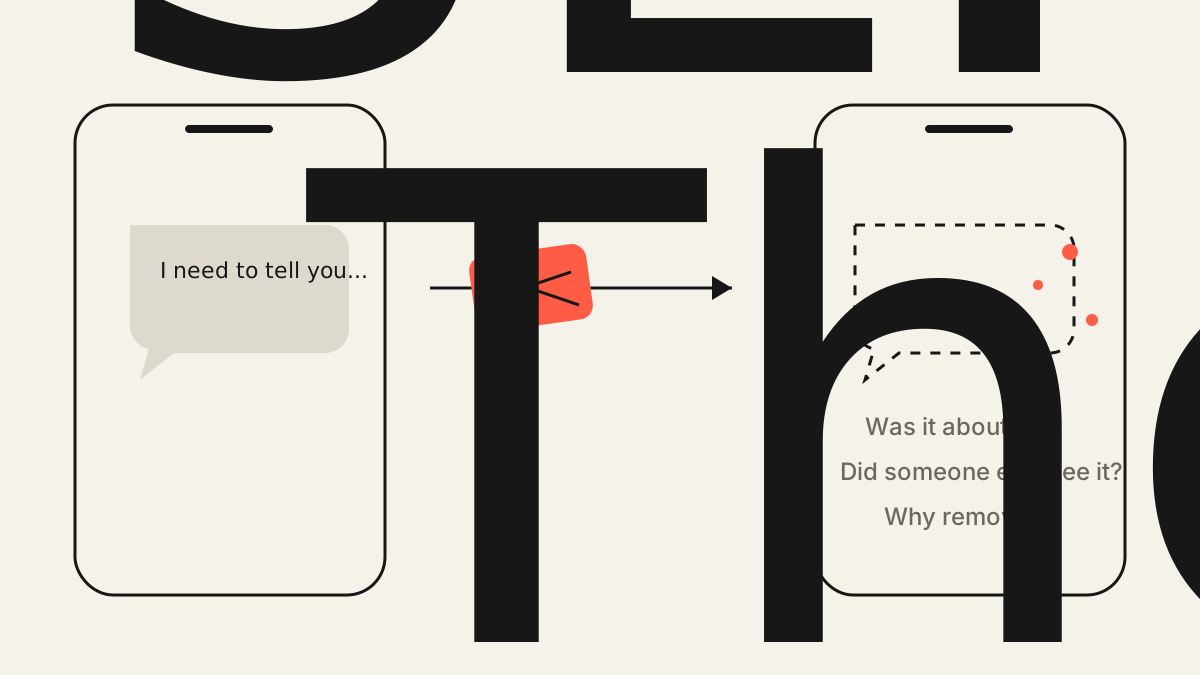
The database model is not the interaction model
Product interfaces encourage us to imagine communication as a list of bubbles. Each bubble appears self-contained. Long-press it and the system offers a set of object-level commands: react, copy, edit, delete.
That model is computationally convenient. It is psychologically incomplete.
A message moves through several states:
drafted → submitted → accepted → delivered → notified → displayed → read → quoted → rememberedThe sender’s control is strongest at the beginning. The recipient’s knowledge increases as the message moves through the system. These two variables do not change together.
Before sending, the author has nearly complete control and the recipient has no knowledge. After a push notification has displayed part of the message, deleting the chat bubble cannot make the recipient unknow the preview. After the recipient has read, quoted or screenshotted it, deletion changes the visible transcript without reversing the recipient’s experience.
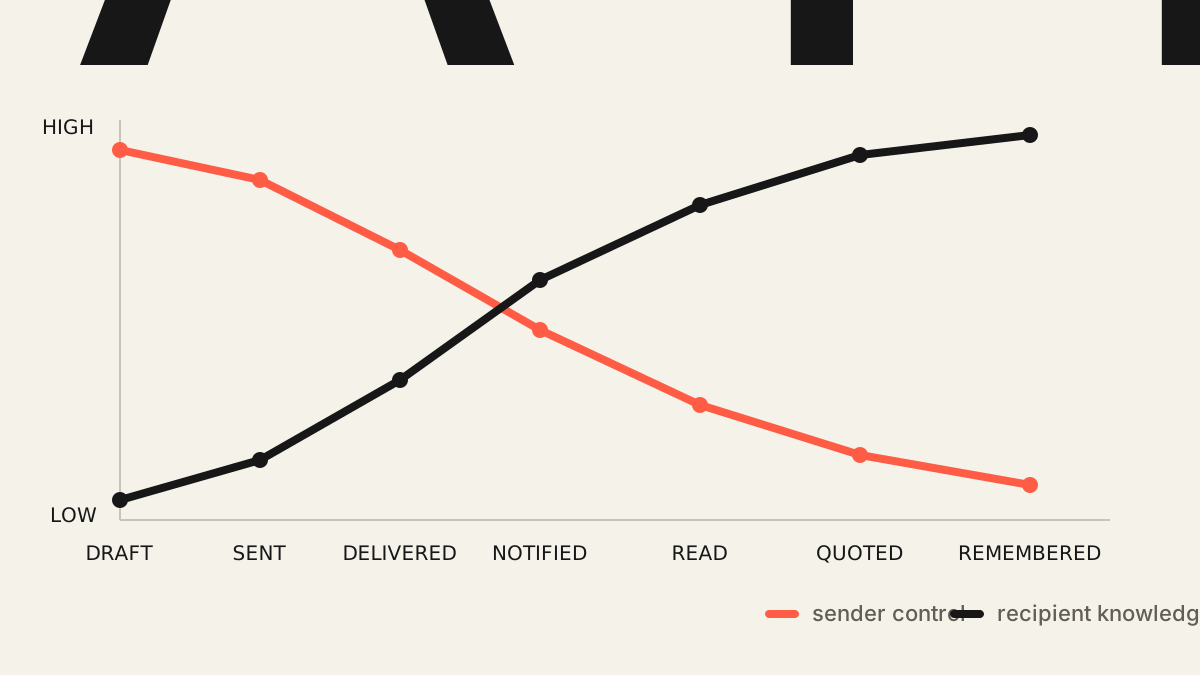
This distinction matters because interfaces often collapse several different actions into the word delete:
Local deletion removes a message only from one person’s view.
Global deletion asks every client to remove or replace the message.
Editing preserves a message while changing its content.
Retraction communicates that the sender no longer stands behind a prior turn.
Ephemerality establishes in advance that content will expire.
Redaction removes content for privacy, safety, legal or moderation reasons.
These operations solve different problems and carry different social meanings. A person correcting a typo ten seconds after sending is not doing the same thing as removing a read message three days later. A chat that was designed to disappear is not equivalent to a permanent chat whose history can be unilaterally rewritten.
Interaction design becomes muddy when all of these actions are represented by the same trash icon.
Deletion is conversational repair
In face-to-face conversation, people constantly repair speech. They restart sentences, correct names, clarify intentions and say, “That came out wrong.”
Conversation does not require perfect first attempts. It requires ways to recover.
Mark Warner and colleagues studied mobile message deletion as a form of error and regret remediation. In their multi-stage survey, people most commonly reported deleting messages to remove incorrect or irrelevant content or improve the message. Deletion was used less like a secret trapdoor and more like a repair tool.(reference 1)
But deletion is a peculiar form of repair because it can remove the turn that explains the next turn.
Imagine this sequence:
A: We should meet at seven. B: Seven works. A deletes the first message.
The deletion does not restore the conversation to a clean state. It produces a damaged reference structure. B’s reply remains, but the thing it answered is missing.
Quote-and-reply features make this problem visible. Some systems retain the quoted content after the source message is deleted. Others replace the quote with an unavailable marker. Some delete both. Each choice changes whether the transcript prioritises privacy, coherence or accountability.(reference 2)
A robust messaging system therefore needs to maintain referential integrity, not only database integrity. If a message is a parent node for replies, reactions, quotes, search results or notifications, removing its body should not make the remaining conversation semantically nonsensical.
The interface should answer three questions:
- What changed?
- Who changed it?
- Which later turns depended on it?
Most deletion interfaces answer only the first, and even then vaguely.
A visible absence becomes an information cue
A deletion marker contains almost no semantic content. That does not make it neutral.
Warner’s study found that delete indicators create information gaps that provoke curiosity. Recipients form narratives to explain what disappeared, while senders worry that those imagined narratives will be worse than the original message.(reference 1)
This is a classic interaction-design asymmetry. The sender knows why they deleted. The recipient sees only that deletion occurred.
The cue distributes information unevenly:
- Sender: usually knows the original content, the reason and the residue.
- Recipient who read it: knows the content and sees the residue, but usually does not know the reason.
- Recipient who missed it: knows neither the content nor the reason, but still sees the residue.
- Group member told later: may know fragments while still seeing the same official gap.
In a group chat, the deletion marker can divide participants into people who saw the message and people who did not. The latter are not merely missing content. They are shown that others may possess information they lack.
A 2025 experiment by Sarah Lutz and Christiane Büttner examined this “out of the loop” condition. Participants exposed to deleted-message notices in a simulated group chat reported lower mood and threats to belonging, self-esteem and meaningful existence compared with participants who were included in the conversation. The paper’s results for perceived control were less consistent than the other needs. The experiment does not mean that every deletion causes serious harm, but it demonstrates that a tiny system message can operate as a social-exclusion cue.(reference 3)
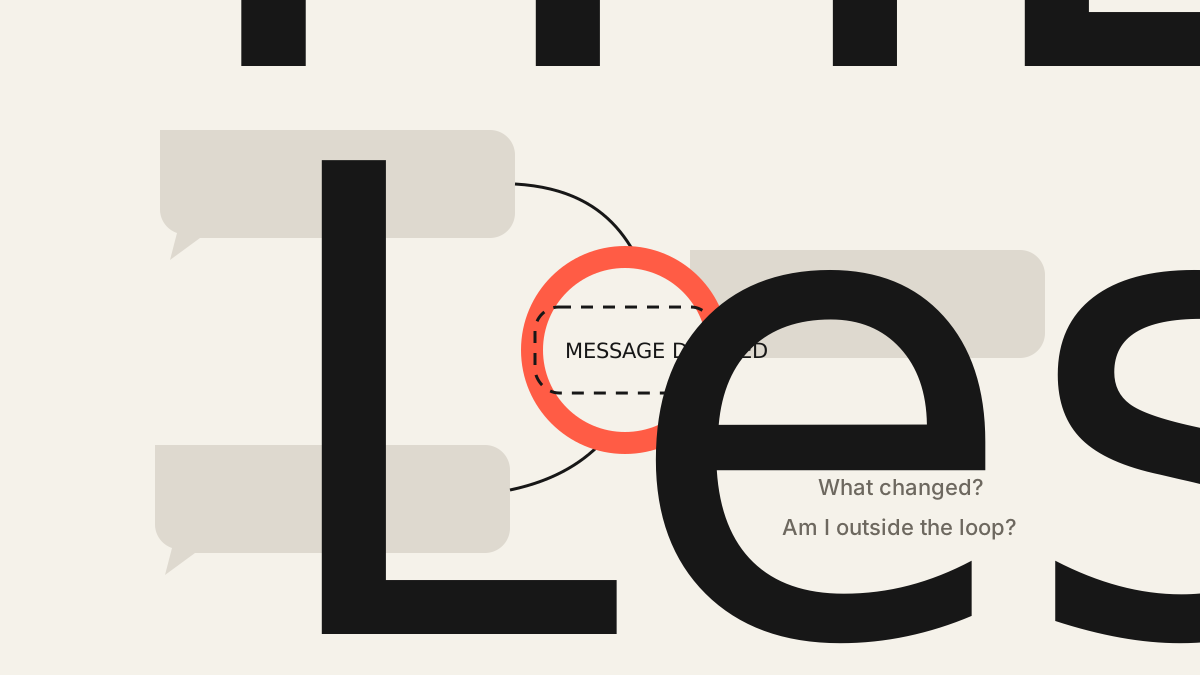
The visual prominence of the marker matters. A grey line of text may look quiet to the designer, but it can become the most cognitively loud element in the conversation because it marks an unresolved gap.
The design variables include:
Persistence. Does the marker remain forever, expire or collapse?
Attribution. Does it name the sender, say only that “a message” was deleted or leave no trace?
Position. Does it occupy the original bubble’s location or appear as a feed-level event?
Salience. Does it use an icon, colour, border, animation or notification?
Read-state coupling. Is silent retraction allowed only before the recipient reads?
Explanation. Can the sender attach a reason such as “wrong chat,” “incorrect information” or “privacy”?
These are not decorative details. They tune how much uncertainty the interface creates.
The deletion marker is a second speech act
It is tempting to call a removed message “silence.” In practice, deletion is often metacommunication. It says something about the sender’s relationship to what they said.
A deletion can communicate:
I made a mistake.
I changed my mind.
You were not supposed to see that.
I do not want this retained.
I am withdrawing from the conversation.
I want you to ask what was there.
The marker can even become playful. Warner’s participants described deletion being used as part of a joke, where retracting a message visibly performed a change of mind.(reference 1)
So the deletion marker does not merely report a system state. It becomes a socially legible gesture.
This is why “make it invisible” is not automatically the correct solution. Silent deletion reduces embarrassment for the sender, but it can also let one participant alter shared history without signalling that anything changed.
The interaction problem is not whether deletion should be visible. It is how visibility should correspond to what has already become knowable.
Four East Asian messenger environments
The psychology of deletion cannot be separated from the surrounding cue system. A deletion marker does not appear on a blank canvas. It sits beside read receipts, response timing, reactions, group membership, work boundaries and local expectations about availability.
Research directly comparing message deletion across Taiwan, South Korea, Japan and mainland China is still limited. The stronger evidence comes from combining deletion mechanics with local research on adjacent messaging cues.
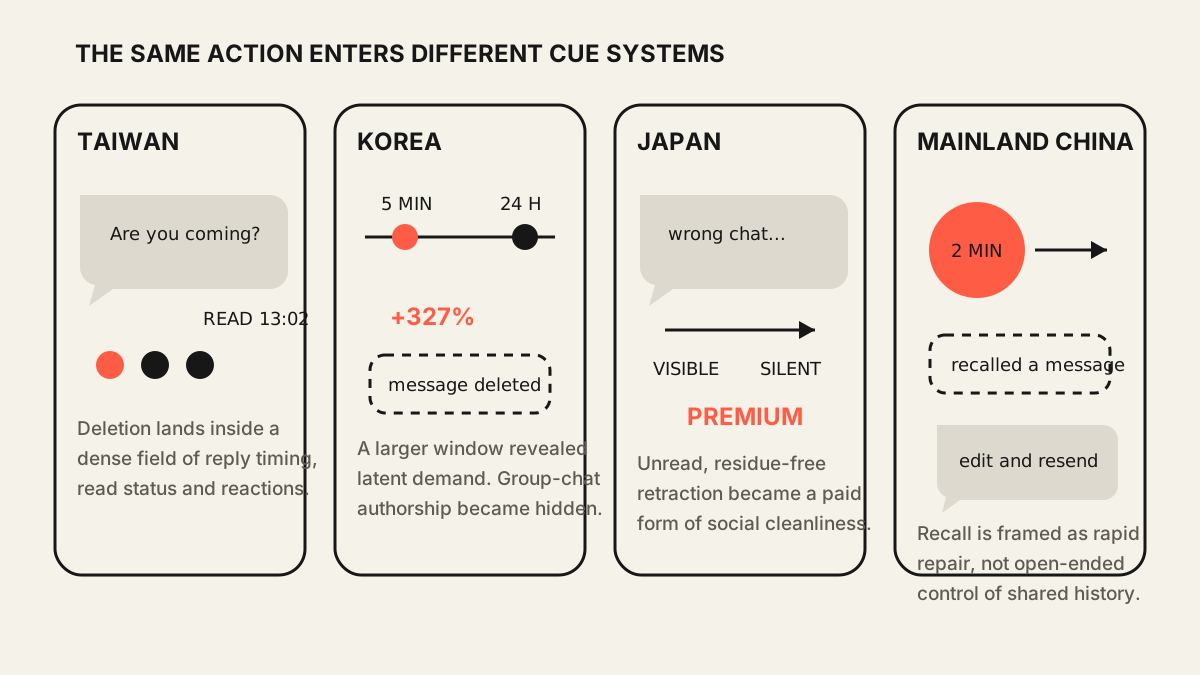
Taiwan: deletion enters a field of relational timing
Taiwanese research has focused more on LINE’s read receipts and reply expectations than on unsending itself.
A study of 524 university students in Taipei and New Taipei found that stronger expectations of receiving a reply were associated with stronger negative emotional reactions to being left on read. Anxious and avoidant attachment tendencies were positively associated with negative responses.(reference 4)
A separate study of 768 Taiwanese university students examined rejection sensitivity and emotion regulation when a LINE message was read but unanswered. Participants commonly used distraction and reframing, while higher rejection sensitivity was associated with less adaptive forms of regulation.(reference 5)
This does not prove that Taiwanese users interpret deletions in one uniform way. It shows that the deleted-message marker enters an environment where small temporal cues already carry relational meaning.
A message can be:
sent, unread, read, unanswered, reacted to, withdrawn.
Each state invites a different interpretation. Deletion adds another state without explaining the transition.
From an interaction-design perspective, the key issue is cue accumulation. Read receipts, reaction icons, timestamps and deletion notices form a composite social signal. Studying each feature in isolation misses the experience produced by their combination.
South Korea: a timing rule changed behaviour at population scale
In August 2025, KakaoTalk expanded its global deletion window from five minutes to 24 hours. It also changed the deleted-message presentation from a sender-shaped bubble to a feed-level notice and, in group chats, made it harder to identify who had deleted the message.
Kakao reported that average deletion use increased by 327 percent after the change. Around 710,000 people per day deleted a message more than five minutes after sending it, accounting for roughly 30 percent of deletion users during the measured period.(reference 6)
That is not evidence of a national personality trait. It is evidence that product rules produce observable behaviour.
A five-minute window frames deletion as immediate error correction. A 24-hour window enables overnight regret, reconsideration after a meeting, removal after no reply and changes prompted by a later emotional state.
At the same time, anonymising the deletion notice changes the information gap. The group sees that something disappeared but may not know whose turn was removed. Attributional uncertainty decreases embarrassment for the deleter and increases ambiguity for everyone else.
KakaoTalk is also used across work and personal life. A Korean HCI study using 30 days of conversation logs examined how work and leisure conversations mix inside KakaoTalk, including work entering private time and personal exchanges entering work contexts.(reference 7)
Deletion therefore operates across collapsed contexts. The sender may not regret the words. They may regret that the words entered the wrong layer of life.
Japan: social cleanliness becomes a premium affordance
Japanese studies consistently describe LINE as both convenient and emotionally demanding.
A study of 423 high-school students identified six dimensions of LINE use: anxiety about being ignored, ease, miscommunication, increased aggression, fixation on quick replies and a sense of connection. Fear of being disliked contributed to ambivalence about messaging.(reference 8)
A 2024 interview study with users aged 15, 18 and 21 found that participants were careful to avoid misunderstanding with anyone other than parents or exceptionally close friends. The older participants increasingly used LINE as functional coordination rather than conversation for its own sake.(reference 9)
In November 2025, LINE Yahoo introduced a premium feature in Japan that allows users to retract an unread message without leaving the usual cancellation notice. Premium users can also retract messages for up to seven days, compared with one hour for the standard feature. Read messages still leave a marker, and the company acknowledges that push notifications may already have exposed part of the content.(reference 10)
This is a remarkable interaction-design decision because it puts residue-free repair behind a subscription.
The paid affordance is not simply extra storage or visual customisation. It changes the social consequences of making a mistake. One user can make an unread error disappear cleanly. Another must leave a visible scar.
The feature also treats read status as an ethical boundary. Before reading, the sender may reclaim the message without residue. After reading, the recipient’s knowledge is recognised and the transcript records the withdrawal.
That boundary is more coherent than a universal silent-delete rule, but monetising it raises another question: should social dignity be a premium feature?
Mainland China: short recall frames deletion as rapid repair
WeChat historically framed ordinary message recall through a short window. Regular text, voice, images and links could generally be recalled within two minutes, with recalled text available briefly for editing and resending. Files have had different windows. The interface leaves a visible recall notice.(reference 11)
The short window communicates a product philosophy: recall is for immediate mistakes, not long-term control of shared history.
Chinese research on WeChat Moments provides a broader conceptual frame. A 2023 study described deletion as self-editing information management. Users remove previous posts in response to security concerns, changes in social environment and reassessments of the content’s value.(reference 12)
Other Chinese scholarship describes delayed replies and restricted visibility as forms of selective disconnection inside a dense network of relationships.(reference 13) Deletion and hiding are not simply exits from sociality. They are techniques for adjusting relational distance without leaving the platform.
This matters because WeChat is not only a messenger. It can connect family, work, school, payments, services and public accounts. The user is not deleting from a single conversation surface. They are managing boundaries inside infrastructure.
A 2025 conversation-analysis study of WeChat’s quote-and-reply feature found that quoting helps users jump across sequences, facilitate responses and spotlight prior text.(reference 14) That means deletion has structural consequences. Removing a quoted source can alter more than memory. It can damage the navigational system people use to make asynchronous group conversation coherent.
Platforms encode moral theories of conversation
Deletion systems can be read as governance models.
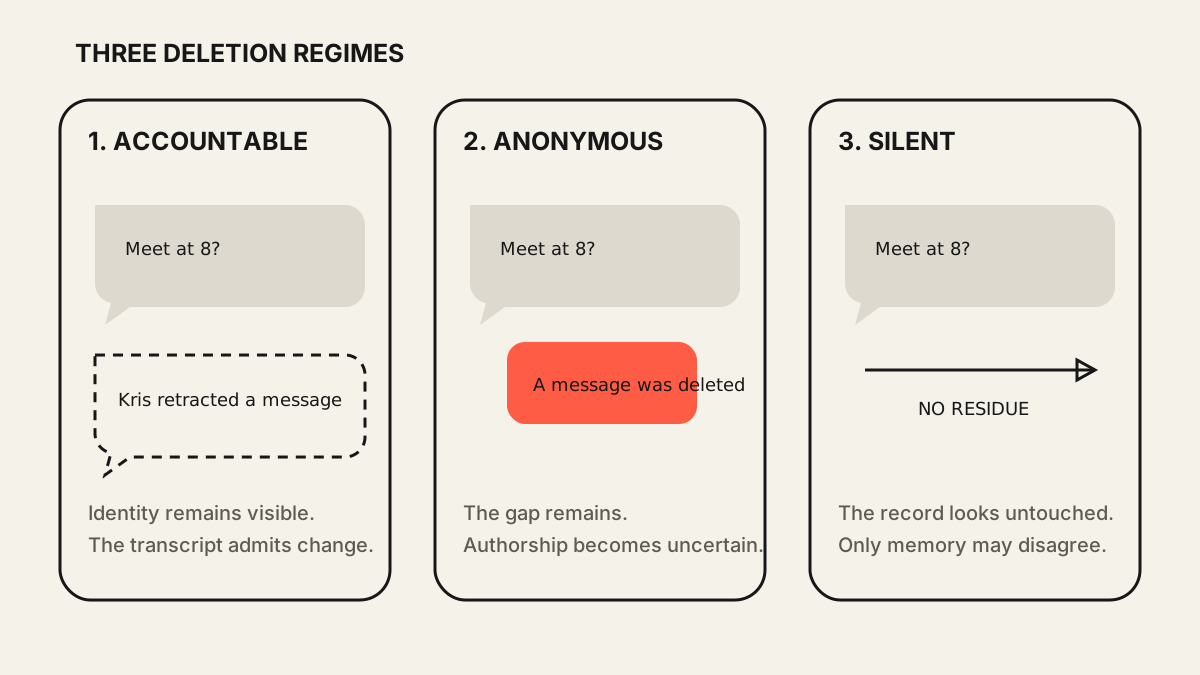
Accountable correction
The system permits a short undo or editing window, but preserves a visible record that the turn changed.
This model prioritises conversational integrity. It accepts human error without pretending the transcript is untouched.
Anonymous residue
The system records that something disappeared but reduces or removes attribution.
This protects the sender from direct scrutiny while preserving evidence that the conversation changed. It also creates a free-floating gap that group members must interpret.
Silent erasure
The system removes the message without residue.
This maximises sender control and transcript cleanliness. It can also make the visible history disagree with notifications, quotations, screenshots and memory.
None of these models is neutral.
A product team choosing between them is deciding how to balance:
- sender autonomy
- recipient autonomy
- privacy
- accountability
- recoverability
- conversational coherence
- emotional friction
- moderation and safety
- evidentiary integrity
The trash icon hides this politics by presenting deletion as housekeeping.
The shared-object problem
Once a message has been delivered, who owns it?
The sender created the words. The recipient received them. The platform stores and renders them. Other participants may have responded to them. Moderators may need them to investigate abuse.
The simplest ownership model says that the author owns the message and can withdraw it.
The simplest recipient model says that anything delivered to my device becomes part of my record.
Neither model is sufficient.
Communication Privacy Management theory offers a useful way to think about disclosure: once private information is shared, it becomes co-owned, and participants need rules for how it can be used. Messaging interfaces rarely make those rules explicit. Instead, platform defaults silently decide whether the sender can revoke content from everyone else’s history.
The result is an interface-level power asymmetry. A global-delete button gives one participant authority over a shared artefact.
That authority may be essential in cases involving accidental disclosure, intimate images, personal data, harassment or danger. It may be harmful when used to erase commitments, threats, instructions or evidence.
A serious design cannot treat all deletion contexts as equivalent.
Design deletion as a protocol, not a button
A better system would model retraction as an event with state-dependent consequences.
At the data layer, do not silently mutate the past. Append a retraction event:
message.created
message.delivered
message.read
message.quoted
message.retracted
The content may be cryptographically deleted or removed from normal access where privacy requires it. The event history can still preserve enough structural metadata to render the conversation coherently.
A retraction event might contain:
{
  "message_id": "m_4815",
  "actor_id": "u_102",
  "scope": "all_participants",
  "reason": "wrong_recipient",
  "requested_at": "2026-08-03T10:21:14Z",
  "knowledge_state": "delivered_unread",
  "dependent_replies": 2,
  "notification_exposure_possible": true
}
The interface can then render different outcomes according to the recipient’s likely knowledge state.
State 1: not yet transmitted
Offer a genuine undo-send delay. Hold the message client-side or in a cancellable outbound queue for several seconds.
No social event has occurred, so no residue is needed.
State 2: delivered but not opened
Allow retraction, but do not promise invisibility if a push notification may have displayed content.
A low-salience marker such as “Message withdrawn before opening” is more accurate than pretending nothing happened.
State 3: read
Treat the action as retraction, not deletion.
Preserve attribution and offer an optional structured explanation:
- incorrect information
- wrong conversation
- privacy concern
- changed decision
- other
The explanation should not be mandatory in dangerous situations. It should be available because reasons reduce the recipient’s need to invent one.
State 4: quoted or replied to
Preserve the conversational skeleton.
Replace the content with a tombstone that retains message ID, sender, timestamp and relation to dependent replies. Quotes should point to the tombstone rather than silently becoming detached.
State 5: old shared history
Avoid unilateral silent deletion by default.
Offer local hiding, mutual redaction requests or privacy escalation flows. High-risk content may require exceptional deletion, but the mechanism should be distinct from ordinary typo correction.
This protocol recognises a basic fact: the longer a message exists, the more people and interface objects may depend on it.
Make the consequences legible before confirmation
The 2020 study by Schnitzler and colleagues found that users often misunderstood what deletion did across different messengers. Participants understood the effect better when the interface explained whether deletion was local or global. Eighty-four percent preferred either deletion from both sides or an explicit choice between local and global deletion.(reference 2)
A confirmation sheet should therefore explain the actual scope:
Remove for everyone? The message will be replaced in this chat. People may already have seen it in notifications, quotes or screenshots.
That is more useful than a generic destructive-action warning.
The interface should also preview the recipient’s result. Senders routinely make deletion decisions without seeing what the other person will see. A tiny preview can prevent the mistaken belief that “delete” means “erase every trace.”
Reduce interpretation debt
Many interfaces create interpretation debt: uncertainty that recipients must resolve socially.
A vague marker externalises the cost of deletion. The sender gets immediate relief. The recipient gets a puzzle.
Design can reduce this debt without exposing the original content.
Possible mechanisms include:
Reason chips. The sender may mark the retraction as typo, wrong chat, outdated information or privacy.
Salience proportional to exposure. An unread, quickly retracted message receives a quieter marker than a read message removed hours later.
Group attribution rules. Hiding authorship may be useful in large groups, but complete ambiguity can damage coherence. The system can identify the deleted turn’s location and relation without publicly naming the sender.
Collapsed residues. Multiple consecutive retractions can collapse into one event to reduce visual noise while remaining auditable.
Conversation repair prompts. After deleting, the composer can suggest: “Send a correction?” or “Clarify why this changed?”
Dependent-turn warnings. Before deletion, show that three replies or two quotes depend on the message.
These cues make the social effects of the action visible at decision time, not only after the damage.
Design before regret
The deepest opportunity may sit before Send.
A 2026 CHI paper by Michael Yin and Robert Xiao studied unsent messages: words people write but withhold because of anger, vulnerability, guilt, affection or fear of social consequences. Participants described writing as a container for feelings and a pause for reflecting on the relationship and themselves. The researchers explored designs in which unsent messages could fade, burn, become temporarily unsendable, return later or remain as private artefacts.(reference 15)
Current messaging design offers a binary composer:
not sent / sentHuman expression is less binary.
People sometimes need to formulate a sentence without yet turning it into an interpersonal event. The interface could provide a pre-send room:
- hold for ten minutes
- send tomorrow
- save privately beside the conversation
- ask what outcome the sender wants
- show a calmer rewrite without replacing the original voice
- let the message fade without sending
- require a second gesture for messages written during a rapid emotional burst
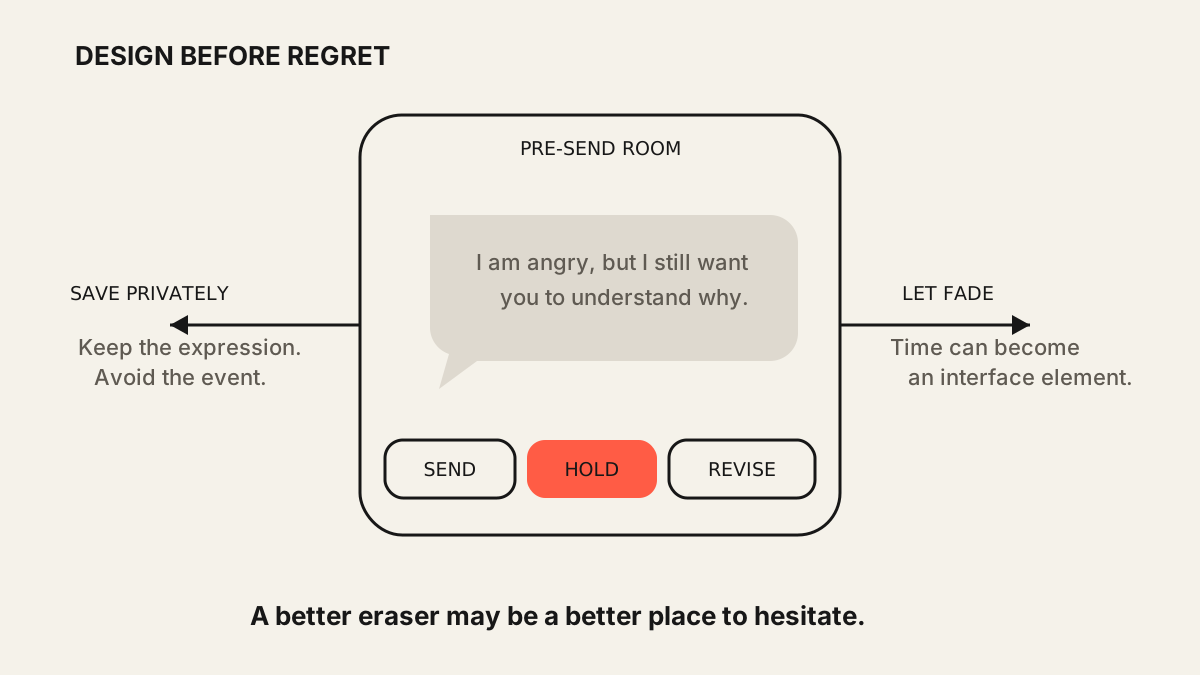
This is not an argument for paternalistic friction on every message. Most messages are harmless and should remain fast.
The system can reserve reflective affordances for moments when the user invokes them. A long press on Send could open “send later,” “hold,” and “keep unsent.” A user could enable a personal cooling-off rule for selected conversations. The important shift is conceptual:
Do not make deletion carry the entire burden of emotional regulation.
A better eraser may be a better place to hesitate.
What should remain impossible
Good interaction design does not maximise user control without limit. It defines where one person’s control ends because another person’s rights begin.
Some operations should remain difficult or visibly consequential:
- silently changing a message after it has been read
- deleting another person’s sent words from their own record
- removing content that later replies depend on without preserving structure
- presenting global deletion as guaranteed when notifications or offline clients may retain content
- charging users to avoid humiliation created by the platform’s own residue design
- allowing ordinary retraction to destroy moderation evidence without a safety pathway
The point is not to make messaging permanent. Permanent casual speech creates its own harms. The point is to distinguish forgetting, correction, withdrawal and historical revision.
The message is gone. The interface remains.
Messaging apps turned casual speech into a searchable archive. Then they added unsend buttons to restore some of the forgetfulness of spoken conversation.
But digital deletion does not reproduce forgetting.
Forgetting is gradual, incomplete and distributed across people. Deletion is a discrete command issued by one participant to a shared system. It changes the visible record at a specific moment, often after knowledge has already escaped the record.
That is why a deleted message is still a message.
It communicates that something existed. It signals that someone wanted it removed. It alters the rhythm and structure of the conversation. It can create curiosity, relief, suspicion, exclusion or repair.
The interaction designer is not designing an eraser.
They are designing who gets to modify a shared past, what traces remain and how everyone else is expected to understand the change.
Research notes
- Warner et al. (2021), “Oops...”: Mobile Message Deletion in Conversation Error and Regret Remediation
- Schnitzler et al. (2020), Exploring user perceptions of deletion in mobile instant messaging applications
- Lutz and Büttner (2025), “This Message was Deleted”: The Psychological Consequences of Being Out of the Loop During Messenger Use
- Yu (2017), attachment, reply expectation and emotional responses to ignored read messages in LINE
- Chen (2019), rejection sensitivity and emotion regulation in LINE left-on-read situations
- Yonhap News Agency (2025), KakaoTalk deletion use rose 327 percent after the window expanded
- Jeong et al. (2019), Mixed Conversations for Work and Leisure using KakaoTalk
- Tokioka et al. (2017), high-school students’ cognition of communication through LINE
- Kiritani (2024), exploratory study of instant-messenger use among people aged 15, 18 and 21
- LINE Yahoo (2025), notification-free unsend for unread messages
- Yu, Shen and Zheng (2023), motivation for deleting information from WeChat Moments
- Yang (2025), Quote-and-Reply in WeChat: A Conversation Analytic Study
- Yin and Xiao (2026), The Words That Can’t Be Shared: Exploring the Design of Unsent Messages
Connected reading
- The Product Happens Between the Screens
- The URL Is the Product’s Public Memory
- A Toggle Is Not an Explanation
- The App Has Received Your Uncertainty
AI authorship note
This essay began with Kris Haamer noticing that deleting a message does not restore silence. It creates a second, highly interpretable event. AI helped gather and compare research on conversational repair, information exclusion, LINE, KakaoTalk and WeChat, and helped translate six interaction mechanisms into SVG diagrams. Kris chose the argument, shaped the regional comparisons, developed the protocol-level design recommendations and approved the final article for publication.